

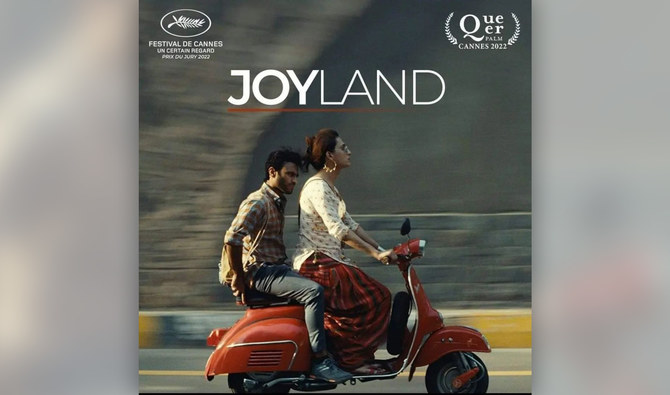

KARACHI: The director of Pakistan’s Oscar entry, “Joyland,” said on Monday the producers of the film were working with the government of Pakistan to “amicably” remove a ban on the film's release from cinemas.
Joyland, which celebrates “transgender culture” in Pakistan and tells the story of a family torn between modernity and tradition in contemporary Lahore, won the Cannes “Queer Palm” prize for best feminist-themed movie as well as the Jury Prize in the “Un Certain Regard” competition, a segment focusing on young, innovative cinema talent.
The Central Board of Film Censors (CBFC) issued the film a clearance certificate for release in August. But in a notification issued last week, the information ministry said the federal government had declared Joyland “repugnant to the norms of decency and morality” and ruled that it was an “uncertified film” for release in cinemas. It was not immediately clear which cinemas would be affected.
The film was due to release across Pakistan on November 18.
“We are in touch with the [information] ministry and trying to resolve this amicably,” Saim Sadiq, writer and director of Joyland, told Arab News on Monday.
Speaking about complaints that the film portrayed a "negative image of Pakistan," Sadiq said:
"The film has if anything portrayed the most empathetic and most compassionate image of Pakistanis of any film ever internationally speaking. And that is why local audiences should also be allowed to watch this film."
In his detailed stance on the matter, Sadiq wrote on Twitter that the information ministry had “caved under pressure from a few extremist factions,” declining to identify the film's opponents by name.
The ministry of information did not respond to several calls seeking comment for this story.
The first-ever Pakistani competitive entry left Cannes audiences slack-jawed and admiring, and got a nearly 10-minute-long standing ovation from the opening night's crowd.
Part of the surprise came from the discovery by many that Pakistan is one the first nations to have given legal protection against discrimination of transgender people.
In 2018, Pakistan passed a landmark transgender rights bill that provides its trans citizens with fundamental rights including prohibiting discrimination and harassment against them educationally and socially, allowing them to obtain driving licenses and passports and to change their gender in the national database at their own discretion.
“Joyland has made Pakistan proud by becoming the first South Asian film to win the Jury Prize at the Cannes Film Festival,” one of Pakistan’s most famous actors and filmmakers, Humayun Saeed, tweeted on Monday, using the trending hashtag, #ReleaseJoyland.
“It is a story of our people told by our people for our people. Hoping for it to be made accessible to these very people #ReleaseJoyland.”
“Joyland: Yet another film that has triggered the country’s moral insecurities, fake piety and social hypocrisies. #ReleaseJoyland,” journalist and cultural critic Nadeem Farooq Paracha wrote.
“Authorities are caving into pressure from some malicious people who have not even seen the film,” said Sarwat Gilani, who stars in the film.
“Give your own people the respect they get in foreign lands. Support us, stand by us and we as Pakistani artists will make this country proud!” actor Sanam Saeed wrote.
Sadiq said it was “heartening” to see so many people speaking up for his film, and he hoped the government was listening.
“The way forward is that we, hopefully, rally together people in the media,” he said. “And that the ministry hopefully puts out a statement that allows the film to release on November 18, as it should.”


