Elon Musk touches on Twitter criticism, workload at G20 forum

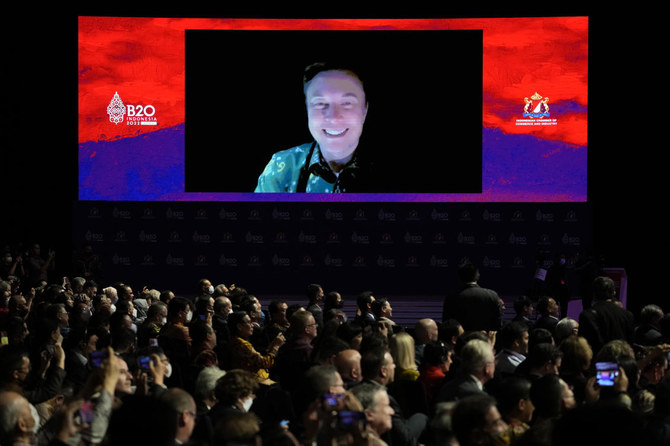
In his appearance Monday at a business forum in Bali, Elon Musk acknowledged criticisms. (AP)
Short Url
Updated 14 November 2022
Follow

Elon Musk touches on Twitter criticism, workload at G20 forum

  • Businessman appeared in a darkened room, saying there had been a power cut just before he connected
  • While Musk was among the most anticipated speakers at the business forum, his remarks broke little new ground

NUSA DUA, Indonesia: It’s not easy being Elon Musk.
That was the message the new Twitter owner and billionaire head of Tesla and SpaceX had for younger people who might seek to emulate his entrepreneurial success.
“Be careful what you wish for,” Musk told a business forum in Bali on Monday when asked what an up-and-coming “Elon Musk of the East” should focus on.
“I’m not sure how many people would actually like to be me. They would like to be what they imagine being me, which is not the same,” he continued. “I mean, the amount that I torture myself, is the next level, frankly.”
Musk was speaking at the B-20 business forum ahead of a summit of the Group of 20 leading economies taking place on the Indonesian resort island. He joined the conference by video link weeks after completing his heavily scrutinized takeover of Twitter.
He had been expected to attend the event in person, but Indonesian government minister Luhut Binsar Pandjaitan, who’s responsible for coordinating preparations for the summit, said Musk could not attend because he’s preparing for a court case later in the week.
He’s got plenty else to keep himself busy.
“My workload has recently increased quite a lot,” he said with a chuckle in an apparent reference to the Twitter deal. “I mean, oh, man. I have too much work on my plate, that is for sure.”
The businessman appeared in a darkened room, saying there had been a power cut just before he connected.
His face, projected on a large screen over the summit hall, appeared to glow red as it was reflected in what he said was candlelight – a visage he noted was “so bizarre.”
While Musk was among the most anticipated speakers at the business forum, his remarks broke little new ground. Only the moderator was able to ask questions.
The Tesla chief executive said the electric carmaker would consider making a much cheaper model when asked about lower-cost options for developing countries like India and G20 host Indonesia.
“We do think that making a much more affordable vehicle would make a lot of sense and we should do something,” he said.
Musk also reiterated a desire to significantly boost the amount and length of Twitter’s video offerings, and share revenue with people producing the content, though he didn’t provide specifics.
He bought Twitter for $44 billion last month and quickly dismissed the company’s board of directors and top executives.
He laid off much of the rest of the company’s full-time workforce by email on Nov. 4 and is now eliminating the jobs of outsourced contractors who are tasked with fighting misinformation and other harmful content.
Musk has vowed to ease restrictions on what users can say on the platform.
He’s reaped a heap of complaints — much on Twitter itself — and has tried to reassure companies that advertise on the platform and others that it won’t damage their brands by associating them with harmful content.
In his appearance Monday, Musk acknowledged the criticism.
“There’s no way to make everyone happy, that’s for sure,” he said.


To infinity and beyond: Grendizer’s 50 years of inspiring Arabs

Updated 27 December 2025
Follow

To infinity and beyond: Grendizer’s 50 years of inspiring Arabs

  • ⁠ ⁠50 years after its creation, the Grendizer anime series continues to capture Arab imagination
  • ⁠ ⁠⁠Arab News Japan speaks to creator Go Nagai, Middle Eastern fans and retells the story behind the UFO Robot tasked with protecting our planet

LONDON: Few cultural imports have crossed borders as unexpectedly, or as powerfully, as Grendizer, the Japanese giant robot that half a century ago became a childhood hero across the Arab world, nowhere more so than in Saudi Arabia.

Created in Japan in the mid-1970s by manga artist Go Nagai, Grendizer was part of the “mecha” tradition of giant robots. The genre was shaped by Japan’s experience during the Second World War, and explored themes of invasion, resistance and loss through the medium of science fiction.

But while the series enjoyed moderate success in Japan, its true legacy was established thousands of kilometers away in the Middle East.

By the early 1980s, “Grendizer” had spread across the Middle East, inspiring fandoms in Saudi Arabia, Kuwait, Iraq and beyond. (Supplied)

The anime “UFO Robot Grendizer” arrived on television in the region in 1979, dubbed into Arabic and initially broadcast in Lebanon during the Lebanese civil war. The story it told of the heroic Duke Fleed, a displaced prince whose planet had been destroyed by alien invaders, struck a chord with children growing up amid regional conflict and occupation by Israel.

Its themes of defending one’s homeland, standing up to aggression and protecting the innocent were painfully relevant in the region, transforming the series from mere entertainment into a kind of emotional refuge.

Much of the show’s impact came from its successful Arabization. The powerful Arabic dubbing and emotionally charged voice-acting, especially by Lebanese actor Jihad El-Atrash as Duke Fleed, lent the show a moral gravity unmatched by other cartoons of the era.

While the series enjoyed moderate success in Japan, its true legacy was established thousands of kilometers away in the Middle East. (Supplied)

The theme song for the series, performed by Sami Clark, became an anthem that the Lebanese singer continued to perform at concerts and festivals right up until his death in 2022.

By the early 1980s, “Grendizer” had spread across the Middle East, inspiring fandoms in Saudi Arabia, Kuwait, Iraq and beyond. For many, it was not only their first exposure to anime, it also delivered lessons on values such as justice and honor.

Grendizer was so influential in the region that it became the subject of scholarly research, which in addition to recognizing the ways in which the plight of the show’s characters resonated with the audience in the Middle East, also linked the show’s popularity to generational memories of displacement, particularly the Palestinian Nakba.

By the early 1980s, “Grendizer” had spread across the Middle East, inspiring fandoms in Saudi Arabia, Kuwait, Iraq and beyond. (Supplied)

Half a century later, “Grendizer” remains culturally alive and relevant in the region. In Saudi Arabia, which embraced the original version of the show wholeheartedly, Manga Productions is now introducing a new generation of fans to a modernized version of the character, through a video game, The Feast of The Wolves, which is available in Arabic and eight other languages on platforms including PlayStation, Xbox and Nintendo Switch, and a new Arabic-language anime series, “Grendizer U,” which was broadcast last year.

Fifty years after the debut of the show, “Grendizer” is back — although to a generation of fans of the original series, their shelves still full of merchandise and memorabilia, it never really went away.


Grendizer at 50
The anime that conquered Arab hearts and minds
Enter
keywords