

Threats to ex-PM Khan’s life have multiplied after Wazirabad shooting — Punjab home advisor

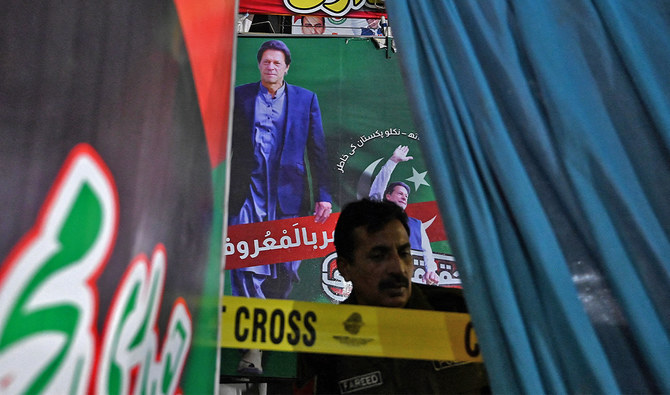
A police officer stands guard in front of container truck used by the former Pakistani prime minister Imran Khan during his political rallies, hours after a gun attack in Wazirabad, Pakistan, on November 3, 2022. (AFP)
Short Url
Updated 14 November 2022
Follow

Threats to ex-PM Khan’s life have multiplied after Wazirabad shooting — Punjab home advisor

  • Omar Sarfraz Cheema says 'extraordinary security measures' are in place around Khan’s residence after intelligence reports
  • Home advisor says Punjab police have 'more than one suspects' in custody for investigation into the Nov 3 Wazirabad shooting

ISLAMABAD: Threats to the life of former Pakistan prime minister Imran Khan have multiplied in recent days and the Punjab provincial government has taken "extraordinary" measures to ensure security around his residence in Lahore, the Punjab home advisor said on Sunday, more than a week after the ex-premier survived a gun attack in Wazirabad city.

Khan’s motorized caravan was sprayed with bullets on November 3 in Wazirabad, a city some 100 kilometres from Lahore, as he led his anti-government march through crowds of supporters on way to Islamabad. The attack killed one person and left Khan among ten others with gunshot wounds.

The ex-premier continues to recover at his Lahore home after being initially treated at Shaukat Khanum Hospital and has since been addressing protest rallies, led by senior members of his Pakistan Tehreek-e-Insaf (PTI) party, through a video link from his residence.

“We have received multiple intelligence reports indicating that threats to the life of Imran Khan have multiplied numerous times after the shooting in Wazirabad,” Omar Sarfraz Cheema, advisor to the Punjab chief minister on home affairs, told Arab News in an exclusive interview on Sunday.

Without elaborating the nature of threats, he said "extraordinary security measures" were in place around Khan's residence in Lahore to deal with any untoward situation.

“We are doing everything; taking all security measures that are humanely possible to protect our leader,” said Cheema, who is also a member of Khan's PTI party.

The government in Punjab province, where Khan and allies are in power, has deployed dozens of police personnel and commandos in and around his home as well as stretched a wall using sandbags around Khan’s residence. The ex-premier’s sons, Suleman and Qasim, who live in the United Kingdom with their mother Jemima Goldsmith, also arrived in Lahore this week to meet their father.

Khan’s party has acquired a new bulletproof container with a bulletproof glass podium atop to safeguard party leaders while traveling and addressing supporters on their way to Islamabad. The ex-premier has announced to join the protest march in Rawalpindi later this month, from where he would lead the marchers to Islamabad.

“The party has yet to decide if it will hold only a protest rally there (Islamabad) or turn it into a sit-in,” the home advisor said.

“Whatever the party decides, we will arrange fool-proof security of Imran Khan and participants accordingly.”

Before the attack on November 3, TV footage and videos shared online showed people welcoming Khan from their rooftops and overhead bridges, some even shaking hands with the former premier as his container truck passed underneath a flyover.

A spokesperson for the Punjab government told Arab News on Friday that Khan would not be facing the public directly under a new security plan. “Khan will be leading the march from Rawalpindi to Islamabad in a bullet-proof vehicle with zero public exposure,” the spokesperson said.

Cheema revealed the Punjab police had “more than one suspects” in custody, who were being interrogated about the Wazirabad shooting and "a breakthrough in the investigation was expected soon."

“The other suspects were arrested following a lead from the shooter who was arrested from the site,” he added.

The Punjab government has also constituted a five-member joint investigation team (JIT) to probe the shooting, which the home advisor said would formally start working from Monday.

“We have not set any timeline for the completion of the probe yet, but definitely it will be completed as early as possible,” Cheema said.

The Punjab police, after much delay, registered a first information report (FIR) of the Wazirabad attack on November 7, on the directives of the Supreme Court. 

Khan had nominated Prime Minister Shehbaz Sharif, Interior Minister Rana Sanaullah and an Inter-Services Intelligence (ISI) official Maj. Gen. Faisal Naseer in his complaint to the police, but the FIR did not mention them as suspects.

Khan, once widely believed to have been supported by Pakistan’s powerful military establishment, is now considered to have fallen out with the army since his ouster in a parliamentary no-trust vote in April.

The former premier as well as members and supporters of his party have been criticizing the military for not intervening to block his ouster by a parliamentary no-trust vote in April, which he says was part of a United States-backed "foreign conspiracy."

Washington, Khan’s opponents and the military deny the allegation.

“A fair and effective investigation into this case is our top priority and we will be putting in our best to reach to the bottom of the conspiracy,” the home advisor added.

Khan started his motorized march towards Islamabad from Lahore late last month to force PM Sharif-led coalition government to announce early elections.


‘Look ahead or look up?’: Pakistan’s police face new challenge as militants take to drone warfare

Updated 14 January 2026
Follow

‘Look ahead or look up?’: Pakistan’s police face new challenge as militants take to drone warfare

  • Officials say militants are using weapons and equipment left behind after allied forces withdrew from Afghanistan
  • Police in northwest Pakistan say electronic jammers have helped repel more than 300 drone attacks since mid-2025

BANNU, Pakistan: On a quiet morning last July, Constable Hazrat Ali had just finished his prayers at the Miryan police station in Pakistan’s volatile northwest when the shouting began.

His colleagues in Bannu district spotted a small speck in the sky. Before Ali could take cover, an explosion tore through the compound behind him. It was not a mortar or a suicide vest, but an improvised explosive dropped from a drone.

“Now should we look ahead or look up [to sky]?” said Ali, who was wounded again in a second drone strike during an operation against militants last month. He still carries shrapnel scars on his back, hand and foot, physical reminders of how the battlefield has shifted upward.

For police in the northwestern Khyber Pakhtunkhwa (KP) province, the fight against militancy has become a three-dimensional conflict. Pakistani officials say armed groups, including the Tehreek-e-Taliban Pakistan (TTP), are increasingly deploying commercial drones modified to drop explosives, alongside other weapons they say were acquired after the US military withdrawal from neighboring Afghanistan.

Security analysts say the trend mirrors a wider global pattern, where low-cost, commercially available drones are being repurposed by non-state actors from the Middle East to Eastern Europe, challenging traditional policing and counterinsurgency tactics.

The escalation comes as militant violence has surged across Pakistan. Islamabad-based Pakistan Institute for Conflict and Security Studies (PICSS) reported a 73 percent rise in combat-related deaths in 2025, with fatalities climbing to 3,387 from 1,950 a year earlier. Militants have increasingly shifted operations from northern tribal belts to southern KP districts such as Bannu, Lakki Marwat and Dera Ismail Khan.

“Bannu is an important town of southern KP, and we are feeling the heat,” said Sajjad Khan, the region’s police chief. “There has been an enormous increase in the number of incidents of terrorism… It is a mix of local militants and Afghan militants.”

In 2025 alone, Bannu police recorded 134 attacks on stations, checkpoints and personnel. At least 27 police officers were killed, while authorities say 53 militants died in the clashes. Many assaults involved coordinated, multi-pronged attacks using heavy weapons.

Drones have also added a new layer of danger. What began as reconnaissance tools have been weaponized with improvised devices that rely on gravity rather than guidance systems.

“Earlier, they used to drop [explosives] in bottles. After that, they started cutting pipes for this purpose,” said Jamshed Khan, head of the regional bomb disposal unit. “Now we have encountered a new type: a pistol hand grenade.”

When dropped from above, he explained, a metal pin ignites the charge on impact.

Deputy Superintendent of Police Raza Khan, who narrowly survived a drone strike during construction at a checkpoint, described devices packed with nails, bullets and metal fragments.

“They attach a shuttlecock-like piece on top. When they drop it from a height, its direction remains straight toward the ground,” he said.

TARGETING CIVILIANS

Officials say militants’ rapid adoption of drone technology has been fueled by access to equipment on informal markets, while police procurement remains slower.

“It is easy for militants to get such things,” Sajjad Khan said. “And for us, I mean, we have to go through certain process and procedures as per rules.”

That imbalance began to shift in mid-2025, when authorities deployed electronic anti-drone systems in the region. Before that, officers relied on snipers or improvised nets strung over police compounds.

“Initially, when we did not have that anti-drone system, their strikes were effective,” the police chief said, adding that more than 300 attempted drone attacks have since been repelled or electronically disrupted. “That was a decisive moment.”

Police say militants have also targeted civilians, killing nine people in drone attacks this year, often in communities accused of cooperating with authorities. Several police stations suffered structural damage.

Bannu’s location as a gateway between Pakistan and Afghanistan has made it a security flashpoint since colonial times. But officials say the aerial dimension of the conflict has placed unprecedented strain on local forces.

For constables like Hazrat Ali, new technology offers some protection, but resolve remains central.

“Nowadays, they have ammunition and all kinds of the most modern weapons. They also have large drones,” he said. “When we fight them, we fight with our courage and determination.”