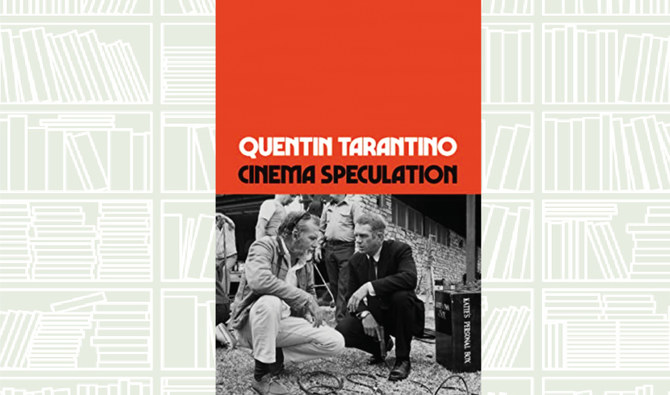
What We Are Reading Today: Cinema Speculation

Short Url
Updated 13 November 2022
Follow

What We Are Reading Today: Cinema Speculation

Author: Quentin Tarantino

The book reads like a series of lectures that Quentin Tarantino might give on his favorite films, and it is very entertaining in that light.
Tarantino is an Academy Award-winning American film director, screenwriter and actor.
He rose to fame in the early 1990s as an independent filmmaker whose films used nonlinear storylines and stylized violence.
His films include “Reservoir Dogs,” “Pulp Fiction,” “Jackie Brown” and “Death Proof.”
“Cinema Speculation” is a very entertaining set of pieces on 70s cinema that’s eminently readable and brimming with passion.
It’s a must-read for 1970s film buffs or movie fans in general, loaded with recommendations and tips of the hat to films that fly under the radar.
Tarantino’s screenplays are also muscular acts of film criticism and revisionist history.
His take on 1960s and 1970s Hollywood, for instance, is already firmly embedded in his 2019 film, “Once Upon a Time in Hollywood.”
The book also weirdly acts as a unifying theory of his own movies, even though he doesn’t really talk about them.


What We Are Reading Today: ‘Fixed’

Updated 22 December 2025
Follow

What We Are Reading Today: ‘Fixed’

Authors: John Y. Campbell and Tarun Tamadorai

We interact with the financial system every day, whether taking out or paying off loans, making insurance claims, or simply depositing money into our bank accounts. 

“Fixed” exposes how this system has been corrupted to serve the interests of financial services providers and their cleverest customers—at the expense of ordinary people.

John Campbell and Tarun Ramadorai diagnose the ills of today’s personal finance markets in the US and across the globe, looking at everything from short-term saving and borrowing to loans for education and housing, financial products for retirement, and insurance. 

They show how the system is “fixed” to benefit those who are wealthy and more educated while encouraging financial mistakes by those who are aren’t, making it difficult for regular consumers to make sound financial decisions and disadvantaging them in some of the most consequential economic transactions of their lives.