- Karachi Biennale 2022 kicked off on October 31 and is currently taking place at nine venues across 'City of Lights'
- The two-week event features works of artists from Pakistan and 12 other countries as well as talks and performances
KARACHI: Themed around the intersection of art and technology, the Karachi Biennale 2022 (KB22), Pakistan’s biggest contemporary art forum, this year showcases 26 audiovisual artworks by artists from Pakistan and 12 other countries.
The event kicked off on October 31 and will run until November 13, with exhibitions, talks and performances taking place at nine venues across Karachi, the southern Pakistani megapolis that many refer to as 'The City of Lights.’
Each art installation on display by the diverse lineup of artists conveys a unique message that reflects the place of its origin, according to the organizers.
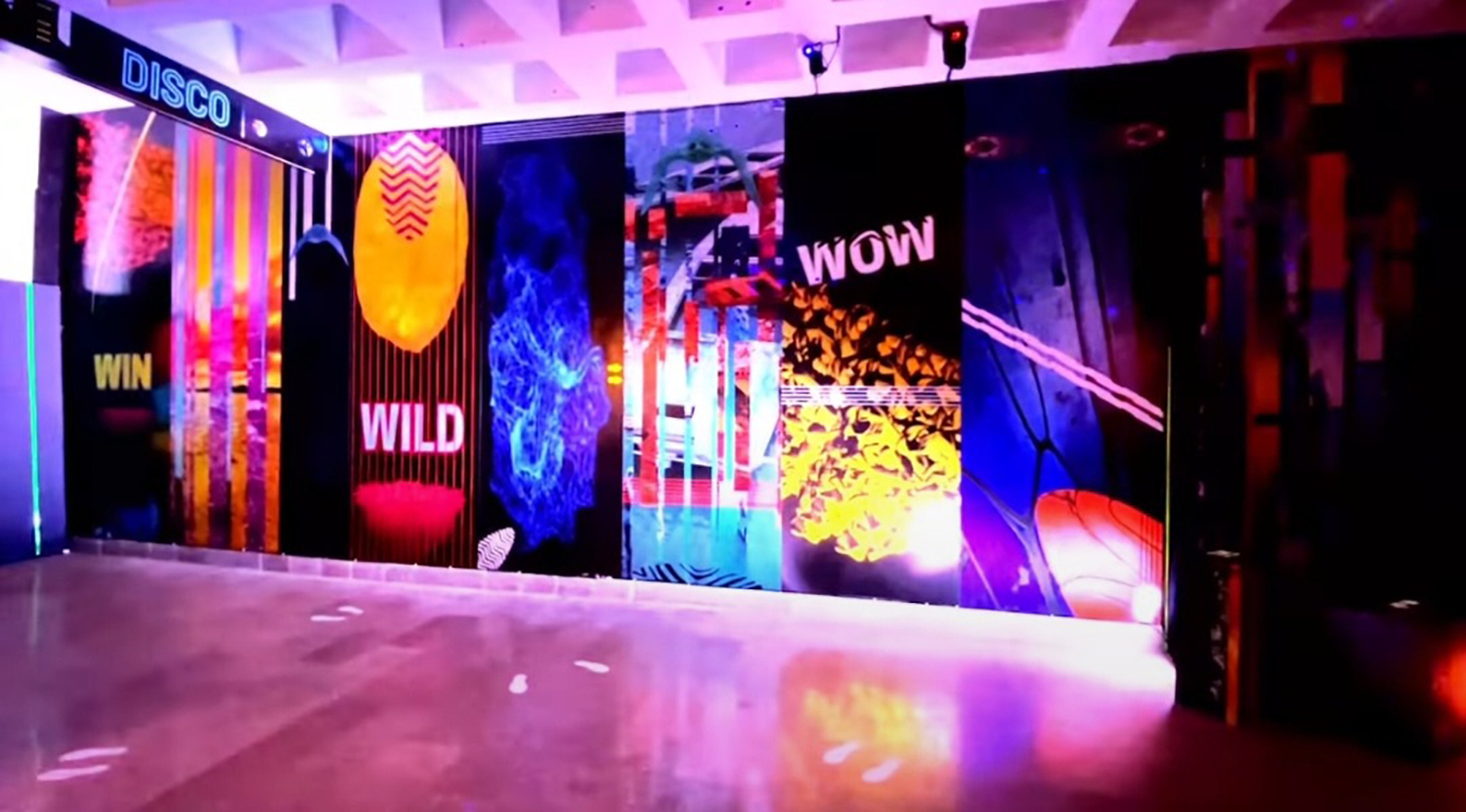
PlugIn Human, a multi-award-winning art duo comprising Dr. Betty Sargeant and Justin Dwyer from Australia, have displayed their installation called, 'Disco Apocalypse.' The artwork uses audiovisual elements collected and created during the duo's time in Amazonia (Brazil), Gamboa (Panama), Batticoloa (Sri Lanka), Karachi (Pakistan), Gili Trawangan (Indonesia) and on Koori lands (Australia).
“We acknowledge the First Peoples and communities of these lands,” they shared with Arab News on the sidelines of KB22.
“We came to these landscapes with presence and intention and pay respect to the culture, lives and struggles of these peoples and lands.”
The Disco’s visuals are an amalgam of traditional art, science, computational mathematics and graphic design. They feature war shields of First Nations—a term used to describe indigenous people—reimagined by Yorta Yorta Australian artist Lorraine Brigdale, as a tool for the protection of natural ecosystems, accompanied by enlarged microscopic and generative-computational imagery.
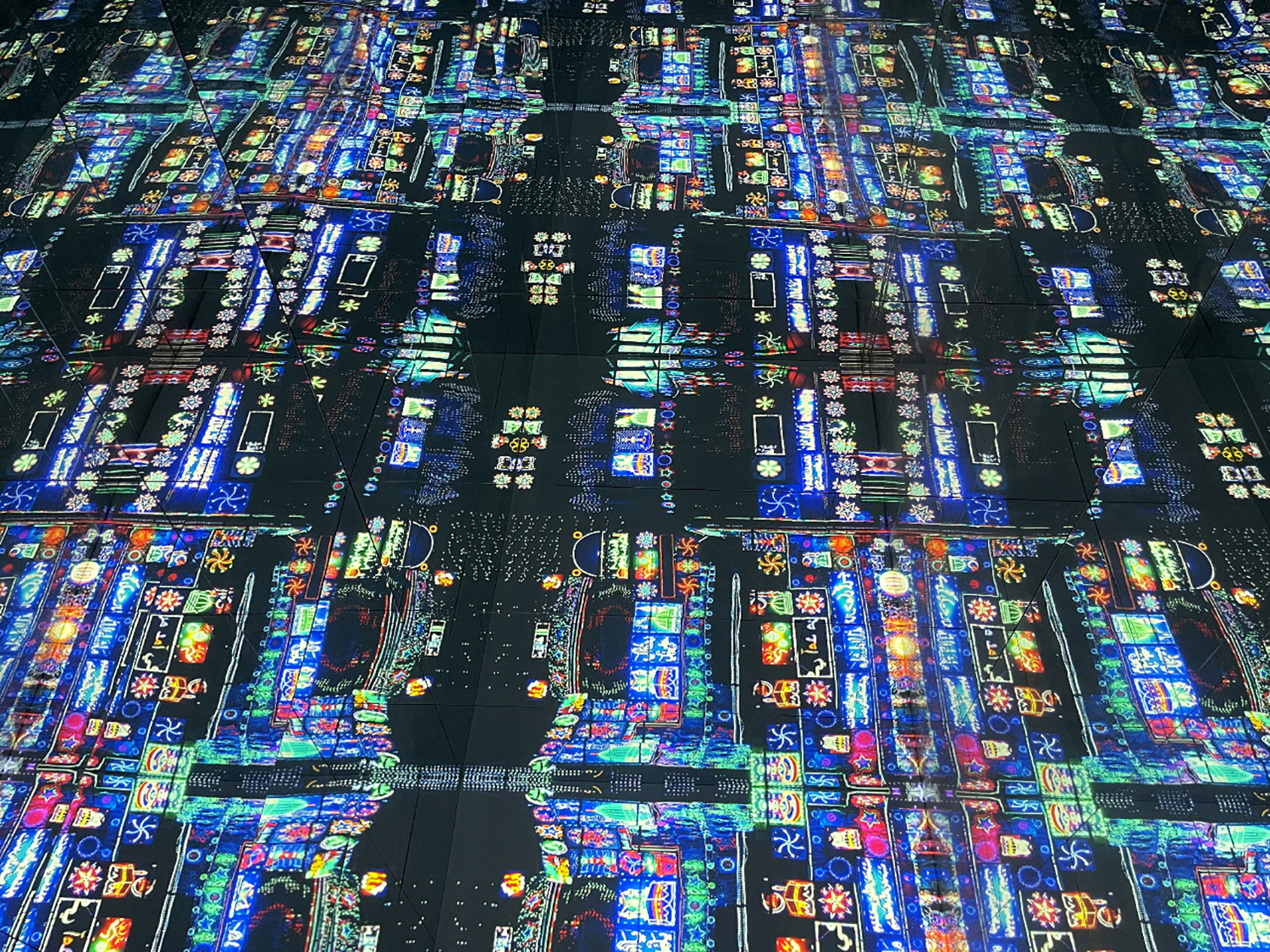
Pakistani visual artist Imran Qureshi presented a site-specific installation, ‘Deen O Duniya’ - The Sacred and the Earthly, interpreting boundaries of religious rituals, culture and modern technology merged in a carnivalesque form. Qureshi's work is based on sound and video projection.
“‘Deen o Duniya’ – The Sacred and the Earthly is inspired by the two houses situated in Riwaz Garden, Lahore, that are decorated every year during Rabiul Awwal," he told Arab News.
Usually, science and religion are considered two different concepts in our part of the world, Qureshi said, adding that he found it interesting how they used science, technology and [elements] of the neo-digital age.
"It is one where residents of a local neighborhood go through profound physical and emotional experiences when their homes, streets, and entire neighborhoods undergo an intense transformation," he said.
"It is an unreal, surreal experience," he added.
Qureshi has incorporated the sound of a qawwali by Ustad Moazam Ali Khan and composed it in collaboration with young composer, Ubaid ur Rehman, as per the artist's vision.
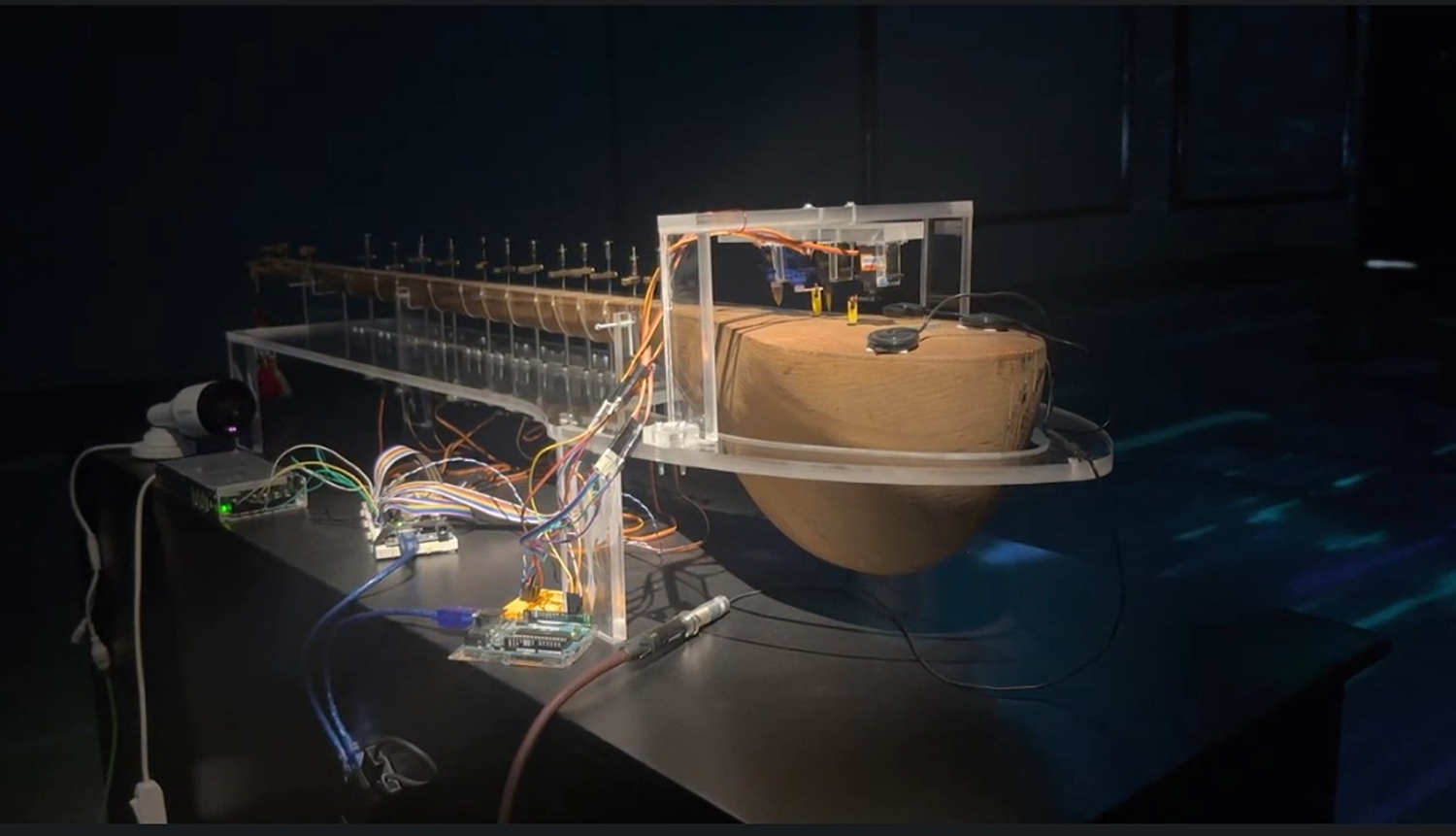
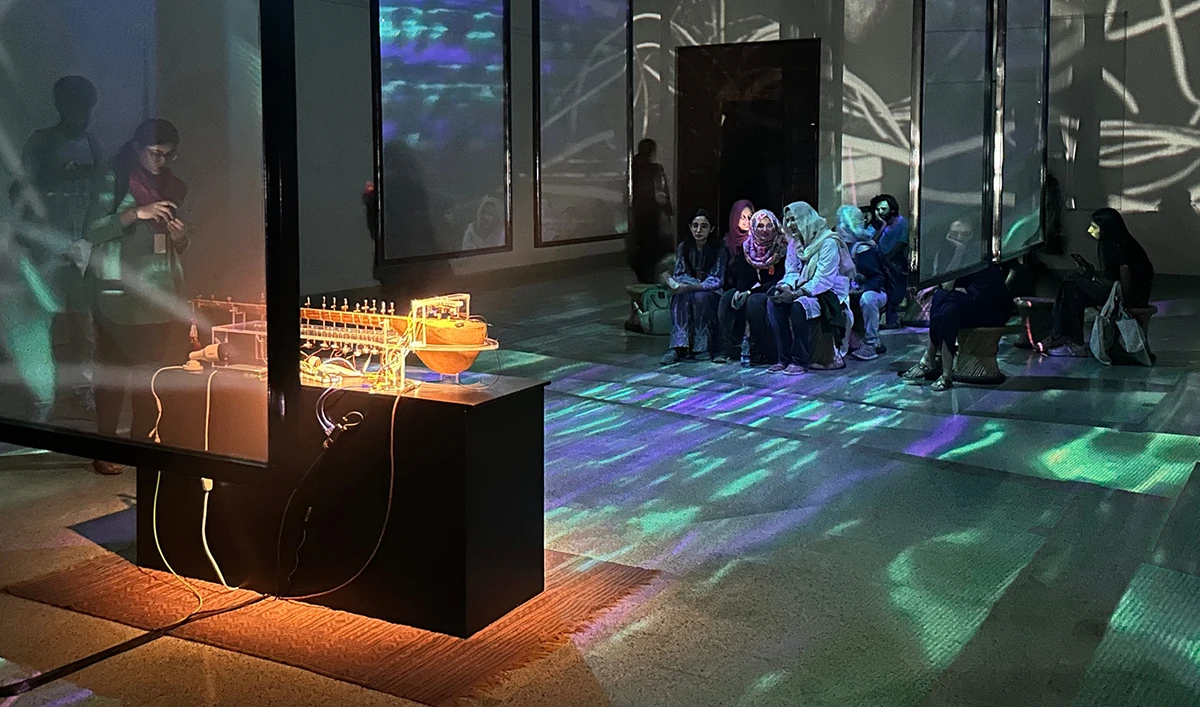
Karachi Community Radio (KCR) Studio, which comprises multiple artists, has showcased its installation, ‘Saaz,’ for which they used an instrument called 'Chitrali sitar.' The instrument is widely used in northern Pakistani music.
"Physically, Saaz is a Chitrali sitar that requires no human presence to play," Jahanzeb Safder, the man behind audio-visual programming, sound design and curation of Saaz, told Arab News.
"The music is performed by a KCR-built mechanical arm that simulates the two human hands required to play the instrument, the strumming hand and the hand pressing on the frets," he added.
"These mechanisms are fed information from a pre-programmed MIDI (Music Instrument Digital Interface) composition on Ableton, written by the members of the team, and sent out through a speaker system in the room," Safder explained.
He said the projection behind the mechanized sitar is the live feed from a CCTV camera placed on a pedestal holding up Saaz, giving a real-time insight into how the mechanism is firing, while exemplifying the raw emotionality of the music.
Karachi Community Radio is an independent online radio archiving and promoting the contemporary music culture of Pakistan. The core team behind its concept design comprises Safder, Murtaza Tunio (Hardware Tech, A/V) and Chitrali musician, Irfan Ali Taj.
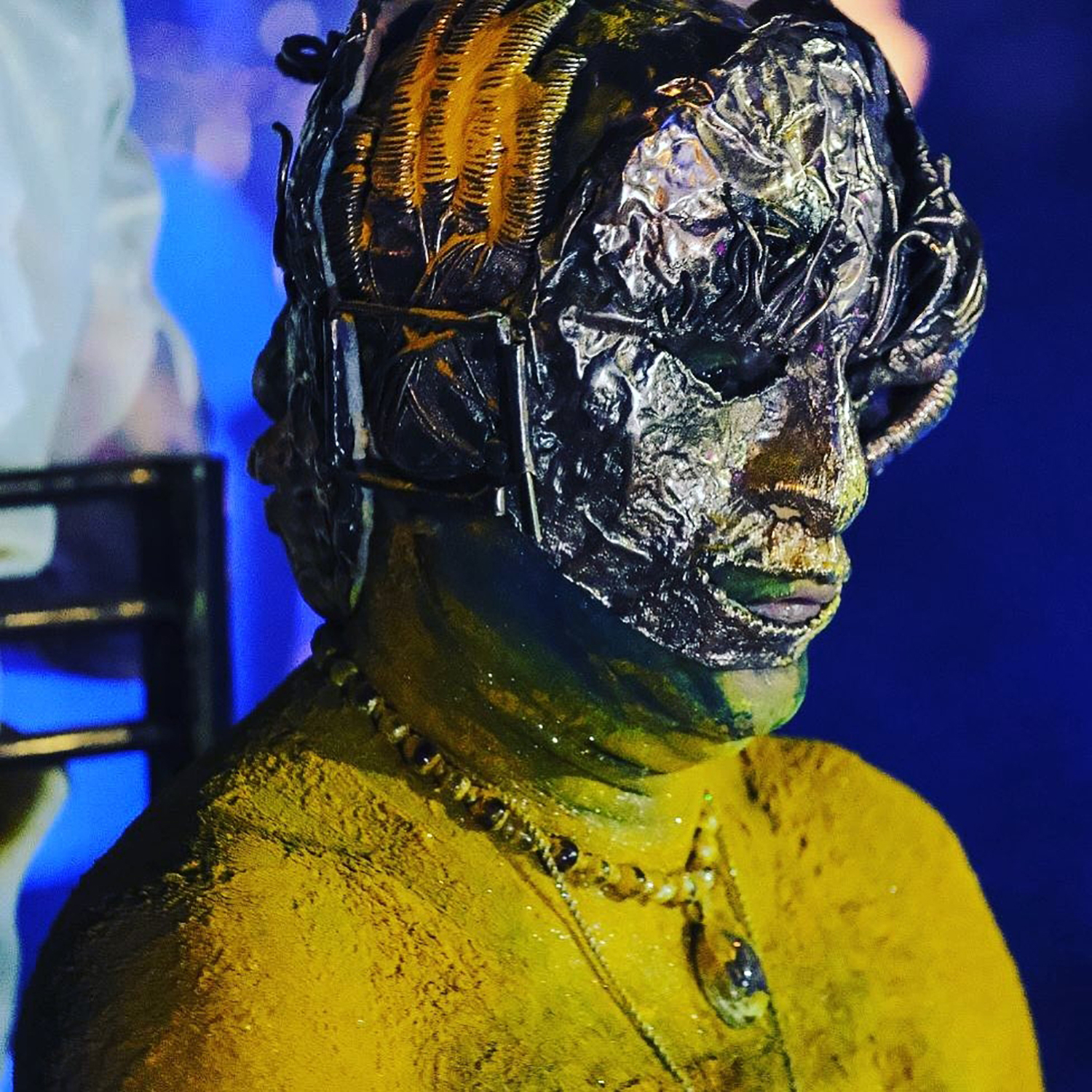
Pakistani artist Amin Gulgee’s work of performative art for KB22, titled ‘The Forgotten March,’ is about “laughter and forgetting.”
Gulgee collaborated with students and teachers of the NJV School, where the performance took place.