

Iran’s top Sunni cleric slams regime brutality against protests

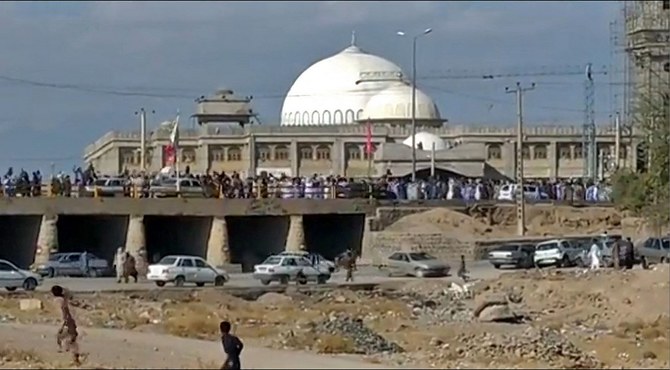
Protesters march in Khash of Iran’s southeastern province of Sistan-Baluchistan in this image grab from a UGC video. (UGC/AFP)
Short Url
Updated 12 November 2022
Follow

Iran’s top Sunni cleric slams regime brutality against protests

  • Abdolhamid Ismail-Zai is the spiritual leader of the country’s Baluchi minority
  • ‘We do not have freedom in the Islamic Republic. Everything is censored. Everything is restricted’

LONDON: Iran’s top Sunni cleric condemned the regime in his Friday sermon, saying authorities are trying to pay to silence the families of people killed in protests that have rocked the country in recent weeks.

Abdolhamid Ismail-Zai, 75, was speaking out following disproportionate violence meted out against members of the Baluchi ethnic minority, a largely Sunni group in Shiite-majority Iran for whom he is a spiritual and political figurehead.

Last week, 18 people were shot by security forces in the southeastern Sistan and Baluchistan province, and the families want justice, said Ismail-Zai.

“We do not want money,” he said in his sermon at Makki mosque in the provincial capital Zahedan. “Who were the people who made this happen, and for what reason? The people who were responsible for this must be brought to justice. This was the demand of the martyrs’ families.”

Ismail-Zai haș become increasingly vocal in his criticism of the regime throughout the protests, which began after the death of 22-year-old Kurdish woman Mahsa Amini in the custody of the country’s morality police in September.

“We do not have freedom in the Islamic Republic,” Ismail-Zai said. “Where is the freedom? Where is the freedom of press? Where is the freedom of expression? Everything is censored. Everything is restricted.

“A large part of the Iranian people is protesting. A majority of the people of Iran have objections, are unsatisfied. I urge regime leaders to listen to them.”

In recent weeks, Ismail-Zai has also questioned why authorities have used live fire against protesters in Baluchistan and Kurdistan, as opposed to teargas and non-lethal rounds against demonstrations elsewhere.

In his sermon, he also criticized politicians who recently called for the death penalty for protesters, though stopped short of discussing Iran’s Supreme Leader Ali Khamenei.

“Representatives represent the people,” he said. “You have to listen to people. You have to defend the people so that the bullets of war are not fired at them.”

One insider close to Ismail-Zai told The Independent: “He doesn’t want the regime to accuse him of provoking violence.”

After Friday prayers, protests erupted against the regime across the region, with demonstrators chanting denunciations of Khamenei and the Islamic Revolutionary Guard Corps. People also reportedly threw stones at security forces, and a number of fires were lit.

Amnesty International says Sistan and Baluchistan has suffered disproportionate violence from the regime compared to many other regions.

“Protesters from the oppressed Baluchi minority have borne the brunt of the security forces’ particularly vicious crackdown on demonstrations,” Amnesty said on Friday.

So far, around a quarter of the people killed during the violence across Iran have been in Sistan and Baluchistan, including nearly 100 killed in Zahedan on Sept. 30. Amnesty says it has the names of at least 100 killed in the province since the unrest began.

It is not the first time Ismail-Zai has condemned the regime — he has been a vocal critic over the years, which has seen him subjected to all manner of curbs on his freedom, including travel bans.

An advocate of peace, he has also criticized armed Baluch separatists, instead advocating for a referendum on the country’s political future.


Iran FM tells UN all military bases of ‘hostile forces’ legitimate targets

Updated 6 sec ago
Follow

Iran FM tells UN all military bases of ‘hostile forces’ legitimate targets

  • UN chief condemns escalation, calls for immediate return to negotiating table
  • Emergency session of Security Council set to convene on Saturday in New York

NEW YORK: Iran will use “all necessary defensive capabilities and means” to confront attacks by the US and Israel, and will treat “all bases, facilities, and assets of the hostile forces in the region” as legitimate military targets under its right to self-defense, Foreign Minister Abbas Araghchi said on Saturday.

In a letter to UN Secretary-General Antonio Guterres and the president of the Security Council, Araghchi said US and Israeli airstrikes are “a clear violation” of the UN Charter and amount to “an open armed aggression” against Iran.

Tehran is exercising its “inherent and lawful right of self-defense” under the UN Charter, he added.

The letter, seen by Arab News, accused the US and Israel of launching coordinated, large-scale attacks on Iranian territory, targeting defensive facilities and civilian sites in several cities.

Araghchi said Iran will continue to act “decisively and without hesitation until the aggression ceases fully and unequivocally,” adding that the US and Israel “shall bear full and direct responsibility for all ensuing consequences, including any escalation arising from their unlawful actions.”

He called on the 15-member Security Council to convene an emergency meeting to address a “breach of peace which is a real and serious threat to international peace and security,” and urged UN member states to “unequivocally condemn this act of aggression.”

An emergency session of the council is set to convene in New York on Saturday, requested by France, Bahrain, Colombia, China and Russia.

The Russian mission at the UN said in a statement that during the meeting, Moscow will demand that the US and Israel “immediately cease their illegal and escalatory actions and embark on a path toward a political and diplomatic settlement.” It added that “Russia is willing to provide all necessary assistance in this process.”

Meanwhile, Guterres condemned the military escalation, saying “the use of force by the United States and Israel against Iran, and the subsequent retaliation by Iran across the region, undermine international peace and security.”

The UN Charter clearly prohibits “the threat of the use of force against the territorial integrity or political independence of any state, or in any other manner inconsistent with the Purposes of the United Nations,” Guterres said in a statement.

He called for an immediate cessation of hostilities and de-escalation, and an immediate return to the negotiating table, adding that “failing to do so risks a wider regional conflict with grave consequences for civilians and regional stability.”

UN human rights chief Volker Turk also deplored the escalation and warned that civilians are the ones who end up paying “the ultimate price.”

He said: “Bombs and missiles are not the way to resolve differences but only result in death, destruction and human misery.”

Turk called for restraint and implored the parties “to see reason, to de-escalate, and (return) to the ‘negotiating table’ where they had been actively seeking a solution only hours earlier.”