


RIYADH: Energy transition, civil nuclear technology and environmental sustainability are among the many potential areas of cooperation between Argentina and Saudi Arabia in the fight against climate change, Santiago Cafiero, the Argentine minister of foreign affairs, said during an exclusive interview with Arab News on Wednesday.
Considerations such as these are high on the global diplomatic agenda this month. Cafiero’s visit to Saudi Arabia coincides with the ongoing UN Climate Change Conference (COP27) in Egypt, where the Kingdom is showcasing its Saudi Green and Middle East Green Initiatives.
“Argentina has signed up to the international commitments and it has actually raised its ambitions with respect to carbon emissions,” said Cafiero, highlighting the South American nation’s commitment to achieve carbon neutrality by 2050.
In this context, he cited energy-transition projects involving solar and green hydrogen as well as sustainability initiatives such as regenerative agriculture as some of the country’s many strengths.
“Argentina is the eighth largest country in the world. It has an immense geography, and it has natural resources that are very well known. But we also take great care of them. We have a view of sustainable productive development with respect to the environment and we intend to keep it that way,” he said.
“Argentina has an important role to play in terms of the energy transition. Today we have green hydrogen projects and we also have developments of strategic minerals for electro mobility, such as copper and lithium. Argentina can really become an important player for the energy transition and there I think we can do cooperative work with Saudi Arabia.”
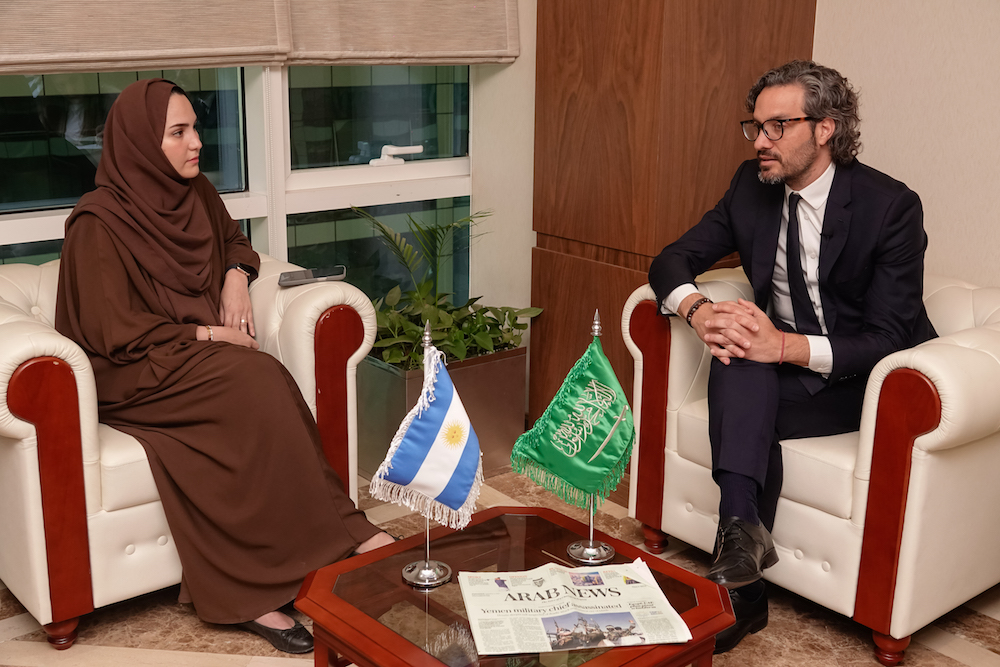
Soft power and expertise exchange are key to growing ties between Buenos Aires and Riyadh, Argentina’s foreign minister told Arab News assistant editor-in-chief Noor Nugali. (AN Photo/Huda Bashatah)
Cafiero’s visit to the Kingdom — his first as Argentina’s top diplomat — comes as the world faces multiple overlapping crises — from the residual effects of the COVID-19 pandemic to inflation, climate pressures and the war in Ukraine — that have caused disruptions to global food and energy supply chains.
While Saudi Arabia and Argentina have risen to these challenges in their own ways, Cafiero believes the two countries have much to contribute by cooperating in everything from business and diplomacy to energy security.
“In this time of uncertainty, I think that friendly countries like Saudi Arabia and Argentina have a lot to contribute to the world if they come together, if they work together and cooperate,” Cafiero told Arab News.
According to Cafiero, Saudi Arabia and Argentina have “all the possibilities” to connect their two peoples commercially, politically and in the areas of culture and clean energy.
“Argentina has natural and human resources,” he said, “and it also has a strong political inclination to move in this direction together with Saudi Arabia when it comes to developing business links, trade, and also to lend a hand to the rest of the world to provide energy and secure food.”
Last year, Argentina’s President Alberto Fernandez urged investors from Saudi Arabia and other countries to “turn your gaze to Argentina,” saying that he wanted foreign investment that “produces and wins.” Since then, fresh business ties have already been established.
“Today, the work that we are carrying forward, in the ministry of foreign affairs and international trade, is that of a road map for strategic sectors that we understand are of interest to Saudi Arabia. These are agribusiness and the biotechnology industry,” said Cafiero.
“And then we also have an interesting development in knowledge-driven economy and strategic minerals. Argentina also has a great capacity for its own development of services related to non-conventional gas production, and high-tech sectors such as the satellite industry or the application of nuclear technology for peaceful purposes.”
Civil nuclear technology is a promising area of cooperation between the two countries. Saudi Arabia — blessed not only with the great gift of oil but also with vast reserves of the uranium required for nuclear generation — is currently planning its first reactor in collaboration with the International Atomic Energy Agency.
“Argentina looks back on 70 years of work on nuclear technology for peaceful purposes,” said Cafiero. “In fact, we are developing a reactor for studies here in Saudi Arabia and for the development of applications related to nuclear technology. That is, applications related to nuclear medicine, cancer treatment and some even applied to agricultural products.
“We also apply nuclear technology to eliminate plastic from the oceans, which is something we are already doing in Antarctica.”
For all its technological strengths, Argentina’s economy has endured several turbulent years, mainly owing to chronic inflation. Last month, the IMF, which has described the country’s economic situation as “fragile,” approved a $17.5 billion loan to Buenos Aires — the second installment of a $44 billion support package.
FASTFACT
* $1.03bn - Value of Saudi imports from Argentina in 2021.
(Source: UN COMTRADE)
Cafiero says that the Argentine economy has now returned to growth, resulting in booming exports, record foreign investment and rising employment.
“We are optimistic about the path that the Argentine economy is taking,” said Cafiero. “We had three consecutive years of economic recession: 2018, 2019 and 2020, with the pandemic.
“Only in 2021 Argentina started to grow again and it grew a lot: 10.3 percent this year. In the first half of this year, we also have a growth of six points in gross national product. So we believe that we are on the right track.”
He added: “During the last year 1.2 million jobs have been created. So far this year, 30,000 jobs have been generated every month … In the first half of the year 2022 we have a record investment rate in the history of Argentina and we are going to reach record export levels during this year.”
Despite its recent economic misfortunes, Argentina remains well known for its wealth of cultural icons, from its acclaimed authors such as Victoria Ocampo and musical greats such as Diego Torres to its celebrated sportsmen Messi and Maradona.

Santiago Cafiero meeting with Saudi Arabia's Foreign Minister Prince Faisal bin Farhan during his visit to the Kingdom. (Twitter/@SantiagoCafiero)
As Saudi Arabia emerges as the Middle East’s new hub for the arts, culture, music, sports and filmmaking, Cafiero believes there is a role for soft power in forging closer ties between the Kingdom and Argentina.
“I think we have all the possibilities to bring more Argentina to Saudi Arabia, and more Saudi Arabia to Argentina,” he said. “We should therefore connect these two peoples not only in their commercial and political development, but we also have to move forward from a cultural point of view.
Referring to Saudi Arabia’s opening match against much-fancied Argentina at the World Cup in Qatar on Nov. 22, Cafiero said: “With respect to football, although we are only divided by one match and we both want our team to win. It really is a sport that builds bridges.”
On the diplomatic front, the Arab Gulf states have long had concerns about Iranian and Hezbollah activities in Latin America. Several regional governments have made attempts to build ties with Iran, doing little to relieve those concerns.
Such attempts by Argentina have been less pronounced in recent decades. After a period of nuclear cooperation that began in the mid-1980s, relations with Iran were set back by two bombings in Buenos Aires in the early 1990s.

Argentina’s top diplomat Cafiero said his country and Saudi Arabia could cooperate in the field of environmental sustainability while forging closer commercial, political, cultural and institutional relations. (AN Photo/Huda Bashatah)
Those bombings, the first of the Israeli embassy in 1992 and the second that of the Argentine Israelite Mutual Association in 1994, destroyed what had previously been a close and mutually beneficial relationship.
“Argentina’s diplomatic relationship with Iran is on a rather low level, as a result of the attacks that Argentina suffered in 1992 and 1994,” said Cafiero.
“At that time, the Argentine justice system requested Iranian authorities to be part of the investigation but they did not cooperate. Since then, this relationship is therefore a tense one.”
By contrast, Cafiero says Saudi Arabia and Argentina can strengthen the international order through cooperation, and enrich one another by establishing cultural and institutional bridges.
“We need a safer world and we strive for that security from the basis of a multilateralism in solidarity,” he said.
“I think we both have two cultures that are very powerful cultures and they should build bridges between each other. Once they know and understand each other, they will surely enrich each other.”


