

Philippine prisons chief ordered murder of journalist: Police

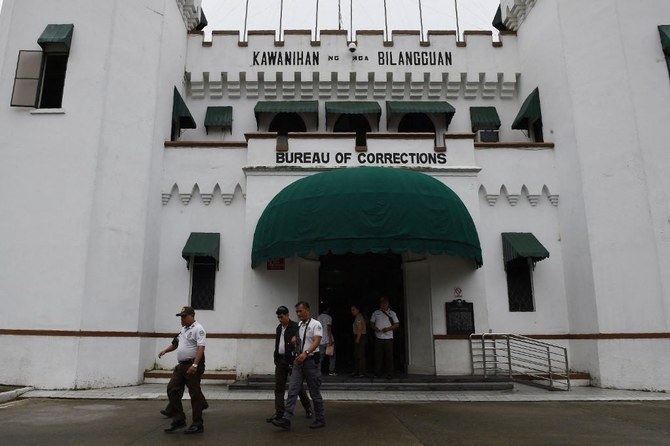
Police filed murder complaints against Bureau of Corrections director general Gerald Bantag, who is currently suspended from duty. (AFP file photo)
Short Url
Updated 07 November 2022
Follow

Philippine prisons chief ordered murder of journalist: Police

  • Police filed murder complaints against Bureau of Corrections director general Gerald Bantag

MANILA: Philippine police accused Monday the country’s prisons chief of ordering the killing of a prominent radio journalist, whose death sparked international alarm.

Radio personality Percival Mabasa, 63, who went by the name “Percy Lapid” in his program, was shot dead in a Manila suburb on October 3 as he drove to his studio.

Police filed murder complaints against Bureau of Corrections director general Gerald Bantag, who is currently suspended from duty, and his deputy security officer Ricardo Zulueta.

The alleged gunman, Joel Escorial, surrendered to authorities last month out of fear for his safety after police broadcast his face from security footage, officials said previously.

“He (Bantag) will probably be the highest official of this land ever charged with a case of this gravity,” Justice Secretary Crispin Remulla said.

Bantag allegedly ordered the murder of Mabasa following the “continued expose by the latter of the issues against the former on his show,” Eugene Javier of the National Bureau of Investigation told reporters, reading from a statement.

Bantag and Zulueta have also been accused of ordering the killing of Cristito Villamor Palana, one of the prison inmates who allegedly passed on the kill order to Escorial.

Escorial had identified Palana to police.

Palana was suffocated with a plastic bag by members of his own gang, Javier said.

Criminal complaints also have been filed against 10 inmates.

Prosecutors at the Department of Justice will decide if there is enough evidence to file charges in court.

Mabasa was an outspoken critic of former president Rodrigo Duterte as well as his successor Ferdinand Marcos’s policies and aides.

He also had been critical of “red-tagging” — accusing someone of being a communist sympathizer — as well as online gambling operations and misinformation around martial law.

He was the second journalist to be killed since Marcos took office on June 30.

While the Philippines is ranked as one of the most dangerous countries in the world for journalists, such murders rarely happen in Manila.

Javier said the investigation into the murders had exposed “the institutionalization of a criminal organization within the government.”

“This will be the cause of many reforms in government and the strengthening of current mechanisms to ensure that nothing of this nature will happen again,” he said, describing it as a “war against impunity.”


Blair pressured UK officials over case against soldiers implicated in death of Iraqi

Former British Prime Minister Tony Blair. (File/AFP)
Updated 5 sec ago
Follow

Blair pressured UK officials over case against soldiers implicated in death of Iraqi

  • Newly released files suggest ex-PM took steps to ensure cases were not heard in civilian court
  • Baha Mousa died in British custody in 2003 after numerous assaults by soldiers over 36 hours

LONDON: Former UK Prime Minister Tony Blair pressured officials not to let British soldiers be tried in civil courts on charges related to the death of an Iraqi man in 2003, The Guardian reported on Tuesday.

Baha Mousa died in British Army custody in Basra during the Iraq War, having been repeatedly assaulted by soldiers over a 36-hour period.

Newly released files show that in 2005 Antony Phillipson, Blair’s private secretary for foreign affairs, had written to the prime minister saying the soldiers involved would be court-martialed, but “if the (attorney general) felt that the case were better dealt with in a civil court he could direct accordingly.”

The memo sent to Blair was included in a series of files released to the National Archives in London this week. At the top of the memo, he wrote: “It must not (happen)!”

In other released files, Phillipson told Blair that the attorney general and Ministry of Defence could give details on changes to the law they were proposing at the time so as to avoid claims that British soldiers could not operate in a war zone for fear of prosecution. 

In response, Blair said: “We have, in effect, to be in a position where (the) ICC (International Criminal Court) is not involved and neither is CPS (Crown Prosecution Service). That is essential. This has been woefully handled by the MoD.”

In 2005, Cpl Donald Payne was court-martialed, jailed for a year and dismissed from the army for his role in mistreating prisoners in custody, one of whom had been Mousa.

Payne repeatedly assaulted, restrained and hooded detainees, including as part of what he called “the choir,” a process by which he would kick and punch prisoners at intervals so that they made noise he called “music.”

He became the first British soldier convicted of war crimes, admitting to inhumanely treating civilians in violation of the 2001 International Criminal Court Act.