Philippine media groups demand protection after journalist’s murder

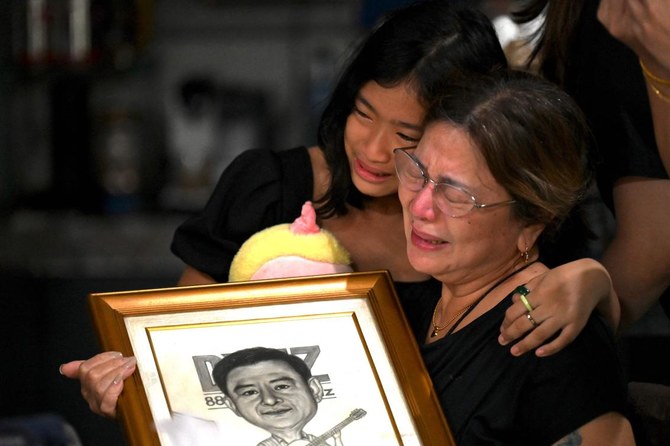
Radio journalist Percival Mabasa had been critical of the previous president and some policies and officials in incumbent Ferdinand Marcos Jr.’s administration. (AFP)
Short Url
Updated 04 October 2022
Follow

Philippine media groups demand protection after journalist’s murder

  • Radio journalist Percival Mabasa killed by two assailants on Monday night

MANILA: A Philippine journalist has been shot dead while driving in the country’s capital, police said on Tuesday, prompting condemnation from media groups and activists, who described his assassination as a blow to press freedom.
Radio journalist Percival Mabasa, 63, was killed by two assailants at the gate of a residential compound in the Las Pinas area of Manila on Monday night, police said.
“That the incident took place in Metro Manila indicates how brazen the perpetrators were, and how authorities have failed to protect journalists as well as ordinary citizens from harm,” said the National Union of Journalists of the Philippines.
The national police vowed to bring justice over the attack. The government had no immediate comment.
It followed the fatal stabbing last month of radio journalist Rey Blanco in central Philippines.
At least 187 have been killed in the past 35 years in the Philippines, according to international watchdog Reporters Without Borders, including 32 killed in a single incident in 2009.
Mabasa’s family called his killing a “deplorable crime” and demanded “his cowardly assassins be brought to justice.”
Rights group Karapatan described him as “one of the country’s fiercest truth-tellers.”
Videos on Mabasa’s YouTube channel, which has 216,000 subscribers, showed he had been critical of the previous president and some policies and officials in incumbent Ferdinand Marcos Jr.’s administration.
“We are not discounting the possibility that the shooting could be related to the victim’s work in media,” local police chief Jaime Santos said in a statement.


Paris exhibition marks 200 years of Le Figaro and the enduring power of the press

Updated 17 January 2026
Follow

Paris exhibition marks 200 years of Le Figaro and the enduring power of the press

  • The exhibition celebrated the bicentennial of Le Figaro, offering visitors a rare opportunity to step inside the newspaper’s vast historical archive

PARIS: One of France’s most influential newspapers marked a major milestone this month with a landmark exhibition beneath the soaring glass nave of the Grand Palais, tracing two centuries of journalism, literature and political debate.
Titled 1826–2026: 200 years of freedom, the exhibition celebrated the bicentennial of Le Figaro, offering visitors a rare opportunity to step inside the newspaper’s vast historical archive. Held over three days in mid-January, the free exhibition drew large crowds eager to explore how the title has both chronicled and shaped modern French history.
More than 300 original items were displayed, including historic front pages, photographs, illustrations and handwritten manuscripts. Together, they charted Le Figaro’s evolution from a 19th-century satirical publication into a leading national daily, reflecting eras of revolution, war, cultural change and technological disruption.
The exhibition unfolded across a series of thematic spaces, guiding visitors through defining moments in the paper’s past — from its literary golden age to its role in political debate and its transition into the digital era. Particular attention was paid to the newspaper’s long association with prominent writers and intellectuals, underscoring the close relationship between journalism and cultural life in France.
Beyond the displays, the program extended into live journalism. Public editorial meetings, panel discussions and film screenings invited audiences to engage directly with editors, writers and media figures, turning the exhibition into a forum for debate about the future of the press and freedom of expression.
Hosted at the Grand Palais, the setting itself reinforced the exhibition’s ambition: to place journalism firmly within the country’s cultural heritage. While the exhibition has now concluded, the bicentennial celebrations continue through special publications and broadcasts, reaffirming Le Figaro’s place in France’s public life — and the enduring relevance of a free and questioning press in an age of rapid change.