

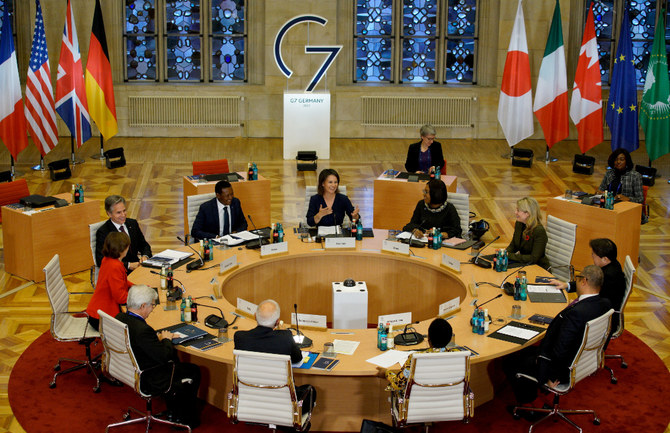
G7 ministers condemn Iran protest crackdown

The G7 also criticized Tehran’s “destabilizing activities in and around the Middle East. (Reuters)
Short Url
Updated 05 November 2022
Follow

G7 ministers condemn Iran protest crackdown

  • Protests continued in the cities of Zahedan, Khash and Saravan in Sistan-Baluchistan

JEDDAH: Foreign ministers from the G7 group of nations on Friday denounced the Tehran regime’s deadly crackdown on the wave of protests sweeping Iran.

“We condemn the brutal and disproportionate use of force against peaceful protesters,” the ministers said after talks in Germany.

“We advocate the right of all Iranians to access information, and we deplore the Iranian government’s erosion of civil space, and independent journalism, its targeting of human rights defenders, including by shutting down the internet and social media,” they said.

The G7 also criticized Tehran’s “destabilizing activities in and around the Middle East,” such as the supply of weapons, including drones, “to state and non-state actors.” Ministers said: “Such proliferation is destabilizing for the region and escalates already high tensions.”

Nationwide demonstrations erupted throughout Iran after the Sept. 16 death in morality police custody of Mahsa Amini, 22, a Kurdish woman who had been detained for wearing her hijab in an “insufficiently modest” manner. Protesters, many of them women, have defiantly removed their headscarves, cut their hair in public, and called for the removal of Iran’s Supreme Leader Ayatollah Ali Khamenei.

Security forces have responded with a brutal crackdown in which more than 500 people have been killed and at least 25,000 arrested, according to dissident groups. The protests continued on Friday in the cities of Zahedan, Khash and Saravan in Sistan-Baluchistan, an impoverished province near the border with Pakistan and Afghanistan that has been a hotbed of unrest.

Several people were injured in clashes when protesters attacked a government building in Khash and torched several vehicles, and security forces opened fire. Video footage online showed a burned bank and damaged storefronts in Khash after the unrest, with dark smoke billowing from a building.

A senior cleric in Zahedan urged Iran’s rulers to hold a referendum to find out what Iranian people wanted.“You should resolve your problem with this nation which once gave you your legitimacy,” Molavi Abdolhamid said during Friday prayers. “The majority of people are dissatisfied now. If you disagree, then hold a referendum with international observers.”

Elsewhere in Iran, there were state-sponsored rallies on Friday marking the 1979 seizure of the US embassy in Tehran, when 52 Americans were held hostage for 444 days. State television showed anti-American demonstrations attended by tens of thousands of people across the country on the “National Day of Fighting Global Arrogance,” while songs called for “Death to America.”

However, anti-regime protests are one of the biggest challenges to the authority of the 1979 revolution, with many young Iranians overcoming the fear that has stifled dissent.


Jordan, Germany committed to two-state solution

King Abdullah of Jordan receives German Chancellor Friedrich Merz in Aqaba. (Petra)
Updated 07 December 2025
Follow

Jordan, Germany committed to two-state solution

  • Chancellor Merz calls for more humanitarian aid to flow into the war-torn Gaza Strip

AMMAN: Jordan’s King Abdullah has warned of “the danger of continued Israeli escalations in the West Bank,” which Israel has occupied since 1967.

King Abdullah received German Chancellor Friedrich Merz during his brief stopover in Jordan on Saturday.

Their discussions in Aqaba focused mainly on the peace process in Israel and the Palestinian territories, AFP reported.

Merz called for more humanitarian aid to flow into the Gaza Strip and for Hamas fighters to lay down their weapons, adding that both Jordan and Germany are committed to a negotiated two-state solution.

FASTFACT

Jordan’s royal palace said in a statement that King Abdullah underlined ‘the need to commit to implementing all stages of the agreement to end the war and deliver humanitarian aid to all areas of the Gaza Strip.’

“There can be no place for terrorism and antisemitism in this shared future,” Merz said.

Jordan’s royal palace said in a statement that King Abdullah had underlined “the need to commit to implementing all stages of the agreement to end the war and deliver humanitarian aid to all areas of the strip.”

The meeting discussed ways to strengthen the partnership between Jordan and Germany, focusing on the deep-rooted ties between the two countries, Jordanian news agency Petra reported.

King Abdullah emphasized the importance of expanding cooperation in various domains, including the economic and defense sectors, and continuing to coordinate in support of efforts to achieve stability in the region, according to Petra.

The leaders highlighted the need to pursue a “political horizon to achieve a just and comprehensive peace in the region.”

Chancellor Merz expressed Germany’s readiness to strengthen cooperation with Jordan in various sectors.

The Syrian Arab Republic’s Sana news agency reported that the two leaders discussed ways to support Syria and Lebanon in maintaining their security, stability, and sovereignty.

They stressed the importance of respecting the sovereignty of regional countries and reviewed key developments in the Middle East.

Deputy Prime Minister and Foreign Minister Ayman Safadi had previously affirmed that Jordan continues to support Syria after years of war and destruction, expressing hope for a stable and secure future that ensures Syria’s territorial unity, Sana added.

King Abdullah separately met with Kaja Kallas, EU high representative for foreign affairs and security policy and European Commission vice president on Sunday to discuss ways to strengthen cooperation within the framework of the strategic and comprehensive partnership between Jordan and the EU.

The meeting at Basman Palace covered the importance of building on available economic opportunities, particularly through the Jordan-EU Summit, scheduled to be held in Amman in January 2026, as well as the joint economic forum scheduled for next year, with participation from investors on both sides.

The meeting also touched on regional developments and the need to achieve comprehensive calm and preserve the sovereignty of states.

The two sides emphasized that the two-state solution is the only way to achieve just and comprehensive peace.

The king reiterated the need to adhere to the terms of the agreement to end the war in Gaza and ensure the flow of relief aid, as well as to stop unilateral measures against Palestinians in the West Bank.

For her part, Kallas emphasized the importance of the EU’s partnership with Jordan and the shared commitment to deepen cooperation in various fields, noting Jordan’s pivotal role in the region.