

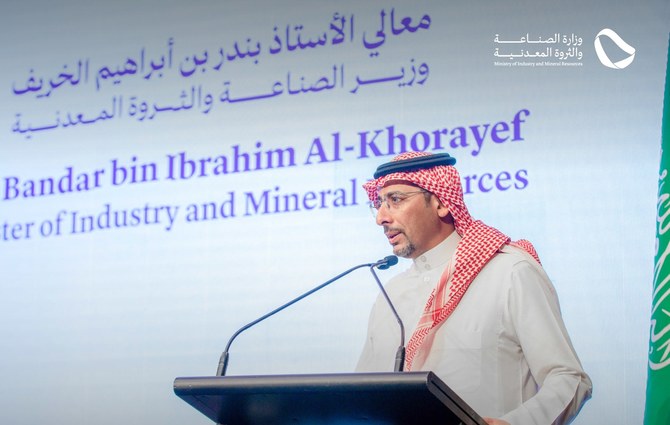

SYDNEY: Saudi Arabia is considering setting up a new metals and mining stock exchange index as it looks to expand its resources sector to diversify away from hydrocarbons, a senior government official said on Friday.
Mining Minister Bandar bin Ibrahim Al-Khorayef told Reuters in an interview in Sydney that his team met with Australian counterparts to learn more about a mining index, similar to Australia’s ASX 300 Metals & Mining sub-index that lists metals and mining firms including producers of gold, steel and precious metals.
“It is something we are studying ... but we have not made up our mind if it would be successful,” Al-Khorayef told Reuters.
“We have a secondary stock market in Saudi...its still evolving. We want to see if its better to have something for mining,” he said.
He did not say how many companies would potentially be included in the index.
Saudi Arabia’s stock exchange consists of the Tadawul main market and a parallel market that companies can join with fewer reporting requirements.
Riyadh’s efforts to build an economy that is not dependent on oil include a shift toward mining to explore the country’s untapped reserves of resources from copper to phosphate and gold.
The minister is at the International Mining and Resources Conference in Sydney this week to drum up investment interest. He said on Wednesday that the kingdom plans to award over a dozen mining exploration licenses to international investors.
Al-Khorayef said the separate index for mining would help put more focus on Saudi’s mining industry, and will enable them to benchmark it with markets like Australia, the UK and others.
“The idea is to help the sector grow faster. We definitely see a need for small and medium firms in the sector to access capital through capital markets,” he said.
Saudi’s stock markets are currently dominated by real estate, energy and trading firms, while there are a just a small number of mining companies with the state miner Saudi Arabian Mining Co, the Gulf’s largest miner, leading the pack.
“The whole idea (of a mining index) is to ensure that we have something that financing companies or financial institutions like banks can have good visibility on,” he said.
SEEKING PARTNERSHIPS
The Saudi government believes it has unused mineral resources worth about $1.33 trillion, with vast quantities of aluminum, phosphate, gold, copper and uranium, Al-Khorayef said.
Al-Khorayef said he held discussions with several mining companies in Sydney this week, including global mining giants like BHP Group, about collaborating on the exchange of knowledge, expertise and the adoption of their successful business model.
“In terms of ability to finance a lot of projects, Saudi Arabia is quite good. But we are always seeking partnerships because we are a great believer that it’s through collaboration that we can succeed,” he said.
“We want to encourage people who offer services to mining companies to come to Saudi either directly or through partnering with some local people. Everyone out there should be looking at Saudi as a potential market,” he said.
Saudi is hosting the Future Minerals Forum in Riyadh in January, where it hopes to announce more details of its plans for the mining sector.


