

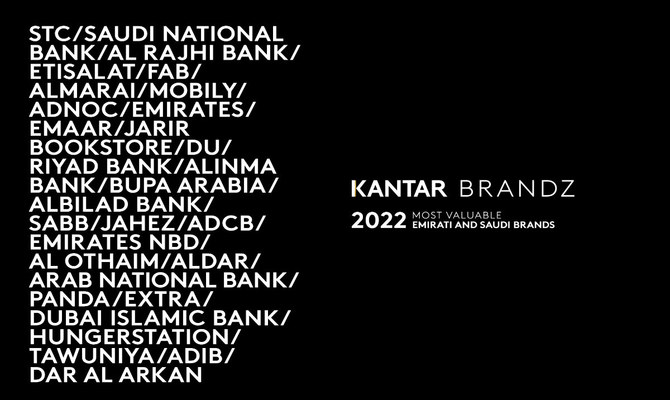

DUBAI: Kantar, an analytics and consulting company, has released its latest BrandZ ranking of the top 30 most valuable brands in Saudi Arabia and the UAE.
Saudi and Emirati brands have more than doubled their total value in the past two years, growing faster than any other global Kantar BrandZ ranking. Spurred by the consistent investment in infrastructure and economic diversification in the two countries, the value of the most valuable Saudi and Emirati brands ranking has grown by 110 percent.
The rate of growth is well ahead of the next-best performing market, India, which achieved 82 percent growth in brand value over the past two years.
“Two of the biggest economies in the Arab world, the UAE and KSA, have lost none of their ambition to diversify their economies,” Amol Ghate, managing director, Middle East, North Africa & Pakistan, Insights Division, Kantar, told Arab News.
He added: “Indeed, as they emerge from the uncertainties of the pandemic, both have stepped up the scale of those ambitions. We see this reflected in the stellar growth of the Kantar BrandZ Top 30 Most Valuable Emirati and Saudi Brands, whose growth has outpaced both their global and country counterparts in the BrandZ rankings by an astonishing 110 percent.”
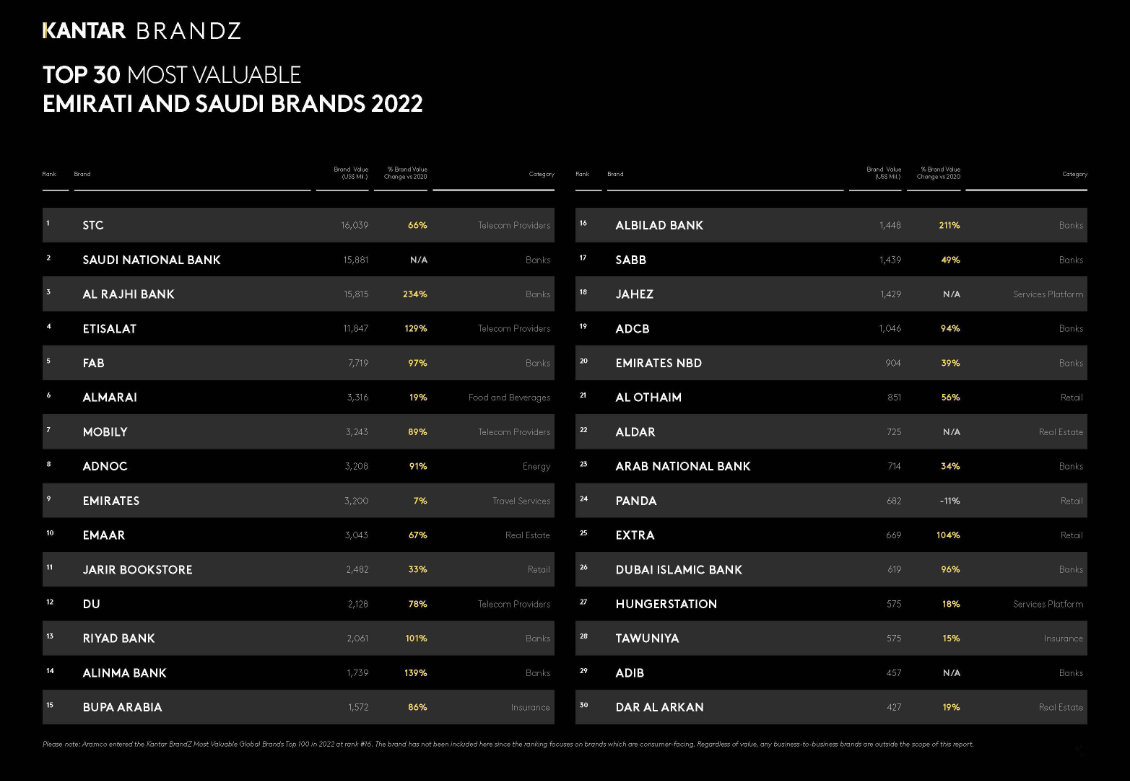
Telecom giant STC is the most valuable brand across the UAE and the Kingdom, as well as in Saudi Arabia, increasing its brand value to $16 billion (+66 percent). The brand has benefitted from both the rollout of 5G, as well as a major diversification in its offer to include digital payments and entertainment services, according to Kantar.
The company’s “DARE” strategy — Digitalize, Accelerate, Reinvent and Expand — is providing a strong sense of direction and rapid transformation.
The No. 1 brand in the UAE is also a telecom company, Etisalat, which rebranded as e& earlier this year. The group’s repositioning as a global conglomerate has resulted in it witnessing a 129 percent increase in brand value from 2020 to $11.8 billion.
Online food-delivery platform Jahez is a new entrant at No. 18, with a brand value of $1.4 billion. The brand has expanded into new cities and new categories, creating new markets in partnership with grocery and non-food retailers. It has also established PIK, a direct commerce platform, which allows local merchants to reach more consumers.
Earlier this year, Jahez was listed on the Saudi Stock Exchange, becoming the first start-up publicly traded in the Kingdom of Saudi Arabia.
Other newcomers on the ranking include the newly merged Saudi National Bank, which was formed from the merger of National Commercial Bank (NCB) and Samba; real estate brand Aldar and banking brand ADIB.
The ranking highlights the broadening of both economies, with new entrants from lifestyle categories, banking and real estate plus a rise of travel brands following the end of the pandemic.
The banking sector is the most prominent in the ranking, responsible for nearly half (47 percent) of the top 30’s total brand value after rising by 187 percent in total category value.
Saudi Arabia’s banking sector saw the fastest risers in the 2022 ranking, with triple-digit growth for the likes of Al Rajhi Bank (No. 3), which was up by 234 percent; Alinma Bank (No. 14), which was up by 139 percent, and Al Bilad Bank (No. 16), which was up by 211 percent.
New entrant Saudi National Bank (SNB) further ups the tally for the category, coming in second overall with a brand value of $15.9 billion.
In the UAE, local banks lead the charge with FAB at No.5, ADCB at No.19, Emirates NBD at No. 20 and Dubai Islamic Bank at No. 26 witnessing impressive growths of 97 percent, 94 percent, 39 percent and 96 percent respectively since the 2020 ranking.
Impressive rises across a broad range of categories, including real estate, reflect the fact that governments have taken a long-term view on investments such as the Neom sustainable city in Saudi Arabia, and the UAE’s bid to become the region’s arts and cultural hub, according to the report.
This stability has boosted the attractiveness to foreign investors whose continued investment helps create a positive economic outlook, which bodes well for both businesses and brands, the report added.
Ghate said: “By investing in their equity and creating a meaningful difference for their brand, they (the UAE and Saudi Arabia) have amplified their salience to win more with consumers in today’s fast-paced and competitive brand world.”


