

Saudi-German cooperation boosted by delegation’s visit, envoy says

1 / 3
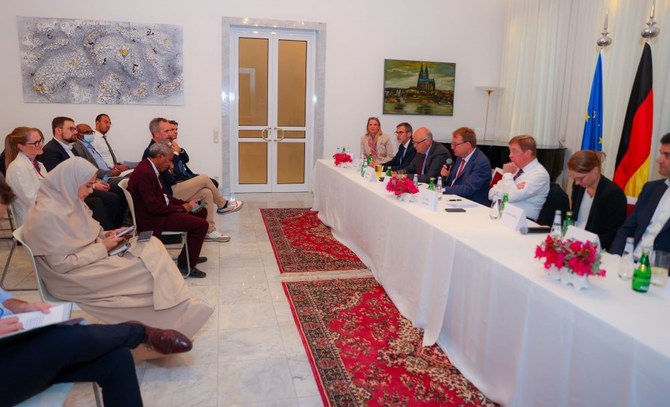
The German Embassy in Riyadh hosted a press conference to discuss points of cooperation with Saudi Arabia. (AN Photo/Saad Al-Dossari)
2 / 3
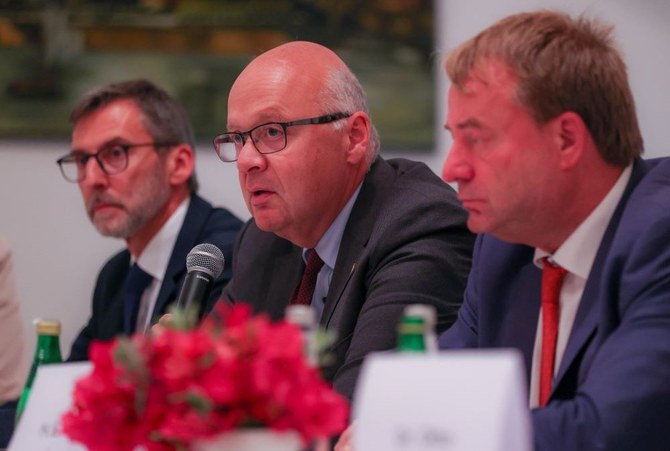
The German Embassy in Riyadh hosted a press conference to discuss points of cooperation with Saudi Arabia. (AN Photo/Saad Al-Dossari)
3 / 3
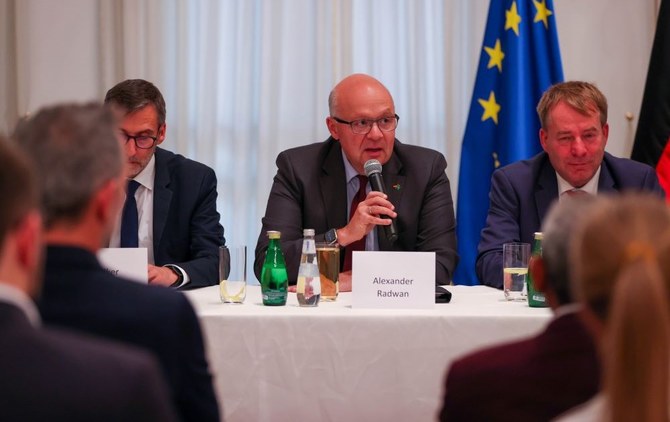
The German Embassy in Riyadh hosted a press conference to discuss points of cooperation with Saudi Arabia. (AN Photo/Saad Al-Dossari)
Short Url
Updated 02 November 2022
Follow

Saudi-German cooperation boosted by delegation’s visit, envoy says

  • ‘Things are moving in the right direction,’ German Ambassador to Kingdom Dieter Lamle says
  • Trip came after Chancellor Olaf Scholz visited Kingdom in September

RIYADH: The visit of a German delegation to Saudi Arabia has been hailed a success by the European nation’s embassy in Riyadh and could pave the way for greater cooperation between the two countries.

The trip came just weeks after German Chancellor Olaf Scholz visited Saudi Arabia in September.

“We had the visit of the federal Chancellor Olaf Scholz on Sept. 24 and I think that to have seven German delegates in Saudi Arabia six weeks later is a very, very good sign that things are moving in the right direction,” German Ambassador to the Kingdom Dieter Lamle said during a panel discussion hosted by the mission.

Scholz met Crown Prince Mohammed bin Salman in Jeddah during a two-day tour of the Gulf region. The pair discussed regional and international issues, the possibility of greater cooperation on energy and how Germany might be able to support Saudi Vision 2030.

Lamle said he welcomed the delegation of German politicians, academics and culture experts — headed by Otto Wiesheu, president of the German-Arab Friendship Association — to Riyadh to discuss the chancellor’s visit and opportunities for more cooperation with the Kingdom.

“We had a press conference with the German delegation that was visiting Saudi Arabia from Bavaria,” Lamle said.

“We had a business dialogue and a very intense dialogue with two universities here in Saudi Arabia to see where our fields of cooperation (might be) … and we agreed on the next steps.”

Members of the delegation had earlier visited King Saud University and King Faisal University where they discussed the possibility of setting up a student exchange program. They also spoke to the Shoura Council and members of the Saudi and German business communities.

During the panel discussion the delegates spoke of the importance of Saudi-German corporation in business, while Lamle stressed the need for regular dialogue between the two countries.

“I think relations live off visits … from Saudi Arabia to Germany and from Germany to Saudi Arabia, because they increase mutual understanding,” he said.

The success of the delegates’ visit and the positive message they would take back home with them would stimulate even more visitors and more cooperation, he added.

Among the visiting delegates were Alexander Radwan, a member of the German Bundestag who serves on the foreign affairs committee, Houssam Maarouf, vice president of the German-Arab Friendship Association, Kai-Olaf Hinrichsen, a professor at the Technical University of Munich, and Volker Leinweber, managing director of the Bavarian Industry Association.


Local ZUMI thermos bottle has heritage-inspired design

Updated 30 January 2026
Follow

Local ZUMI thermos bottle has heritage-inspired design

  • References Zamzam and Hajar’s search for water
  • Helps to tell Kingdom’s story, says firm Teeb Made

ZUMI, a thermos bottle unveiled this month by Saudi Arabia brand Teeb Made, has a design referencing local memory, ritual and place, according to its producers.

“We believe meaningful design can influence how people live, feel, and connect,” said Abeer Alessa, CEO of The Bold Group and co-founder of Teeb Made.

“ZUMI draws from our heritage yet speaks to a global audience seeking intention and authenticity in the objects they choose.”

Developed under The Bold Group, ZUMI reflects a growing movement within Saudi Arabia’s creative sector to translate cultural narratives into tangible products.

Rather than following global design trends, the team focused on grounding the product in a story that resonates locally while remaining accessible internationally.

Above, the team behind Zumi.

The name ZUMI is inspired by Hajar’s call, “Zummi, zummi,” meaning “gather, gather,” during her search for water for her son Ismail between the hills of Safa and Marwah.

That moment led to the emergence of Zamzam water, a source revered for centuries and deeply embedded in Islamic and Saudi identity. For the creators, this origin story became the philosophical core of the product.

“Culture starts with a story,” Alessa explained. “With Teeb Made, we wanted to tell our story not only through communication, but through a product you can touch, live with, and keep close to you.”

Visually, ZUMI draws inspiration from the dorag, the historical vessel used by the Zamazmah men of Makkah to serve Zamzam water to pilgrims for more than 1,400 years.

Traditionally utilitarian, the dorag carried spiritual weight through its purpose rather than ornamentation. Teeb Made reinterpreted this form into a minimal, contemporary silhouette suited for modern lifestyles.

“We wanted ZUMI to be a vessel of meaning, not just water,” said Mohamad Baalbaki, executive creative director of The Bold Group and co-founder of Teeb Made.

“Its form, its patented base, and its simplicity all serve one purpose: to create something that feels familiar, timeless, and deeply personal.”

“We believe meaningful design can influence how people live, feel, and connect,” said Abeer Alessa, CEO of The Bold Group and co-founder of Teeb Made. (Supplied)

The design process was extensive. Translating a historical silhouette into a thermos bottle required more than 18 months of research and development.

The final product received a patented design certification from the Saudi Ministry of Culture, marking a milestone in original Saudi intellectual property within product design.

One of ZUMI’s most talked-about features is that it does not stand upright. This decision was entirely intentional.

“We wanted people to carry it, not leave it on a table,” Baalbaki said. “It’s a statement piece, but more importantly, it’s a personal object that invites interaction and conversation.”

Color selection further reinforces the connection to place. The launch collection features hues inspired by Saudi landscapes, including tin (mud), forest, and matar (rain), reflecting the Kingdom’s environmental diversity and grounding the product visually in its origins.

“ZUMI is a product with a Saudi story that is scalable and built to last,” said Souad Merheb, general manager of Teeb Made. “Our vision is to create intellectual property that can live long, grow as a brand, and carry these stories to new generations without losing their meaning.”

“Teeb Made is, at its core, a product design company,” Merheb added. “Our expertise lies in design and creativity, and ZUMI is a reflection of that focus, a piece of IP developed with intention, patience, and depth.”

“There are many rich and insightful stories in Saudi Arabia that remain untapped,” Alessa said. “With ZUMI, this is just the beginning.”

Beyond the product itself, ZUMI aligns with broader national efforts to elevate Saudi culture through the creative economy.

Teeb Made has engaged with several government entities and cultural platforms that recognize the value of culturally rooted products in shaping global perceptions of the Kingdom.

“Today, every Saudi has a role in telling our story to the world,” Alessa said. “For us, it is an honor to contribute to that narrative through design.”

ZUMI also signals the beginning of a wider design ecosystem under Teeb Made, with future editions and complementary accessories already in development.

According to the team, this is only the first chapter in a larger effort to revive untapped cultural stories through modern design.

ZUMI is available at www.zumibottle.com and on Instagram @zumibottle.