LONDON: What3words, a global address system, is focusing on developing partnerships in Saudi Arabia with government and private sectors, ranging from emergency services and ride-hailing apps to deliveries and logistics.
Chris Sheldrick, co-founder and CEO of what3words, said establishing a solid foothold in the Kingdom is his company’s main focus in the region, with more “really exciting” expansion opportunities to come.
“We’re incredibly excited about Saudi’s plans over the next decade. Vision 2030 and infrastructure are a huge part of that, and I think we see ourselves as addressing infrastructure to be able to get wherever you want to go. With the rapid pace of development you’re seeing around the country, it just means that what3words and the services we work with can start operating straight away once something new is built,” he told Arab News in an exclusive interview.
Sheldrick, who has worked in the music industry and organized live events around the world, found that, particularly with large venues or when traveling in a foreign country, people experienced navigation issues, as addresses were inaccurate or not precise enough.
In 2013, Sheldrick co-founded what3words with three friends, Jack Waley-Cohen, Mohan Ganesalingam and Michael Dent. They developed an algorithm and split the world into 57 trillion three-meter squares, each named with three unique words from the dictionary in 54 languages.
“It’s been a really interesting experience developing the system in so many different languages,” he said. “Of course, with things like Arabic, you have right to left, with Vietnamese, you have spaces in the middle of words, there are some languages in Cyrillic character sets, but fundamentally, what3words does work exactly the same in all of those languages.”
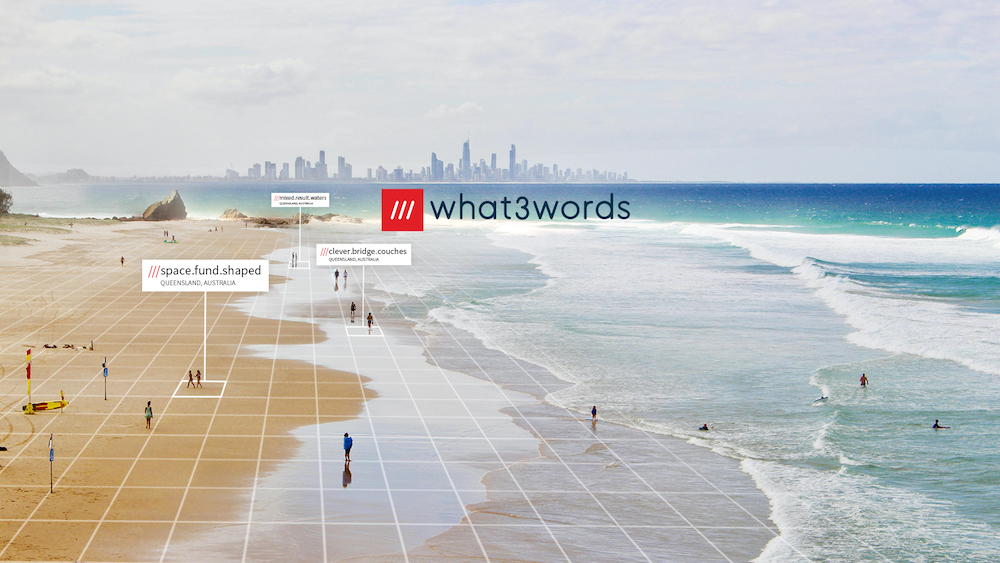
The three-word GPS system is particularly useful in Saudi Arabia as it can pinpoint exact locations in the middle of the desert, the mountainous regions, and the sea. (Supplied/what3words)
In the UK, what3words is a “household name,” and millions of people around the world are using three-word addresses to find and share locations, said Sheldrick.
“We’re starting to now see the same thing happening across the Gulf region and in KSA.”
In the past few months they have made a number of visits to the Kingdom and done a lot of advertising work. People in Saudi Arabia are now downloading the app and they are starting to see business integrations as well.
Aramex was the first delivery company in the Gulf region to integrate what3words in its products, and more delivery companies are coming on board in Saudi Arabia, such as SLS Express, Zain e-commerce, as well as ride-hailing apps Careem and Jeeny, with food delivery soon to follow.
“So many times I’ve been in Riyadh or in Jeddah, and it’s been difficult to clarify the destination. You can now drop those three words right into the destination box with Careem and Jeeny to specify where you want to go,” he said.
What3words, which works with 85 percent of police, fire and ambulance services in the UK, has been partnering with the Saudi Red Crescent Authority since 2019.
The emergency medical service has encouraged Hajj pilgrims, especially, to use the app, which can save precious time when urgent medical treatment is needed.
Sheldrick said that talks are taking place with government agencies to form similar partnerships on a nationwide level.
The three-word GPS system is particularly useful in Saudi Arabia as it can pinpoint exact locations in the middle of the desert during camping season, in the mountainous regions while trekking, and at sea when diving.

Chris Sheldrick, co-founder and CEO of what3words, said establishing a solid foothold in Saudi Arabia is his company’s main focus in the region. (Supplied/what3words)
“It’s so exciting up in AlUla, just seeing things like Habitas AlUla now taking shape there, which are great projects further north, of course, in NEOM as well, and we would love to be a part of any of these really exciting, groundbreaking projects,” he added.
Although the company’s primary focus is Saudi Arabia, it has also set up partnerships in the UAE, Egypt and Oman in an effort to take a regional approach to expansion in the Middle East.
“We see the Middle East as a region that has often struggled with address infrastructure. But, of course, with the on-demand economy absolutely exploding, we think that the Middle East and Asia are key regions for what3words to be successful, and ultimately become a global standard for location,” Sheldrick said.