

Dhaka eyes opportunity to send health workers to Saudi Arabia

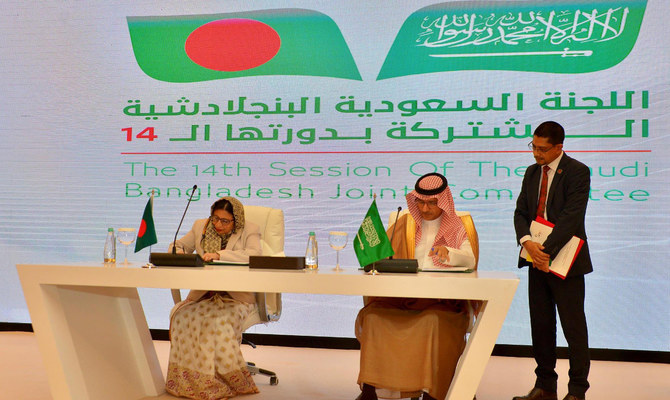
The MoU signing to establish a Saudi-Bangladesh business council. (SPA)
Short Url
Updated 01 November 2022
Follow

Dhaka eyes opportunity to send health workers to Saudi Arabia

  • Only about 50 Bangladeshi clinicians reside in the Kingdom
  • Bangladesh health sector struggling to employ medical graduates

DHAKA: Bangladesh is eyeing a new opportunity to send its clinicians to Saudi Arabia, officials said on Wednesday, after an initial agreement was reached during a Bangladesh-Saudi Arabia Joint Commission meeting in Riyadh.

The 14th session of the joint commission took place on Oct. 30-31, focusing on wide-ranging cooperation, including in the fields of energy, security, labor, investment and health.

During the meeting, the two countries agreed to form a business council to increase trade and a task force to enhance energy cooperation. The two sides also signed an expedited memorandum of understanding for the recruitment of Bangladeshi medics.

“We agreed to initiate an executive program to bring Bangladeshi health sector professionals into the Kingdom. Under this program, Bangladeshi doctors, nurses and other health professionals will get the opportunity to work in the Kingdom,” Dr. Mohammad Javed Patwary, Bangladeshi envoy to Riyadh and permanent representative to the Organization of Islamic Cooperation, told Arab News.

“A big development took place on this point,” he added.

“I hope this program will move forward very fast. It’s almost final and I hope the deal will be signed shortly.”

According to Bangladesh Medical Association data, only about 50 Bangladeshi clinicians reside the Kingdom, which otherwise is home to some 2.5 million expat workers from the South Asian country.

The potential to increase that number would not only enhance the Kingdom’s workforce in the health sector, but would also be an investment in the quality of Bangladeshi medics, given the top quality of equipment at Saudi clinics, according to Dr. Ehteshamul Huq Choudhury, the medical association’s secretary general.

“Sending health workers to the Kingdom will create win-win opportunities for both countries. Hospitals in the Kingdom are very well equipped with state-of-the-art technology. When our doctors and nurses work with this equipment, it will obviously increase their skills also,” Choudhury told Arab News.

“Eventually, when they return home with these skills, they will be able to serve the people back home.”

Employment abroad would also help them to retain their profession, as thousands of medical graduates in Bangladesh are now without jobs despite their high education levels.

Bangladesh’s more than 100 medical colleges produce large numbers of certified doctors, and many nursing graduates have completed master’s degrees. But the country’s health infrastructure is unable to accommodate them all.

“At present we have 110,000 registered doctors in the country while there are 123,000 trained nurses. Of them, the government health sector employs 40,000 doctors. The rest are either employed by the private sector or remain unemployed,” Choudhury said.

“As per my knowledge, around 30,000 doctors are currently unemployed,” he added.

“If these health workers remain unemployed for a longer period of time, their knowledge and skills will somehow derail.”

The number of clinicians Bangladesh could send to Saudi Arabia would depend on demand.

“But I think Saudi Arabia is in need of expert doctors, nurses and health technologists. This sort of shortage is seen in many parts of the world now, like in the UK, Australia etc.,” Choudhury said.

“Since we have a huge number of skilled doctors and trained nurses, we can send as many as the Kingdom requires.”


Youth voters take center stage in Bangladesh election after student-led regime change

Updated 4 sec ago
Follow

Youth voters take center stage in Bangladesh election after student-led regime change

  • About 45% of Bangladeshis eligible to vote in Thursday’s election are aged 18-33
  • Election follows 18 months of reforms after the end of Sheikh Hasina’s 15-year rule

DHAKA: When he goes to the polls on Thursday, Atikur Rahman Toha will vote for the first time, believing that this election can bring democratic change to Bangladesh.

A philosophy student at Dhaka University, Toha was already eligible to vote in the 2024 poll but, like many others, he opted out.

“I didn’t feel motivated to even go to vote,” he said. “That was a truly one-sided election. The election system was fully corrupted. That’s why I felt demotivated. But this time I am truly excited to exercise my voting rights for the first time.”

The January 2024 vote was widely criticized by both domestic and international observers and marred by a crackdown on the opposition and allegations of voter fraud.

But the victory of the Awami League of ex-Prime Minister Sheikh Hasina was short-lived, as a few months later the government was ousted by a student-led uprising, which ended the 15-year rule of Bangladesh’s longest-serving leader.

The interim administration, led by Nobel laureate Muhammad Yunus, took control in August 2024 and prepared a series of reforms to restructure the country’s political and institutional framework and organize the upcoming vote.

About 127.7 million Bangladeshis are eligible to cast their ballots, according to Election Commission data, with nearly a third of them, or 40.4 million, aged 18-29. Another 16.9 million are 30-33, making it a youth–dominated poll, with the voters hopeful the outcome will help continue the momentum of the 2024 student-led uprising.

“We haven’t yet fully transitioned into a democratic process. And there is no fully stable situation in the country,” Toha said. “After the election we truly hope that the situation will change.”

For Rawnak Jahan Rakamoni, also a Dhaka University student, who is graduating in information science, voting this time meant that her voice would count.

“We are feeling that we are heard, we will be heard, our opinion will matter,” she said.

“I think it is a very important moment for our country, because after many years of controversial elections, people are finally getting a chance to exercise their voting rights and people are hoping that this election will be more meaningful and credible. This should be a fair election.”

But despite the much wider representation than before, the upcoming vote will not be entirely inclusive in the absence of the Awami League, which still retains a significant foothold.

The Election Commission last year barred Hasina’s party from contesting the next national elections, after the government banned Awami League’s activities citing national security threats and a war crimes investigation against the party’s top leadership.

The UN Human Rights Office has estimated that between July 15 and Aug. 5, 2024 the former government and its security and intelligence apparatus, together with “violent elements” linked to the Awami League, “engaged systematically in serious human rights violations and abuses in a coordinated effort to suppress the protest movement.”

It estimated that at least 1,400 people were killed during the protests, with the majority shot dead from military rifles.

Rezwan Ahmed Rifat, a law student, wanted the new government to “ensure justice for the victims of the July (uprising), enforced disappearances, and other forms of torture” carried out by the previous regime.

The two main parties out of the 51 contesting Thursday’s vote are the Bangladesh Nationalist Party and Jamaat-e-Islami. Jamaat, which in 2013 was banned from political participation by Hasina’s government, heads an 11-party alliance, including the National Citizen Party formed by student leaders from the 2024 movement.

“I see this election as a turning point of our country’s democratic journey … It’s not just a normal election,” said Falguni Ahmed, a psychology student who will head to the polls convinced that no matter who wins, it will result in the “democratic accountability” of the next government.

Ahmed added: “People are not voting only for their leaders; they are also voting for the restoration of democratic credibility. That’s why this election is very different.”