

Brickbats for struggling Babar Azam as World Cup exit looms

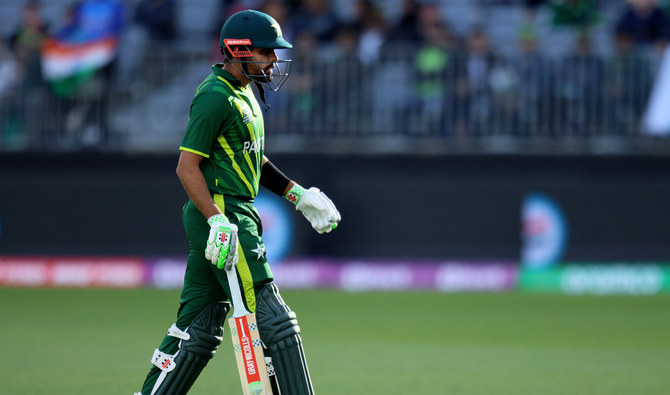
Pakistan's Captain Babar Azam walks off the field after his dismissal during the ICC men's Twenty20 World Cup 2022 cricket match between Pakistan and Netherlands at the Perth Stadium on October 30, 2022 in Perth. (AFP)
Short Url
Updated 01 November 2022
Follow

Brickbats for struggling Babar Azam as World Cup exit looms

  • Babar Azam scored the most runs at last year’s World Cup in taking his country to the semifinals
  • But Azam, ranked among the best, has scored just eight runs in three matches so far in Australia

PERTH: Babar Azam was supposed to lead Pakistan to Twenty20 World Cup glory but his side are on the brink of an early exit and the usually inspirational skipper is facing growing questions about his batting and leadership.

Azam scored the most runs at last year’s World Cup in taking his country to the semifinals, where they lost to eventual champions Australia.

But the player ranked among the best batsmen in the world has scored just eight runs in three matches so far in Australia.

He got out for a first-ball duck in Pakistan’s agonizing last-ball defeat to arch-rivals India in their first game of the tournament.

The 28-year-old Azam then made four as the team lost by one run against Zimbabwe in a shock defeat.

Pakistan finally managed a win over the Netherlands in their third Super 12 match on Sunday, but they lost four wickets including Azam run out on four while chasing 91.

They play South Africa on Thursday in Sydney and must win their remaining two matches and hope other results go their way to stand any chance of making the semifinals.

Azam’s struggles have reflected a wider malaise among the Pakistani batsmen at the World Cup.

“Even when they score runs, why we lose? Because of the way they score runs,” said former captain Waqar Younis, also taking aim at Azam’s opening partner Mohammad Rizwan, referring to their scoring rates.

The strike rates of Babar 129.19 and Rizwan (127.11) are below some other T20 openers including South Africa’s Quinton de Kock (136.14) and Indian skipper Rohit Sharma (140.13).

Azam was ranked the leading batsman in the world in T20 international cricket before being displaced by Rizwan during the Asia Cup in September.

Azam has since slipped to fourth but still holds the top position in the ODI chart.

“I think Babar sometimes plays for himself,” another former captain, Wasim Akram, said previously in suggesting the opening batsman drop down the order in the Pakistan Super League. The skipper wasn’t comfortable with the idea.

Waqar called Azam “insecure” and also took aim at his ability as a captain.

“There is a difference between a captain and a leader,” Waqar told a chat show.

When India’s superstar batsman Virat Kohli was in a slump earlier this year, Azam backed him to climb out of it, tweeting: “This too shall pass. Stay strong.”

That tweet came back to haunt Azam when former India spinner Amit Mishra sarcastically aimed it back at the Pakistani batsman after another low score against the Dutch.

Vice-captain Shadab Khan jumped to the defense of his leader after the six-wicket victory over the Dutch in Perth.

“He’s a world-class player, no doubt about that, but he’s human also. Sometimes humans make mistakes, but he’s our leader, he’s our best captain,” said Shadab.

“He supports us, so we have to support him now. He’s one shot away (from regaining form).”

Former captain Shahid Afridi also expects Azam, who still averages over 42 in 95 T20 internationals since making his debut in 2016, to prove his doubters wrong.

“Two to three bad games don’t make you a bad player!” Afridi said on Twitter.

“Babar Azam is our most consistent performer, he needs our support and backing.

“He will be back with a big match-winning innings soon.”


Pakistan to promote mineral sector at Saudi forum this month with 13 companies

Updated 02 January 2026
Follow

Pakistan to promote mineral sector at Saudi forum this month with 13 companies

  • Delegation will take part in the Future Minerals Forum in Riyadh from Jan. 13-15
  • Petroleum minister will lead Pakistan, participate in a 90-minute country session

ISLAMABAD: Around 13 Pakistani state-owned and private companies will attend the Future Minerals Forum (FMF) in Saudi Arabia from Jan. 13 to 15, an official statement said on Friday, as the country seeks to ramp up global engagement to develop its mineral resources.

The FMF is an international conference and investment platform for the mining sector, hosted by mineral-rich countries to attract global investors, companies and governments.

Petroleum Minister Ali Pervaiz Malik confirmed Pakistan’s participation in a meeting with the Saudi envoy, Nawaf bin Said Al-Malki.

Pakistan hosts one of the world’s largest copper-gold zones. The Reko Diq mine in southwestern Balochistan, with an estimated 5.9 billion tons of ore, is partly owned by Barrick Gold, which calls it one of the world’s largest underdeveloped copper-gold deposits. Its development is expected to boost Pakistan’s struggling economy.

“Upon an invitation of the Government of the Kingdom of Saudi Arabia, the Federal Minister informed the Ambassador that Pakistan will fully participate in the upcoming Future Minerals Forum (FMF), scheduled to be held in Riyadh later this month,” Pakistan’s Press Information Department (PID) said in an official statement.

The Pakistani minister will lead his country’s delegation at the FMF and take part in a 90-minute country showcase session titled “Unleashing Potential: Accelerating Pakistan’s Mineral Revolution” along with local and foreign investors.

Pakistan will also establish a dedicated pavilion to highlight the vast potential of its rich geological landscape to the global mineral community.

The Saudi envoy welcomed Pakistan’s decision to participate in the forum and discussed enhancing bilateral cooperation in the minerals and energy sectors during the meeting.

According to the statement, he highlighted the potential for cooperation between Saudi Arabia and Pakistan in the minerals and energy sectors, expressing confidence that the FMF would provide a platform to expand collaboration.
Pakistan’s mineral sector, despite its rich reserves of salt, copper, gold and coal, contributes only 3.2 percent to the country’s GDP and just 0.1 percent to global mineral exports.

However, many countries, including the United States, have shown interest in Pakistan’s underdeveloped mineral sector, particularly in copper, gold and other critical resources.

In October, Pakistan dispatched its first-ever shipment of rare earth and critical minerals to the United States, according to a Chicago-based US public relations firm’s report.