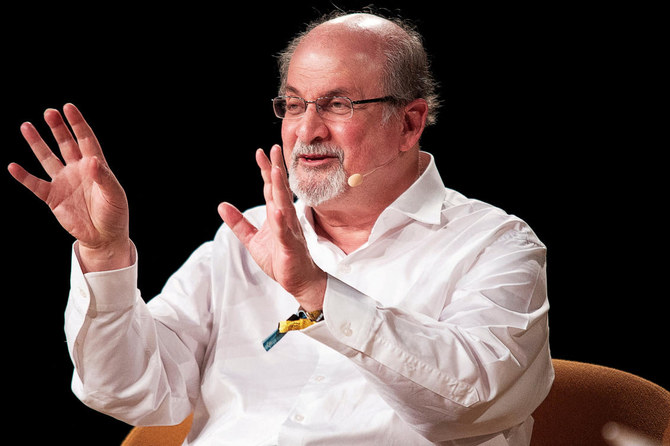
NEW YORK: The United States on Friday imposed sanctions on the Iran-based foundation that issued a multi-million-dollar bounty on the life of acclaimed “Satanic Verses” author Salman Rushdie, who was brutally attacked in August.
The sanctions are aimed at the “15 Khordad Foundation,” which the US Treasury Department says is affiliated with deceased Supreme Leader Ayatollah Ruhollah Khomeini, who originally issued a fatwa calling for Rushdie’s death in 1989.
A statement from US Secretary of State Antony Blinken said the United States is designating the group “for providing financial support for an act of terrorism.”
The foundation “maintains a multi-million dollar bounty on Rushdie,” the Treasury Department said, adding that as recently as 2012 the organization increased the bounty to $3.3 million.
In August Rushdie, 75, was stabbed several times in the neck and abdomen before he was due to give a talk in the state of New York.
He was air-lifted to a nearby hospital for emergency surgery, and though his condition improved in subsequent weeks, his agent has said the writer lost sight in one eye.
The British-American author had lived in hiding for years after Iran’s first supreme leader ordered Rushdie’s killing for what he deemed the blasphemous nature of “The Satanic Verses.”
The main suspect, Hadi Matar, a 24-year-old from New Jersey with roots in Lebanon, was arrested immediately after the attack on Rushdie. He pleaded not guilty during a hearing in New York state in mid-August.
The attack sparked outrage in the West but was praised by extremists in Muslim countries like Iran and Pakistan.
“The infamous fatwa was intended to incite terrorism and violence, bring about the death of Rushdie and his associates, and intimidate others,” Blinken’s statement on Friday read. “The United States condemns such incitement and the attack on Rushdie in the strongest terms as a blatant assault on freedom of speech and an act of terrorism.”

US sanctions Iran-based foundation over Salman Rushdie bounty
Short Url
https://arab.news/wbx5h
US sanctions Iran-based foundation over Salman Rushdie bounty
- Blinken said the United States is designating the group “for providing financial support for an act of terrorism”
- British-American author lived in hiding for years after Iran’s first supreme leader ordered his killing
Long-delayed decision due on Chinese mega-embassy in London
LONDON: The UK government is Tuesday due to rule on plans for a sprawling Chinese mega-embassy in central London, amid security concerns and ahead of Prime Minister Keir Starmer’s expected visit to China.
Beijing’s proposal for a new embassy on the historic site of the former Royal Mint — a stone’s throw from the Tower of London — has been dogged by delays since China bought it in 2018.
If the relocation from its current site in London’s upmarket Marylebone area is approved, it would be the largest embassy complex in the UK by area, and one of the largest embassies in the heart of a Western capital.
But the move has faced fierce opposition from residents, rights groups and critics of China’s ruling Communist Party who fear the site could be used to surveil and harass dissidents.
The embassy proposal has proved to be particularly sensitive domestically, and appears to be a sticking point in bilateral ties as well.
The UK’s plans to redevelop its own embassy in China are also reportedly being held up.
Starmer is expected to visit China later this month, according to British media — although the trip has not yet been confirmed by Downing Street — as he tries to reset ties with the economic powerhouse.
If it goes ahead, it would be the first visit by a UK prime minister since 2018, after ties between London and Beijing fell to new lows under the previous Conservative government.
But the embassy plans, domestic furor over a collapsed case against two British men accused of spying for China, and the conviction of media mogul and British citizen Jimmy Lai in Hong Kong on two national security charges could make for an eventful first visit for Starmer.
While UK media reported that the development is likely to receive the green light this week, a refusal would not go down well in China.
When the decision was postponed once again in December, China’s foreign ministry spokesman Lin Jian said Beijing was “deeply concerned” and “strongly dissatisfied.”
Meanwhile, Starmer last month acknowledged that while China provided significant economic opportunities for the UK, it also posed “real national security threats.”
- ‘Spy embassy’ -
Last week, The Daily Telegraph reported the new embassy site would house 208 underground rooms, including a “hidden chamber,” according to unredacted plans obtained by the daily newspaper.
The vast site would also run alongside sensitive underground Internet cables, with the unredacted plans showing that Beijing would demolish and rebuild a wall between the cables and the embassy.
The high-speed Internet cables connect to the City of London financial district, with the Telegraph raising concerns that they could be tapped underground.
Hundreds rallied against the impending decision outside the proposed site on the weekend.
“We cannot allow the Chinese to build this spy embassy in an area so crucial to our national security,” said opposition Conservative party leader Kemi Badenoch.
A protester in London who gave his name only as Brandon, for fear of reprisals, told AFP on Saturday that the plans raised a “lot of concerns.”
“I don’t think it’s good for anyone except the Chinese government,” said the 23-year-old bank employee who moved to the United Kingdom from Hong Kong.
Clara, a protester also originally from Hong Kong, said she was “really afraid of transnational repression that China can impose on us.”
“UK government, why are you still endorsing it?“
Local residents could meanwhile also launch a legal challenge against approval further delaying the project.
Beijing’s proposal for a new embassy on the historic site of the former Royal Mint — a stone’s throw from the Tower of London — has been dogged by delays since China bought it in 2018.
If the relocation from its current site in London’s upmarket Marylebone area is approved, it would be the largest embassy complex in the UK by area, and one of the largest embassies in the heart of a Western capital.
But the move has faced fierce opposition from residents, rights groups and critics of China’s ruling Communist Party who fear the site could be used to surveil and harass dissidents.
The embassy proposal has proved to be particularly sensitive domestically, and appears to be a sticking point in bilateral ties as well.
The UK’s plans to redevelop its own embassy in China are also reportedly being held up.
Starmer is expected to visit China later this month, according to British media — although the trip has not yet been confirmed by Downing Street — as he tries to reset ties with the economic powerhouse.
If it goes ahead, it would be the first visit by a UK prime minister since 2018, after ties between London and Beijing fell to new lows under the previous Conservative government.
But the embassy plans, domestic furor over a collapsed case against two British men accused of spying for China, and the conviction of media mogul and British citizen Jimmy Lai in Hong Kong on two national security charges could make for an eventful first visit for Starmer.
While UK media reported that the development is likely to receive the green light this week, a refusal would not go down well in China.
When the decision was postponed once again in December, China’s foreign ministry spokesman Lin Jian said Beijing was “deeply concerned” and “strongly dissatisfied.”
Meanwhile, Starmer last month acknowledged that while China provided significant economic opportunities for the UK, it also posed “real national security threats.”
- ‘Spy embassy’ -
Last week, The Daily Telegraph reported the new embassy site would house 208 underground rooms, including a “hidden chamber,” according to unredacted plans obtained by the daily newspaper.
The vast site would also run alongside sensitive underground Internet cables, with the unredacted plans showing that Beijing would demolish and rebuild a wall between the cables and the embassy.
The high-speed Internet cables connect to the City of London financial district, with the Telegraph raising concerns that they could be tapped underground.
Hundreds rallied against the impending decision outside the proposed site on the weekend.
“We cannot allow the Chinese to build this spy embassy in an area so crucial to our national security,” said opposition Conservative party leader Kemi Badenoch.
A protester in London who gave his name only as Brandon, for fear of reprisals, told AFP on Saturday that the plans raised a “lot of concerns.”
“I don’t think it’s good for anyone except the Chinese government,” said the 23-year-old bank employee who moved to the United Kingdom from Hong Kong.
Clara, a protester also originally from Hong Kong, said she was “really afraid of transnational repression that China can impose on us.”
“UK government, why are you still endorsing it?“
Local residents could meanwhile also launch a legal challenge against approval further delaying the project.
© 2026 SAUDI RESEARCH & PUBLISHING COMPANY, All Rights Reserved And subject to Terms of Use Agreement.


