TRENTON: At a pizzeria along a noisy Ohio highway, Matt Kruse and his family have come to hear J.D. Vance, a Republican Senate candidate who has seized on soaring inflation as the pillar of his campaign.
Kruse, holding a daughter in his arms, is an eager listener, already angry about “runaway inflation.” The message he wants the US midterm elections to send to Democrats is clear: “Stop spending money.”
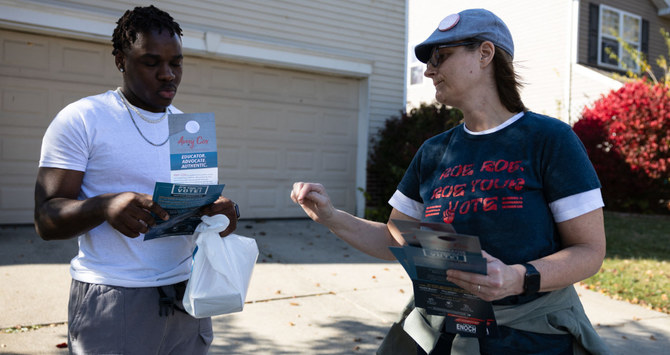
An hour’s drive away, the tone is different: a dark minivan cruises slowly along a suburban street, looking for a specific house number. “This has to be 800,” says Amy Cox, who gets out to hang a flyer on the front door.
Back behind the wheel, with a dog Toby sitting by the handbrake, the Democratic candidate for state office explains she is campaigning for what moves her — abortion — because for many women “their rights are way more important than inflation.”
With the approach of elections seen by both parties as hugely consequential, one issue is overwhelming all others: soaring prices.
And in the residential towns of Ohio, where Halloween pumpkins and election signs are numerous, Republicans are trying to exploit this theme to rally voters — while Democrats, determined to defend abortion rights, tend to dodge it.
To buy food for one’s family, “Now, you’re spending on one trip $350, $400, you know, for a family of four,” says Kruse, a short- haired man who works in law enforcement. “In the past, it was costing you under 200 bucks.”
“When they talk about abortion or whatever like that, that doesn’t affect everybody. Inflation affects every single person,” Kruse adds.
That is particularly true in Ohio, gateway to the agricultural Midwest, where “a majority... are middle-class working people.”
Until recently Ohio was America’s premier electoral bellwether, holding up a political mirror to the vast nation as the state voted for every presidential winner since 1960.
But that bell was unrung in 2020 when Donald Trump won the state decisively while losing the White House to Democrat Joe Biden — and experts have predicted Ohio will continue tilting rightward.
That dynamic could well benefit J.D. Vance, one of many Republicans pinning blame for cost-of-living woes squarely on Biden.
“The inflation that we’re going through right now in this country is a tax on the middle class,” Vance hammers out in Mt. Orab, where Kruse and his family came to hear him.
In 2020, Brown County surrounding Mt. Orab voted 78 percent for Trump, who is supporting Vance in one of the country’s most-watched duels.
In jeans and white shirt, the 38-year-old bemoans the soaring price of eggs — “it’s crazy” — while 30 or so curious sympathizers and local voters nod in agreement.
Vance makes sure to recall his own humble origins, which he recounted in his best-selling 2016 memoir, “Hillbilly Elegy.”
“We have got to get back to a country where people like my mamaw can go to the grocery store without completely breaking the bank,” he says.
“If the Democrats keep printing money... it’s gonna get worse and we have to stop that,” said Angela Marlow, an annoyed tone to her voice. “We’ve got to get our financial house in order.”
The 58-year-old mother of nine said she believes the state of the economy is pushing voters to cast ballots for Republicans.
Inflation is close to a 40-year high and by far the top concern for American voters.
But the Supreme Court’s June ruling reversing a constitutional right to abortion has also shaken the country, women in particular.
So it is with cold anger that Cox, a 44-year-old mushroom farmer, campaigns along autumn-colored tree-lined roads in Trenton, near the Indiana border.
A cap on her head, Cox paces across a yard and knocks on a door. An elderly woman opens, and Cox hands her a leaflet bearing her name and that of Tim Ryan, a Democratic congressman vying with Vance for Ohio’s open Senate seat.
“Are you going to vote on election day?” Cox asks.
“I vote at every election,” the woman responds, sending Cox into a short spiel: “We’re all about higher wages, better health care, better education for our kids, safer communities, and taking care of people — especially women.”
The first point in her campaign flyer: a defense of abortion rights.
Cox climbs back into her van, joining Melissa VanDyke, who is also a candidate for the Ohio House of Representatives but from a neighboring district.
“I don’t campaign on inflation, no, because we don’t call it inflation. We call it corporate greed,” VanDyke says.
The priority for her volunteers: phoning young women in conservative households to convince them to vote Democratic. Many white working-class men, VanDyke says, are “lost” to her party already.

Inflation vs abortion: two issues at play in US midterms
https://arab.news/95yvf
Inflation vs abortion: two issues at play in US midterms
EU leaders work into the night to ease Belgian fears of Russian retaliation over a loan to Ukraine
BRUSSELS: European Union leaders worked into the night on Thursday, seeking to reassure Belgium that they would provide guarantees to protect it from Russian retaliation if it backs a massive loan for Ukraine. Ukraine’s Volodymyr Zelensky meanwhile pleaded for a quick decision to keep Ukraine afloat in the new year.
At a summit in Brussels with high stakes for both the EU and Ukraine, leaders of the 27-nation bloc discussed how best to use tens of billions of euros in frozen Russian assets to underwrite a loan to meet Ukraine’s military and financial needs over the next two years.
The bulk of the assets — some 193 billion euros as of September — are held in the Brussels-based financial clearing house Euroclear. Russia’s Central Bank launched a lawsuit against Euroclear last week.
“Give me a parachute and we’ll all jump together,” Belgian Prime Minister Bart De Wever told lawmakers ahead of the summit. “If we have confidence in the parachute that shouldn’t be a problem.”
Belgian concerns over Russian pressure
Belgium fears that Russia will strike back and wants the bloc to borrow the money on international markets. It says frozen assets held in other European countries should be thrown into the pot as well, and that its partners should guarantee that Euroclear will have the funds it needs should it come under legal attack.
An estimated 25 billion euros in Russian assets are frozen in banks and financial institutions in other EU countries, including France, Germany and Luxembourg.
The Russian Central Bank’s lawsuit ramped up pressure on Belgium and its EU partners ahead of the summit.
The “reparations loan” plan would see the EU lend 90 billion euros to Ukraine. Countries like the United Kingdom, which said Thursday it is prepared to share the risk, as well as Canada and Norway would help make up any shortfall.
Russia’s claim to the assets would still stand, but the assets would remain locked away at least until the Kremlin ends its war on Ukraine and pays for the massive damage it caused.
In mapping out the loan plan, the European Commission set up safeguards to protect Belgium, but De Wever remained unconvinced and EU envoys were working late on Thursday to address his concerns.
Zelensky describes it as a moral question
Soon after arriving in Brussels, the Ukrainian president sat down with the Belgian prime minister to make his case for freeing up the frozen funds. The war-ravaged country is at risk of bankruptcy and needs new money by spring.
“Ukraine has the right to this money because Russia is destroying us, and to use these assets against these attacks is absolutely just,” Zelensky told a news conference.
In an appeal to Belgian citizens who share their leader’s worries about retaliation, Zelensky said: “One can fear certain legal steps in courts from the Russian Federation, but it’s not as scary as when Russia is at your borders.”
“So while Ukraine is defending Europe, you must help Ukraine,” he said.
Allies maintain support for Ukraine
Whatever method they use, the leaders have pledged to meet most of Ukraine’s needs in 2026 and 2027. The International Monetary Fund estimates that would amount to 137 billion euros .
“We have to find a solution today,” European Commission President Ursula von der Leyen told reporters. EU Council President António Costa, who is chairing the meeting, vowed to keep leaders negotiating until an agreement is reached, even if it takes days.
Polish Prime Minister Donald Tusk said it was a case of sending “either money today or blood tomorrow” to help Ukraine.
If enough countries object, the plan could be blocked. There is no majority support for a plan B of raising the funds on international markets, although that too was being discussed at the summit.
German Chancellor Friedrich Merz said that he hopes Belgium’s concerns can be addressed.
“The reactions of the Russian president in recent hours show how necessary this is. In my view, this is indeed the only option. We are basically faced with the choice of using European debt or Russian assets for Ukraine, and my opinion is clear: We must use the Russian assets.”
Hungary and Slovakia oppose a reparations loan. Apart from Belgium, Bulgaria, Italy and Malta are also undecided.
“I would not like a European Union in war,” said Hungarian Prime Minister Viktor Orbán, who sees himself as a peacemaker. He’s also Russian President Vladimir Putin’s closest ally in Europe. “To give money means war.”
Orbán described the loan plan as a “dead end.”
High stakes for the EU
The outcome of the summit has significant ramifications for Europe’s place in negotiations to end the war. The United States wants assurances that the Europeans are intent on supporting Ukraine financially and backing it militarily — even as negotiations to end the war drag on without substantial results.
The loan plan in particular also poses important challenges to the way the bloc goes about its business. Should a two-thirds majority of EU leaders decide to impose the scheme on Belgium, which has most to lose, the impact on decision-making in Europe would be profound.
The EU depends on consensus, and finding voting majorities and avoiding vetoes in the future could become infinitely more complex if one of the EU’s founding members is forced to weather an attack on its interests by its very own partners.
De Wever too must weigh whether the cost of holding out against a majority is worth the hit his government’s credibility would take in Europe.
Whatever is decided, the process does not end at this summit. Legal experts would have to convert any political deal into a workable agreement, and some national parliaments may have to weigh in before the loan money could start flowing to Ukraine.


