

League of Islamic Universities launches climate action on campuses

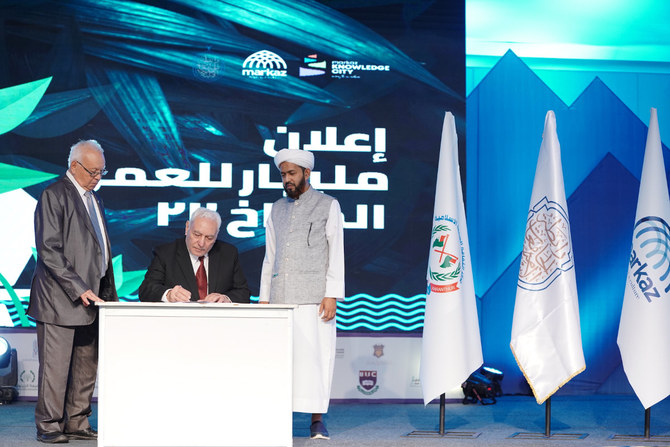
Dr. Osama Al-Abed, secretary-general of the League of Islamic Universities, signs the Malabar Declaration on climate action in Kozhikode, India, on Oct. 20. (Photo courtesy: LIU)
Short Url
Updated 22 October 2022
Follow

League of Islamic Universities launches climate action on campuses

  • Representatives from 200 Islamic universities gathered in India for summit
  • Center dedicated to environmental studies will be established in Calicut, India

NEW DELHI: The League of Islamic Universities will launch environment courses at the campuses of its member institutions, following a climate action summit held in India earlier this week.

Based in Cairo, Egypt, the league is an association representing Islamic universities around the world.

Its members, including 200 universities from 60 countries, gathered at Jamia Markaz, an Islamic university in Kozhikode, Kerala, for the International Climate Action Summit on Oct. 17-20.

The event was inaugurated by the league’s secretary general, Dr. Osama Al-Abed, who urged global stakeholders to employ new strategies in addressing climate problems, as the world is “facing challenges that are structurally different from the past.

“Even a minor variation in the ecosystem in a remote village can have huge global impacts. The human population across the globe is now entangled with each other in unprecedented ways,” he said.

“This demands policymakers and governments to resort to more international approaches toward issues such as climate change and come up with global solutions for even local issues.”

The summit concluded with a joint declaration for climate action that obliges the league’s members to include environmental science in their curricula and allocate resources for research on confronting climate change-related problems.

“We thought that the real community who has to work on climate change is students. In every country, if the universities go for some course on climate then the future generation would be working on climate change,” Jamia Markaz rector Dr. Abdul Hakeem Al-Kandi told Arab News on Friday.

“Students, who are the future leaders, when they are getting aware of climate change, (they) will impact the whole world.”

Al-Kandi added that a center dedicated to environmental studies will be established by the league in Calicut, India.

“This would be part of the League of Islamic Universities,” he said.

“Anyone can come and study here.”

Environmentalist and principal of Markaz Law College Dr. C. Abdul Samad, who coordinated the summit, said the idea of the university league’s action was to mobilize community members in different societies and make them stakeholders in protecting the environment.

“Introducing environmental science courses in universities is important as the young leaders need to be educated to think about nature and climate change, and its impact,” he said.

“It is the new generation that can preserve the diversity of nature and respect the environment. The whole idea is to save the planet for the future.”

Saudi environmentalist Ahmed Sabban, who took part in the summit, also highlighted the urgency of climate action dedicated to the young generation.

“Let’s start teaching the environmental science courses to young graduates, because the universities are places where research and development, and professors and students, will come up with solutions quicker than other organizations,” he told Arab News, adding that such courses are already underway in Saudi universities.

“Educational institutions are bodies which will come with solutions. This is why it’s important for the new generation to understand and start helping, and think about this problem.”


Ukraine-Russia peace talks resume in Geneva with pressure on Kyiv

Updated 5 sec ago
Follow

Ukraine-Russia peace talks resume in Geneva with pressure on Kyiv

  • Ukraine-Russia peace talks resume in Geneva with pressure on Kyiv
  • Ukrainian President Volodymyr Zelensky criticizes US pressure for Ukraine concessions

GENEVA: Negotiators from Ukraine and Russia began a second day of talks in Geneva on Wednesday, as Ukrainian President Volodymyr Zelensky said the United States was putting undue pressure on him to bring an end to the four-year-old war in his country.
The US-mediated peace talks in Switzerland have been taking place as US President Donald Trump has twice in recent days suggested it was up to Ukraine and Zelensky to take steps to ensure the talks were successful.
In an interview with US website Axios published on Tuesday, Zelensky was quoted as saying that it was “not fair” Trump kept publicly calling on Ukraine, not Russia, to make concessions in negotiating terms for a peace plan.
Zelensky also ‌said any plan ‌requiring Ukraine to give up territory that Russia had not captured in the ‌eastern ⁠Donbas region would be ⁠rejected by Ukrainians if put to a referendum.
“I hope it is just his tactics and not the decision,” Axios quoted Zelensky as saying in the interview.
Trump told reporters on Monday that “Ukraine better come to the table fast. That’s all I’m telling you.”
Talks come days before fourth anniversary of invasion
The Geneva talks resumed on Wednesday morning.
“The consultations are taking place in groups by areas within the political and military groups. We are working on clarifying the parameters and mechanics of the decisions that were discussed yesterday,” Ukraine’s lead negotiator and head of the National ⁠Security and Defense Council Rustem Umerov said on social media.
The talks come just ‌days before the fourth anniversary of Russia’s 2022 invasion of its ‌much smaller neighbor. Hundreds of thousands of people have been killed, millions have fled their homes, and many Ukrainian cities, ‌towns and villages have been devastated by the conflict.
Russia denies deliberately targeting civilians.
Russian source called talks ‘very tense’
Umerov ‌said Tuesday’s talks had focused on “practical issues and the mechanics of possible decisions,” without providing details. Russian officials made no comments on the talks.
However, Russian news agencies quoted a source as saying that the Tuesday talks were “very tense” and lasted six hours in different bilateral and trilateral formats.
Ukrainian government bonds fell as much as 1.9 cents on the dollar in ‌morning trade in Europe on reports of stalled progress at the talks.
Before the talks began, Umerov had played down hopes for a significant step forward in ⁠Geneva, saying the Ukrainian delegation ⁠was working “without excessive expectations.”
The Geneva meeting follows two rounds of US-brokered talks in Abu Dhabi that concluded without a major breakthrough as the two sides remained far apart on key issues such as the control of territory in eastern Ukraine.
Russia occupies about 20 percent of Ukraine’s national territory, including Crimea and parts of the eastern Donbas region seized before the 2022 full-scale invasion. Its recent airstrikes on energy infrastructure have left hundreds of thousands of Ukrainians without heating and power during a harsh winter.
Zelensky thanked Trump for his peacemaking efforts and told Axios that his conversations with the top US negotiators, envoy Steve Witkoff and the president’s son-in-law, Jared Kushner, did not involve the same kind of pressure.
Witkoff early on Wednesday said Trump’s efforts to get Russia and Ukraine talking were yielding fruit.
“President Trump’s success in bringing both sides of this war together has brought about meaningful progress, and we are proud to work under his leadership to stop the killing in this terrible conflict,” he said on X. “Both parties agreed to update their respective leaders and continue working toward a deal.”