

Pakistan, Saudi Arabia review progress in investigation of 2011 killing of Saudi diplomat

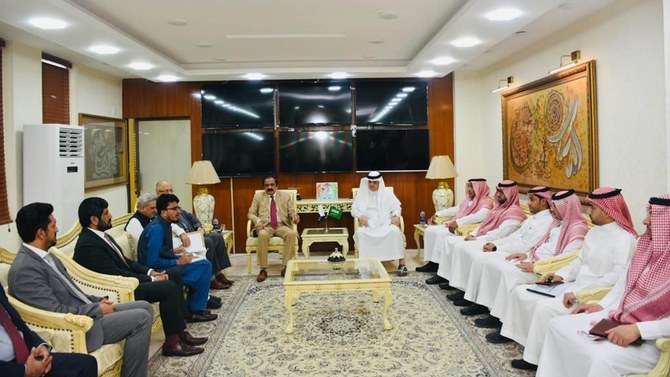
Pakistani interior minister Rana Sanaullah (center right) and Saudi ambassador to Pakistan Nawaf bin Said Al-Malki (center left) meet with the Saudi delegation and Pakistani officials in Islamabad on Oct. 18, 2022. (APP)
Short Url
Updated 19 October 2022
Follow

Pakistan, Saudi Arabia review progress in investigation of 2011 killing of Saudi diplomat

  • Hassan Al-Qahtani was killed by gunmen in Pakistan’s southern metropolis of Karachi
  • The killing was claimed by Pakistan Taliban, killers are believed to be harbouring in Iran

ISLAMABAD: Pakistani interior minister Rana Sanaullah on Tuesday briefed a Saudi delegation on progress in an investigation into the killing of a Saudi diplomat in Karachi in 2011, the ministry said in a statement, with officials from Riyadh expressing satisfaction with the probe. 

Gunmen on motorcycles shot and killed Hassan Al-Qahtani in Karachi on May 16, 2011, in an assault that was claimed by the Tehreek-i-Taliban Pakistan. 
Pakistani authorities established a special investigation team in November last year to probe the murder. This January, Pakistani police asked for assistance from authorities in Tehran to arrest the suspected killers, who are believed to be harbouring in Iran. 
On Tuesday, a delegation of senior officials from the Saudi interior ministry met with Pakistani interior minister Rana Sanaullah. The meeting was also attended by Saudi ambassador Nawaf bin Said Al-Malki, federal interior secretary Yousaf Naseem Khokhar and other senior officials. 
“In the meeting, both sides reviewed the progress related to the investigation of the murder of Saudi diplomat Al-Qahtani and the arrest of the perpetrators,” the Pakistani statement said. 
“The criminals involved in the murder of the Saudi diplomat will soon be brought to justice,” Sanaullah was quoted as saying in the statement, adding that "all resources" would be used to arrest the suspects. 
The Saudi officials expressed satisfaction over the ongoing investigation, the statement said, while both sides also agreeing to improve coordination between the interior ministries of the two countries. 
Four people riding motorcycles opened fire on the Saudi diplomat’s car. The envoy, a low ranking security official, was on his way to the consulate when the assailants struck. 
The shooting, which occurred about 60 meters (200 feet) from the Karachi consulate, came days after unidentified attackers threw two hand grenades at the consulate in Pakistan’s commercial hub. No one was hurt in that attack. 
In November last year, Pakistani authorities established a special team to investigate Al-Qahtani's murder after previous probes yielded no result. Counter Terrorism Department Deputy Inspector General Omar Shahid Hamid told Arab News at the time the team was working on “fruitful leads” from the country’s intelligence. 


Pakistan highlights economic reforms at Davos, eyes cooperation in AI, IT and minerals

Updated 21 January 2026
Follow

Pakistan highlights economic reforms at Davos, eyes cooperation in AI, IT and minerals

  • Prime Minister Shehbaz Sharif speaks at breakfast event in Davos at sidelines of World Economic Forum summit
  • Pakistan, rich in gold, copper reserves, has sought cooperation with China, US, Gulf countries in its mineral sector

ISLAMABAD: Prime Minister Shehbaz Sharif highlighted Pakistan’s recent economic reforms during the sidelines of the ongoing World Economic Forum (WEF) summit in Davos on Wednesday, saying that his country was eyeing greater cooperation in mines and minerals, information technology, cryptocurrency and artificial intelligence with other states. 

The Pakistani prime minister was speaking at the Pakistan Pavilion in Davos on the sidelines of the WEF summit at a breakfast event. Sharif arrived in Switzerland on Tuesday to attend the 56th annual meeting of the WEF, which brings together global business leaders, policymakers and politicians to speak on social, economic and political challenges. 

Pakistan has recently undertaken several economic reforms, which include removing subsidies on energy and food, privatization of loss-making state-owned enterprises and expanding its tax base. Islamabad took the measures as part of reforms it agreed with the International Monetary Fund (IMF) in exchange for a financial bailout package. 

“We are now into mines and minerals business in a big way,” Sharif said at the event. “We have signed agreements with American companies and Chinese companies.”

Islamabad has sought to attract foreign investment in its critical minerals sector in recent months. In April 2025, Pakistan hosted an international minerals summit where top companies and government officials from the US, Saudi Arabia, China, Türkiye, the UK, Azerbaijan, and other nations attended.

Pakistan is rich in gold, copper and lithium reserves as well as other minerals, yet its mineral sector contributes only 3.2 percent to the countrys GDP and 0.1 percent to global exports, according to official figures.

Sharif said Pakistan has been blessed with infinite natural resources which are buried in its mountains in the northern Gilgit-Baltistan, Khyber Pakhtunkhwa, Azad Kashmir and southwestern Balochistan regions. 

“But we have now decided to go forward at lightning speed,” he said. “And we are also moving speedily in the field of crypto, AI, IT.”

He said the government’s fiscal and economic measures have reduced inflation from nearly 30 percent a few years ago to single-digit figures, adding that its tax-to-GDP ratio had also increased from 9 to 10.5 percent. 

The prime minister admitted Pakistan’s exports face different kinds of challenges collectively, saying the country’s social indicators needed to improve. 

“But the way forward is very clear: that Pakistan has to have an export-led growth,” he said. 

SHARIF MEETS IMF MANAGING DIRECTOR

Separately, Sharif met IMF Managing Director Kristalina Georgieva on improvements in Pakistan’s macroeconomic indicators, efforts toward stability and progress on institutional reforms, a statement from Sharif’s office said.

He emphasized Pakistan’s commitment to fiscal discipline, revenue mobilization and sustainable development, it added. 

The IMF managing director acknowledged and appreciated Pakistan’s reform efforts, the Prime Minister’s Office (PMO) said.

“Both sides exchanged views on the global economic outlook, challenges facing emerging economies, and the importance of multilateral cooperation in safeguarding economic stability,” the PMO said.