

Police in Sindh turn to technology as street crimes surge in southern Karachi city

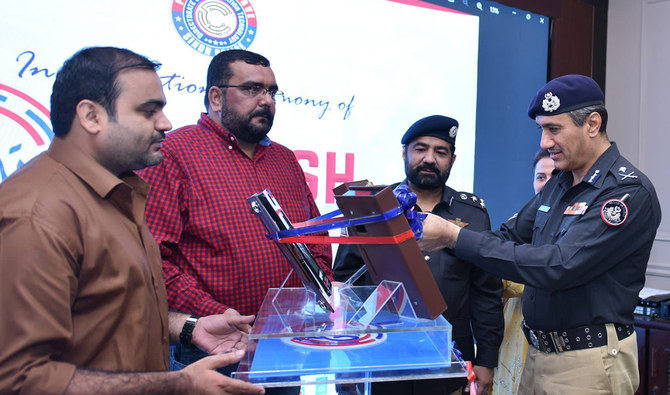
Inspector General Sindh Police Ghulam Nabi Memon launches an app with the central data of wanted criminals at the Central Police Office in Karachi, Sindh on October 17, 2022. (Photo courtesy: Sindh Police)
Short Url
Updated 18 October 2022
Follow

Police in Sindh turn to technology as street crimes surge in southern Karachi city

  • Talash will have the data of 1.5 million criminals in different parts of Pakistan’s Sindh province
  • Police officials advocate the use of other modern gadgets to improve their department’s capacity

KARACHI: Police in Pakistan’s southern Sindh province have launched an app called Talash to fight street crimes in the megacity of Karachi, confirmed its top official on Tuesday, adding the new app was among several modern tools introduced to improve the capacity of the law enforcing agency.

Karachi is Pakistan’s largest city and commercial capital. It also witnessed the presence of transnational militant networks, sectarian outfits and local gangs in the past which needed an elaborate security operation which was spearheaded by paramilitary rangers and began in September 2013.

Street criminals have posed a major challenge to the law enforcers in the city since then. Briefing the Senate Standing Committee on Interior earlier this month, police officials in Sindh admitted the incidents of street crimes had increased in Karachi.

Two weeks ago, an infant was killed and her mother wounded, as the police clashed with a group of street criminals. The incident also led to a significant outrage in the city.

Talash device, body-worn cameras and modern tools to collect evidence through CSU [Crime Scene Unit] are a few recent initiatives to improve the capacity of the Sindh police,” Inspector General Police Ghulam Nabi Memon told Arab News.

“We believe we will not be effective until we provide proper tools and resources to the police, especially the investigation branch,” he continued.

The app was launched in Karachi on Monday in the first phase of a program which would soon be extended to the entire province.

Addressing the launch ceremony, Memon said Talash could be used as the “best weapon” to defeat criminal elements.

He informed the Sindh chief minister had already issued funds for the acquisition of other forms of technology and a committee had also been formed to train the investigation department that played a vital role in bringing down the crime ratio.

“We are trying to make the investigation system effective by providing modern training to officers and personnel associated with the investigation department,” he said, adding it was important to eliminate crimes to protect the lives, property and honor of Pakistani citizens.

Sharing the details of the app, Deputy Inspector General Police Parvez Ahmed Chandio said it would help the police identify a person during snap-checking.

The app uses the biometric system and is linked to the country’s central database, he continued.

Chandio said the device would have the data of 1.5 million criminals in the province before its use was extended to other districts of Sindh.

“The app will have the data of criminals,” he added. “Taking their fingerprints on the device will immediately help us identify them, including all those individuals who are on bail.”



Pakistan Air Force conducts successful test of air-launched cruise missile

Updated 03 January 2026
Follow

Pakistan Air Force conducts successful test of air-launched cruise missile

  • The indigenously developed ‘Taimoor’ missile has a range of 600 kilometers and carries a conventional warhead
  • The missile is designed to fly at low altitudes, which enables it to evade hostile air, missile defense systems

ISLAMABAD: The Pakistan Air Force (PAF) has successfully conducted a test of an air-launched cruise missile, ‘Taimoor,’ the Pakistani military said on Saturday, marking another significant milestone in advancement of national aerospace and defense capabilities.

The indigenously developed Taimoor weapon system is capable of engaging enemy land and sea targets with high precision. The missile has a range of 600 kilometers and carries a conventional warhead.

The missile test comes months after a brief but intense military conflict between Pakistan and India in which the nuclear-armed neighbors exchanged missile and artillery fire and deployed drones and fighter jets.

Equipped with state-of-the-art navigation and guidance system, Taimoor is designed to fly at very low altitudes, enabling it to effectively evade hostile air and missile defense systems.

“Its precision-strike capability significantly enhances the conventional deterrence and operational flexibility of Pakistan Air Force, further strengthening the country’s overall defense posture,” said the Inter-Services Public Relations (ISPR), the military’s media wing.

“The successful flight test underscores the technical maturity, innovation and self-reliance achieved by Pakistan’s defense industry.”

The missile’s launch was witnessed by senior officers of the armed forces along with distinguished scientists and engineers, who played a pivotal role in the development of this advanced weapon system.

PAF’s Air Chief Marshal Zaheer Ahmed Baber Sidhu congratulated the scientists, engineers and the entire PAF team on this remarkable achievement, lauding their professional excellence, dedication and unwavering commitment to strengthening Pakistan’s defense capabilities.

“The air chief reaffirmed that such accomplishments are a testament to the nation’s resolve to achieve technological self-sufficiency and maintain a credible conventional deterrent in the evolving regional security environment,” the ISPR said.

“The successful test of the Taimoor weapon system reflects Pakistan Air Force’s continued pursuit of operational readiness, technological superiority and national security objectives.”

Pakistan has placed greater emphasis on battle readiness in recent months. On Dec. 15, Pakistan Navy test-fired surface-to-air missile in the northern Arabian Sea.

Prior to that, Chief of Defense Forces Field Marshal Asim Munir visited frontline garrisons of Gujranwala and Sialkot to observe a field training exercise involving tanks and drones, where he had highlighted the importance of technological adaptability, saying modern warfare required agility, precision, situational awareness and rapid decision-making.