

China’s party congress promises continuity, not change

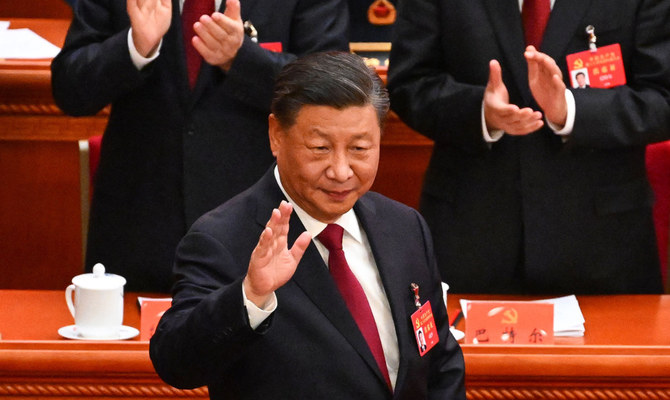
China's President Xi Jinping arrives for the opening session of the 20th Chinese Communist Party's Congress at the Great Hall of the People in Beijing on October 16, 2022. (AFP)
Short Url
Updated 17 October 2022
Follow

China’s party congress promises continuity, not change

  • The economy is struggling under the weight of severe COVID-19 restrictions imposed by Xi’s government, a sharp real estate slowdown and the fallout from the war in Ukraine

BEIJING: The overarching theme emerging from China’s ongoing Communist Party congress is one of continuity, not change.

The weeklong meeting, which opened Sunday, is expected to reappoint Xi Jinping as leader, reaffirm a commitment to his policies for the next five years and possibly elevate his status even further as one of the most powerful leaders in China’s modern history.

A look at what has happened so far, and what is to come: More of the same.

This is not an inflection point for the party. That happened 10 years ago when it named Xi as leader, though it was not evident at the time.

Since then, Xi has reoriented China both domestically and internationally. The military has staked claims to disputed territory while diplomats have become more assertive, saying China will not be bullied by the US and others.

Xi has brought back stronger state control over the economy and society, expanding censorship and arrest to stifle dissent. An unprecedented crackdown on corruption has brought down hundreds of senior officials, including some potential political rivals.

All of that is here to stay — that was the message from a 1-hour-and-45-minute party report that Xi delivered to the opening session on Sunday.

Willy Lam, a senior fellow with the Jamestown Foundation think tank, noted the report described a “Chinese-style modernization” that must conform to socialist values.

“China will stick to its own road,” the Hong Kong-based Lam said. “It will not borrow any measures or governance style from foreign countries.”

China on Monday abruptly canceled the announcement of third-quarter economic growth figures due out Tuesday.

No specific reason was given. The gross domestic product report was likely to conflict with the confident tone of the party congress by showing the economy grew by as little as 3 percent in the latest quarter, barely half the official 5.5 percent target.

The economy is struggling under the weight of severe COVID-19 restrictions imposed by Xi’s government, a sharp real estate slowdown and the fallout from the war in Ukraine.

A woman who answered the phone in the press office of the National Bureau of Statistics said only that the postponement was due to “work arrangements.”

Xi has already swept away competitors and consolidated power. The question is whether he will gain even more power — and how.

Practically, he has placed himself in charge of the military, foreign policy, the economy and most other matters through a series of party working groups that he heads.

Symbolically, his ideology, known as Xi Jinping Thought, was enshrined in the party congress at the previous congress in 2017.

Another amendment to the constitution is on the agenda for this week’s congress. No details have been divulged, but analysts say it could further raise his status in the party.

It is customary for the party to unveil its top leadership for the next five years the day after the congress closes, with the small group named to the Politburo Standing Committee identified for the first time when they parade out on stage.

Xi is widely expected to be at the top, getting a third five-year term. That would dispense with an unwritten agreement for party leaders to step down after two terms. The others named to the Standing Committee, which currently has seven members, could offer clues to Xi’s future and the direction of policy.

He is expected to stack the committee with loyalists. Analysts wonder whether China’s economic slump will force him to temper his enthusiasm for a state-run economy and include supporters of a more market-oriented approach.

No obvious successor was picked for the current Standing Committee in 2017, signaling that Xi was eyeing a third term. Doing so again would suggest he plans an even longer stay.


UN chief says 37,000 West Bank Palestinians displaced in 2025; warns Gaza war threatens two-state solution

Updated 04 February 2026
Follow

UN chief says 37,000 West Bank Palestinians displaced in 2025; warns Gaza war threatens two-state solution

  • ‘We enter 2026 with the clock ticking louder than ever. Will the year ahead bend towards peace or slip into the abyss of despair?” asks Secretary-General Antonio Guterres
  • Illegal settlement expansions, demolitions, displacements and evictions in the West Bank are accelerating, he says

NEW YORK CITY: More than 37,000 Palestinians were displaced in the occupied West Bank during 2025, a year in which there were also record-high levels of violence committed by Israeli settlers, UN secretary-General Antonio Guterres said on Tuesday.
The situation on the ground was rapidly eroding the prospects for a two-state solution, he warned.
“We enter 2026 with the clock ticking louder than ever,” Guterres told the opening session of the UN Committee on the Exercise of the Inalienable Rights of the Palestinian People. 
“Will the year ahead bend towards peace or slip into the abyss of despair?”
Illegal settlement expansions, demolitions, displacements and evictions in the West Bank were accelerating, said Guterres, who described the Israeli actions as destabilizing in nature and unlawful under international law.
“The recently published tender by Israel for 3,401 housing units in the E1 area (of the West Bank), alongside continued demolitions, is profoundly alarming,” he added.
“If carried forward, it would sever the northern and southern West Bank, undermine territorial contiguity, and strike a severe blow to the viability of a two-state solution.”
Turning to the situation in Gaza, Guterres said Palestinians there continued to endure “grave suffering.” More than 500 have been killed since the truce between Israel and Hamas in October, he noted.
“I urge all parties to implement the (ceasefire) agreement in full, exercise maximum restraint, and comply with international law and UN resolutions,” he said.
He called for the rapid and unimpeded delivery of humanitarian aid at scale, including through the Rafah border crossing between Gaza and Egypt, which Israel reopened on Monday.
Guterres criticized Israeli authorities for the continued suspension of international non-governmental organizations that provide aid, which he said “defies humanitarian principles, undermines fragile progress, and worsens the suffering of civilians.”
Regarding the future of Gaza, he said any sustainable solution must include governance of the territory and the West Bank, including East Jerusalem, by a unified and internationally recognized Palestinian government.
“Gaza is and must remain an integral part of a Palestinian state,” Guterres added.
He also reaffirmed his support for the UN Relief and Works Agency for Palestine Refugees, and condemned recent Israeli legislation and other actions he said impeded the ability of the agency to operate, including moves to demolish its Sheikh Jarrah compound in occupied East Jerusalem.
“Let me be clear: UNRWA premises are United Nations premises,” he said. “They are inviolable and immune from any form of interference.”
Guterres described public threats against UNRWA staff as “utterly abhorrent,” and said Israel was obliged under international law to respect the privileges and immunities of the UN.
He also reiterated that an end to Israeli occupation of Palestinian territory was essential.
“There is only one viable route (to peace): the two-state solution, in line with international law and relevant United Nations resolutions,” he said, as he called on the international community to act “with clarity, unity and determination” on the issue.