GENEVA: The UN Human Rights Council damaged its credibility by dodging a discussion on Xinjiang, experts say, but campaigners brand it a Pyrrhic victory for China with Beijing’s impunity finally dented.
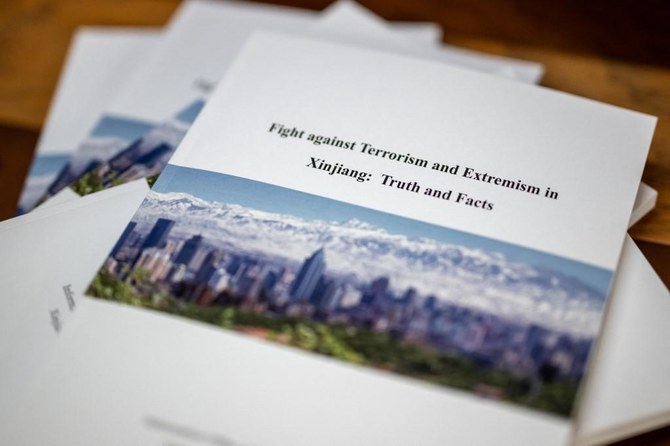
A bombshell United Nations report into China’s Xinjiang region, published on August 31, found torture allegations were credible and cited possible crimes against humanity against Uyghurs and other Muslim minorities.
Western countries sought to put the situation before the UN’s top rights body by seeking a debate on the report.
The United States and its allies were testing the water with a first-ever draft council decision targeting China by raising the issue at a low-key level.
But in a moment of high drama in Geneva on Thursday, the stand-off ended in council members voting against debating the report.
Intense Chinese lobbying in the 47-country council saw nations vote 19-17 against discussing the findings, with 11 abstaining — although Ukraine said Friday they meant to vote ‘yes’ rather than abstain.
The sore defeat for Western nations laid bare the strength of China’s diplomatic leverage and the frailties of their own.
While Beijing touted a victory for truth and justice, some said it made a mockery of the council and its core mission to promote and protect human rights worldwide.
Jo Smith Finley, a reader in Chinese studies at Britain’s Newcastle University, branded the council “completely dysfunctional.”
“It operates according to politics and economics (economic dependencies and indebtedness), not the universal values of human rights,” she tweeted.
David Griffiths, a human rights consultant at London’s Chatham House think-tank, called it the council’s “nadir.”
Nonetheless, rights groups and experts said there were plenty of silver linings, with the notion that China can never be challenged shattered.
Olaf Wientzek, director of the Multilateral Dialogue Geneva branch of the Konrad Adenauer Foundation think-tank, said the Xinjiang vote “absolutely hurts the credibility of the council.”
But, he said, the outcome flushed out where everyone stood.
“Every country had to confess its true colors. That alone was worth it,” he said.
Phil Lynch, executive director of the International Service for Human Rights NGO, suggested China had secured only a Pyrrhic victory: a win that comes with losses resembling a defeat.
He said the narrow 19-17 margin could be characterized as the opposite for rights campaigners, calling it a “Pyrrhic loss.”
“We weren’t successful in the vote but the closeness has really galvanized a sense that this is a cause we need to pursue and China cannot continue to enjoy impunity for crimes against humanity,” he explained.
“China mobilized massively and exerted enormous pressure and made various threats and offered inducements to delegations to oppose this text, and that notwithstanding it was only very, very narrowly defeated. We take heart and courage from that.”
“We’ve demonstrated that no state is above scrutiny.”
Lynch said the Xinjiang vote also demolished the common notion that a result should be guaranteed before seeking a vote, which also encouraged impunity.
Western liberal democracies will be doing plenty of head-scratching over the coming months to re-calibrate their approach at the next council session, set to start in February.
“It’s not like this (Xinjiang) report will be thrown in a trash bin of silence. I would be surprised if this issue would not come up again,” said Wientzek.
One major factor is that the council’s membership will be different next time round. On Tuesday, the UN General Assembly in New York will elect 14 new members to serve from 2023 to 2025.
“One or two countries or governments change, and the balance might shift,” Wientzek said.
On Friday, the Human Rights Council adopted its first-ever resolution on Russia’s domestic rights situation, appointing a special rapporteur to monitor abuses.
Seventeen countries voted ‘yes’, six said ‘no’ and 24 abstained.
Experts said the two votes showed the clear difference in diplomatic clout between China and Russia — two of the five permanent members (P5) of the UN Security Council — with Moscow down to a handful of reliable friends following its invasion of Ukraine.
After the disappointment on China, Friday’s Russia vote was “a glimmer of hope that at least, for the first time, there was enough courage to take on a P5 member,” said Wientzek.


![]()

UN rights vote Pyrrhic victory for China, say campaigners
Short Url
https://arab.news/b8fpg
UN rights vote Pyrrhic victory for China, say campaigners
- A bombshell United Nations report into China’s Xinjiang region found torture allegations were credible


Latest updates


© 2026 SAUDI RESEARCH & PUBLISHING COMPANY, All Rights Reserved And subject to Terms of Use Agreement.