RAQQA, Syria: It has been five years since the Syrian Democratic Forces hoisted their flag in the main square in Raqqa, which, for four years, had been the capital of Daesh. The streets and squares of Raqqa had witnessed horrendous atrocities — beatings, torture, beheadings, and other unspeakable acts.
Global media, which watched the operation to liberate the city with bated breath, almost immediately packed up and fled once Raqqa was freed from the terror group, leaving the people alone again in the rubble of their once great city.
But among the ruins, cultural flowers are in bloom. Groups of writers, artists, and intellectuals are making every effort to restore Raqqa’s culture, despite the black mark left by Daesh.
The area around Raqqa has been inhabited since the third millennium B.C. It gained a reputation when the Abbasid caliph Harun Al-Rashid, himself a lover of culture and tradition, chose the city as the site for his imperial residence in 796 A.D.
Though the city has been destroyed six times over its long history, many of its centuries-old historic sites remain as a testament to its importance.
When Daesh stormed into Raqqa in 2014 and declared the city its capital, the local artistic and cultural community were immediately gripped by fear.
“When the armed groups came, our group dissolved. We couldn’t sing or do anything. It got to the point where Daesh arrested me twice,” traditional singer Melek Muhammad Al-Saleh told Arab News.
“The militants said I was committing blasphemy. They said it was haram, that it was the work of Satan,” he said with a quizzical look.

The newly-restored statue of Caliph Harun Al-Rashid, one of the forefathers of Raqqa. (AN Photo/Ali Ali)
Then, speaking more seriously, Al-Saleh added: “They came to destroy and eliminate our culture. They destroyed our museum. They broke and destroyed all our antiquities.
“They were sent to eliminate the history of this city and country, because they have no history themselves; they have no opinions or goals. Their only goal was destruction.”
Al-Saleh had a distinguished career as a traditional singer spanning decades. After returning to his native Raqqa from Aleppo in the 1990s, he established a seven-member musical group called Njoom. The group travelled not only within Raqqa governorate, but all over Syria, performing at weddings and cultural festivals.
When Daesh came, the city’s proud culture and heritage came under attack. All cultural centers became departments for Daesh’s various bureaus. They seized musical instruments from people’s homes and destroyed them. They destroyed cassettes, CDs and televisions. Weddings, formerly jovial affairs in Raqqa complete with music and dancing, became silent and solemn.
Daesh interrogated Al-Saleh, saying that he had “forgotten God,” and threatened to behead him. The group was shocked, though, to find that Al-Saleh was a pious Muslim who knew a lot about the Islamic faith. “I was with them for 12 hours. I had religious discussions with them. My faith was strong, and theirs was not. They were wrong,” he said.
He continued: “They were shocked; they asked me how a singer could know so many things about religion, because they said singers were infidels. They asked me to become a judge for them.”
Al-Saleh refused to work for the group and was eventually released. He continued to sing, but in secret — his group’s musical concerts were held inside private homes at night, usually with a guard standing outside on the lookout for Daesh patrols.
As Raqqa rebuilt itself, the new Autonomous Administration of North and East Syria’s cultural departments began searching the city for its remaining artists. Al-Saleh was made a member of the Artists’ Union, and proudly showed his union ID card.
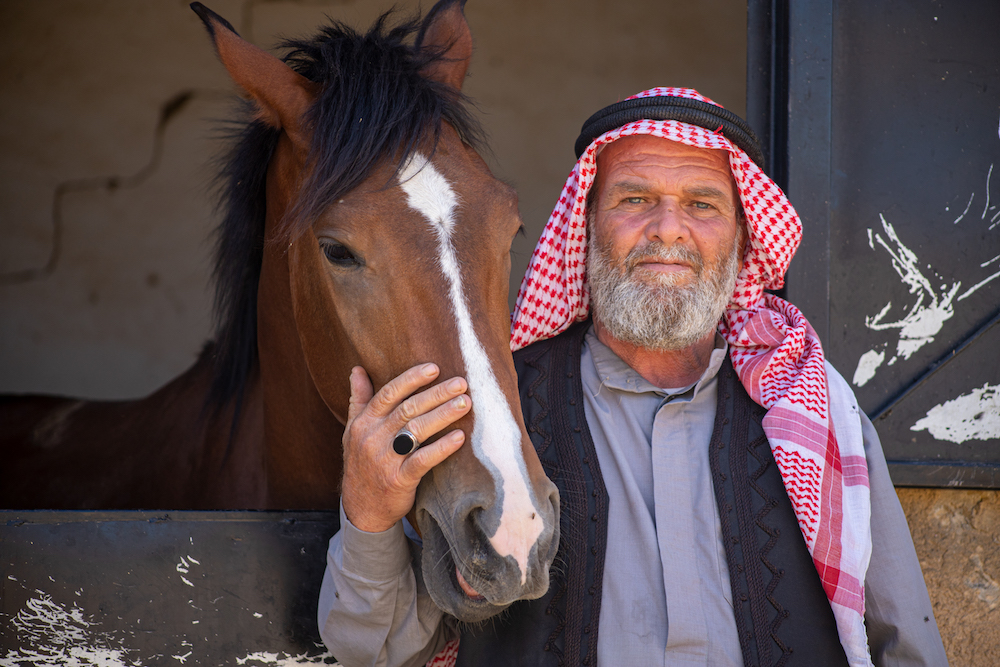
Equestrian and horse owner Amer Medad with one of his Arabian horses. (AN Photo/Ali Ali)
All the members of his old musical group have either passed away or left the country, so he has started a new group with 11 members. Additionally, he is teaching his son the rudiments of traditional Raqqa music, “so that the new generation will not forget our traditions.
“For the past four or five years, we have been making all efforts to bring our culture back to what it was, or make it even better. It will take a lot of time, though,” he said.
Daesh were just as angry with the free expression of the written word as they were with traditional music. Mohamed Bashir Al-Ani, a poet from Deir Ezzor, was executed along with his son for “blasphemy.” Many writers were forced to flee, including the Raqqawi writer Fawziya Al-Marai.
“I saw my city totally destroyed and felt that my head would explode. Everything was in ruins,” Al-Marai told Arab News, recalling her return to Raqqa after living in Turkey during the Daesh occupation.
“Not just the city was destroyed. Everything inside of me was destroyed,” she said. “I lost everything that was beautiful in these ruins.”
Al-Marai, 74, is a prolific writer, having penned over 10 books of poetry and short stories since she began writing in the late 1990s.
Most of her writings were inspired by the traditions of Raqqa, particularly the dress and folklore of Arab women, and by the Euphrates River. She attended literary festivals several times a year, meeting famous Syrian poets such as Nizar Qabbani and Raqqawi native Abdal Salam Al-Ujayli.
When Daesh attacked, “I fled. If I had stayed, they would have killed me. They were searching for me by name,” Al-Marai said.
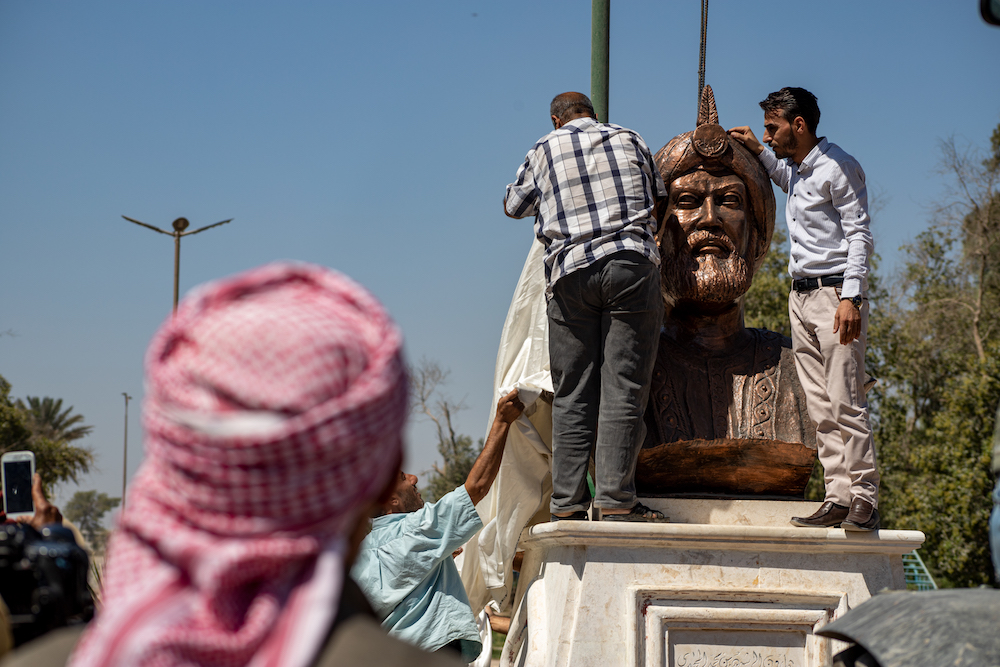
The unveiling of the statue of Harun Al-Rashid, which was previously destroyed by Daesh, in one of Raqqa's parks. (AN Photo/Ali Ali)
Her books, which she referred to as her children, were all burned by the terror group. “I had 25-50 copies of every book, and when I came back, none of them were left,” she said.
It was not just her books that were destroyed — the entire intellectual community she spent decades building was gone. “None of my friends were left. They all fled and became refugees in Europe,” she said.
Al-Marai was determined to help rebuild the culture of her beloved city. Having become an adviser to the Autonomous Administration’s Art and Culture Department, she now holds regular literary salons in the city’s fushat hiwar, or conversation space, to read and discuss literature.
“Now we are organizing festivals and training sessions for our youth on how to write stories and poetry. We celebrate them and always have activities to return our culture to the way it was before. We are always taking the chance to inform the youth that the future lies with them,” she said.
Shahla Al-Ujayli, a niece of Abdal Salam Al-Ujayli, has carried on her uncle’s literary tradition by writing several books, including one in which the protagonist joins one of Raqqa’s most famous cultural pastimes — horse racing.
For over a thousand years, Raqqa was famous for its equestrian heritage. The unique Arabian breed of horses were used as means of work, transportation, and eventually, as status symbols.
“The horse was a symbol of the family. If a family had a horse, it was known that they were wealthy. Then it became a cultural tradition, passed down from grandparents to parents to children,” Ammer Medad, a horse owner, told Arab News.
Medad estimates that though there were once between three and four thousand original Arabian horses in Raqqa, the current number is around only 400.
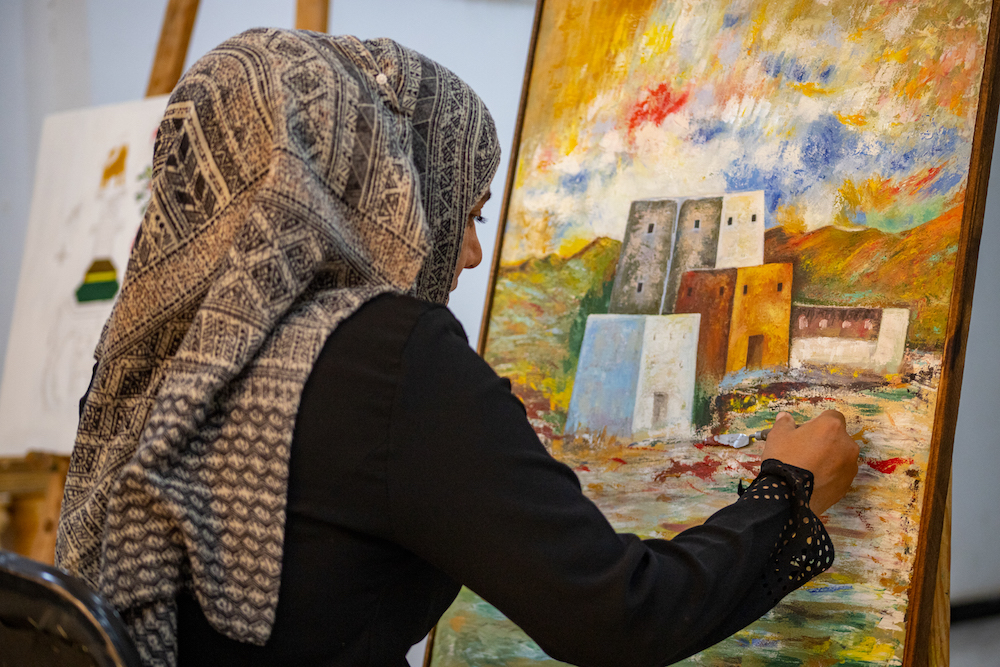
An artist paints in the Raqqa Culture and Art Center. (AN Photo/Ali Ali)
He recalls that in 1983, the first facility for horse racing in Raqqa was created. A makeshift facility in a local landowner’s garden, it measured about just 1,000 square meters in size. A local man from a famous equestrian family donated 10 horses to help create the first equestrian club.
The club began to train and eventually started to compete on the national level. They were the poorest team from all Syrian governorates, having only their horses. The riders trained in the desert rather than a regulation-grade racetrack. As they did not even have separate uniforms, they were forced to share a single uniform with one another.
Despite this, however, Raqqa’s riders always took bronze, silver, or gold in the competitions. Their skill was so unmatched that according to Medad, it caught the attention of Basil Assad, the late brother of current Syrian president Bashar Assad, who himself was an equestrian champion.
Basil funded the construction of a racetrack and horse facilities in Raqqa, which was completed in 1989. The team competed in races across the Arab world, including Qatar, Jordan, and Egypt. Though eventually the popularity of horse racing waned, it was still very much a part of the local traditional culture. All of this changed when Daesh came to the city.
Daesh destroyed the racetrack and littered it with landmines. They used the Raqqa facilities as a holding ground for 4,000 stolen horses, according to a local track worker. “They stole the horses for themselves. They even used them for food,” Medad said. He recalled an incident during which a Daesh militant approached a friend of his, intending to buy a horse to eat.
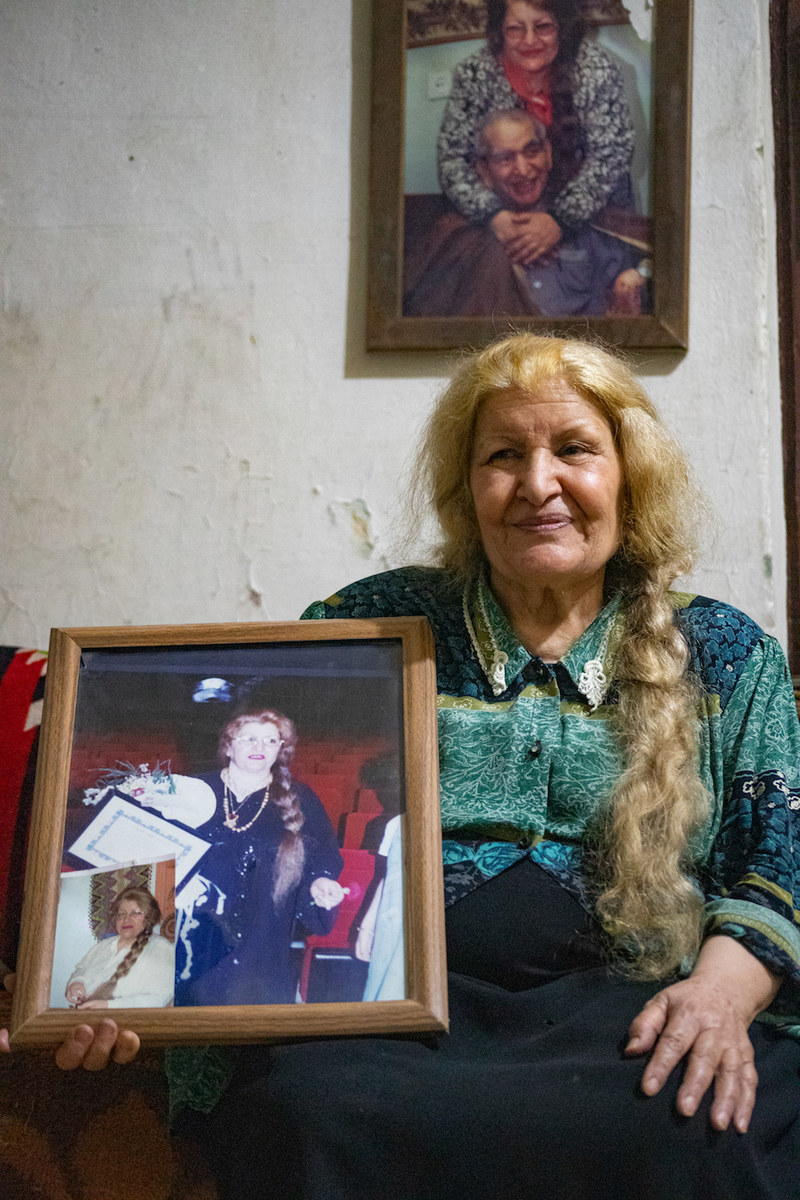
Author Fawziya Al-Marai, 74, holds an old photo of herself, with a photo of the late Syrian poet Abd Al-Salam Al-Ujayli in the background. (AN Photo/Ali Ali)
Medad asked why the militant would purchase such a beautiful horse just to eat it.
“Daesh militants rebuked me, saying that I could not forbid what God had allowed, and said that I must come to their court. I ran away for 15 days, at which point, the militant who wanted to take me to court had been killed and I could finally return home.”
Five years on, the racetrack has been cleared of Daesh landmines, and the facility has been 50 percent rebuilt, according to Medad. The track has already held one local festival, and plans on holding one at the national level, the first such race in Raqqa since Daesh took the city, in mid-October.
The statue of Raqqa’s cultural forefather Harun Al-Rashid, which had been destroyed by Daesh, was replaced in front of a crowd of onlookers in early September, symbolizing the city’s slow but inexorable return to its roots.