Pakistani finance minister sees gradual recovery from floods 

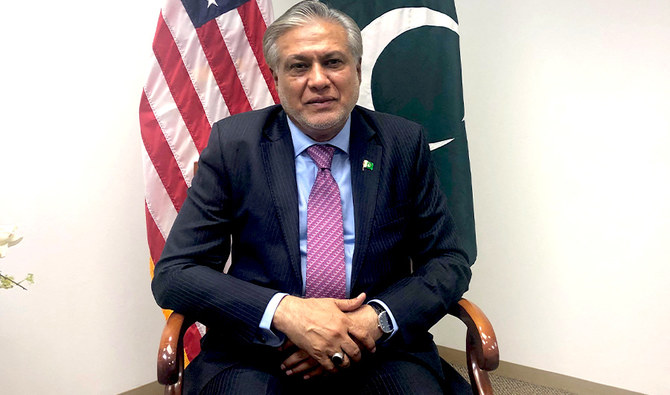
Pakistani Finance Minister Ishaq Dar speaks during an interview in Washington, DC, on October 14, 2022. (AFP)
Short Url
Updated 15 October 2022
Follow

Pakistani finance minister sees gradual recovery from floods 

  • Ishaq Dar was in Washington this week for the fall meetings IMF and World Bank
  • Losses from the floods were estimated to surpass $32 billion, finance minister says 

WASHINGTON: Pakistan’s new finance minister estimated that it could take “close to three years’’ for the south Asian country to recover from devastating floods that killed more than 1,700 people and displaced another 7.9 million.
Ishaq Dar, who last month took the finance post for the fourth time in his career, told The Associated Press Friday that losses from the floods were estimated to surpass $32 billion and that the cost of rebuilding damaged infrastructure will exceed $16 billion.
Monsoon rains, likely made worse by climate change, hammered Pakistan for months starting in mid-June, damaging or washing away 2 million homes.
Rebuilding, Dar said, “can’t be done overnight” and will take ” maybe close to three years’’ though he acknowledged that he was “not an engineer.” The World Bank last month pledged $2 billion in flood aid.
Dar is returning to the finance ministry at a difficult time for Pakistan. Moody’s Investors Service, citing Pakistan’s decreased foreign currency reserves, this month downgraded the country’s government debt. With inflation running at more than 20 percent year-over-year, Pakistan’s currency, the rupee, has fallen 19 percent against the US dollar this year.
But Dar, who earned a reputation for supporting a strong rupee during his earlier tenure as finance minister, noted that the currency rallied upon his return to the job; it’s up nearly 10 percent against the dollar since late September.
Dar was in Washington this week for the fall meetings of the International Monetary Fund and World Bank.
The visit got off to a rocky start.
He was heckled and called “a thief’’ by an unidentified individual upon arrival Thursday at Dulles International Airport.
On Friday, he shrugged off the incident, which was captured on video and shared online, as the act of a political opponent of the government of Prime Minister Shahbaz Sharif. “Obviously, this is domestic politics which has gone cross border,’’ Dar said. “That shouldn’t be.’’ 


Pakistan’s defense chief accuses ‘Indian-sponsored proxies’ of fueling violence in Balochistan

Updated 4 sec ago
Follow

Pakistan’s defense chief accuses ‘Indian-sponsored proxies’ of fueling violence in Balochistan

  • Field Marshal Syed Asim Munir speaks to participants of 18th National Workshop on Balochistan
  • Warns violation of Pakistan’s territorial integrity will be met with a “firm and decisive response”

ISLAMABAD: Pakistan’s Chief of Defense Forces (CFD) Field Marshal Syed Asim Munir on Wednesday blamed militant groups allegedly sponsored by India for fueling violence and disrupting development in the province, warning the military will foil their designs. 

Munir was speaking to participants of the 18th National Workshop on Balochistan (NWB) at the General Headquarters of the military in Rawalpindi. The NWB features discussions on Pakistan’s policies on security, development and other challenges related to Balochistan by officials, leaders and citizens. 

Pakistan accuses India of sponsoring militant groups in its southwestern Balochistan province, who demand independence from Islamabad. India rejects the allegations. These ethnic Baloch militant groups accuse Pakistan’s government and military of denying locals a share in the province’s mineral wealth, charges that both deny. 

“Highlighting the security challenges, the COAS & CDF remarked that Indian-sponsored proxies continue to propagate violence and disrupt development in Balochistan,” the Inter-Services Public Relations (ISPR), the military’s media wing, said in a statement.

“He reaffirmed that such inimical designs will be thwarted through stern actions by security forces to rid the province of terrorism and unrest.”

The Pakistani army chief lauded the federal and provincial governments’ initiatives for Balochistan’s development, underscoring a people-centric approach to unlock the province’s “vast economic potential.”

Munir appreciated the civil society for its constructive role in debunking propaganda, the military’s media wing said. 

“He stressed the importance of rejecting vested political agendas to ensure that Balochistan’s future is shaped by long-term prosperity for all its residents,” the ISPR said. 

The CDF reaffirmed Pakistan’s commitment to regional peace but stressed that any violation of the country’s territorial integrity will be met with a decisive response. 

Pakistan suffered a surge in militant attacks in its northwestern and Balochistan provinces this year. As per the Pakistan Institute for Conflict and Security Studies (PICSS) think tank, combat-related deaths in 2025 rose by 73 percent to 3,387, compared with 1,950 in 2024. 

These deaths included 2,115 militants, 664 security forces personnel, 580 civilians and 28 members of pro-government peace committees (combatants), the think tank said in a press release. 

“PICSS noted that most violence remained concentrated in Pashtun-majority districts of Khyber Pakhtunkhwa, including the tribal districts (erstwhile FATA), and in Balochistan,” the think tank said in its report on Sunday. 

Islamabad also accuses Afghanistan of sheltering militants who launch attacks on Pakistan soil. Kabul rejects these allegations and says it cannot be held responsible for Pakistan’s security lapses.