

Pakistan’s defense chief accuses ‘Indian-sponsored proxies’ of fueling violence in Balochistan

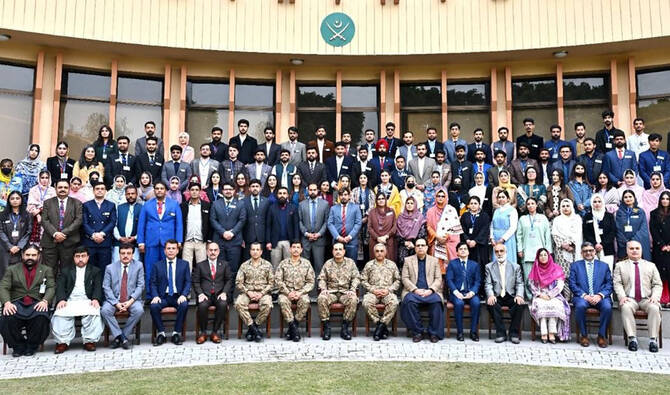
Pakistan’s Chief of Defense Forces (CFD) Field Marshal Syed Asim Munir (center front row) poses for a group photo along with the participants of the 18th National Workshop on Balochistan (NWB) at the General Headquarters of the military in Rawalpindi, Pakistan, on December 31, 2025. (ISPR)
Short Url
Updated 31 December 2025
Follow

Pakistan’s defense chief accuses ‘Indian-sponsored proxies’ of fueling violence in Balochistan

  • Field Marshal Syed Asim Munir speaks to participants of 18th National Workshop on Balochistan
  • Warns violation of Pakistan’s territorial integrity will be met with a “firm and decisive response”

ISLAMABAD: Pakistan’s Chief of Defense Forces (CFD) Field Marshal Syed Asim Munir on Wednesday blamed militant groups allegedly sponsored by India for fueling violence and disrupting development in the province, warning the military will foil their designs. 

Munir was speaking to participants of the 18th National Workshop on Balochistan (NWB) at the General Headquarters of the military in Rawalpindi. The NWB features discussions on Pakistan’s policies on security, development and other challenges related to Balochistan by officials, leaders and citizens. 

Pakistan accuses India of sponsoring militant groups in its southwestern Balochistan province, who demand independence from Islamabad. India rejects the allegations. These ethnic Baloch militant groups accuse Pakistan’s government and military of denying locals a share in the province’s mineral wealth, charges that both deny. 

“Highlighting the security challenges, the COAS & CDF remarked that Indian-sponsored proxies continue to propagate violence and disrupt development in Balochistan,” the Inter-Services Public Relations (ISPR), the military’s media wing, said in a statement.

“He reaffirmed that such inimical designs will be thwarted through stern actions by security forces to rid the province of terrorism and unrest.”

The Pakistani army chief lauded the federal and provincial governments’ initiatives for Balochistan’s development, underscoring a people-centric approach to unlock the province’s “vast economic potential.”

Munir appreciated the civil society for its constructive role in debunking propaganda, the military’s media wing said. 

“He stressed the importance of rejecting vested political agendas to ensure that Balochistan’s future is shaped by long-term prosperity for all its residents,” the ISPR said. 

The CDF reaffirmed Pakistan’s commitment to regional peace but stressed that any violation of the country’s territorial integrity will be met with a decisive response. 

Pakistan suffered a surge in militant attacks in its northwestern and Balochistan provinces this year. As per the Pakistan Institute for Conflict and Security Studies (PICSS) think tank, combat-related deaths in 2025 rose by 73 percent to 3,387, compared with 1,950 in 2024. 

These deaths included 2,115 militants, 664 security forces personnel, 580 civilians and 28 members of pro-government peace committees (combatants), the think tank said in a press release. 

“PICSS noted that most violence remained concentrated in Pashtun-majority districts of Khyber Pakhtunkhwa, including the tribal districts (erstwhile FATA), and in Balochistan,” the think tank said in its report on Sunday. 

Islamabad also accuses Afghanistan of sheltering militants who launch attacks on Pakistan soil. Kabul rejects these allegations and says it cannot be held responsible for Pakistan’s security lapses.


Pakistan says Sri Lanka to ease visa restrictions after Colombo talks

Updated 5 sec ago
Follow

Pakistan says Sri Lanka to ease visa restrictions after Colombo talks

  • Pakistan Interior Minister Mohsin Naqvi meets Sri Lankan President Anura Kumara Dissanayake in Colombo
  • Naqvi informs Sri Lankan president about visa-related difficulties being faced by Pakistani nationals

KARACHI: Sri Lankan President Anura Kumara Dissanayake has assured Islamabad that the island nation will ease visa restrictions for Pakistani citizens, the Pakistani interior ministry said on Tuesday.

Pakistan’s Interior Minister Mohsin Naqvi, who is also the chairman of the Pakistan Cricket Board (PCB), met Dissanayake during a visit to the country on Tuesday. The Pakistani minister arrived in Sri Lanka last week to watch the T20 World Cup cricket clash between India and Pakistan in Colombo on Sunday. 

Naqvi informed the Sri Lankan president about visa-related difficulties being faced by Pakistani nationals during the meeting, the interior ministry said in a statement. 

“The Sri Lankan president took immediate notice and directed that Pakistan be removed from all such lists without delay,” it said. 

Both sides held detailed discussions on counterterrorism, counternarcotics and joint training between their security forces, the statement added. 

Naqvi thanked Dissanayake for the arrangements the government had taken to accommodate Pakistan’s matches in Sri Lanka. The Sri Lankan president reaffirmed his commitment to strengthen ties with Pakistan further. 

Dissanayake also conveyed a message of thanks for Pakistan’s Prime Minister Shehbaz Sharif for allowing the national men’s cricket team to play its cricket match against India. 

Pakistan’s government earlier this month announced it would not allow the cricket team to play against India to express solidarity with Bangladesh. The International Cricket Council (ICC) last month replaced Bangladesh with Scotland after the former said it would not play its matches in India owing to security concerns. The move drew sharp protests from the cricket boards of Pakistan and Bangladesh. 

Pakistan withdrew its decision and cleared the national team to play against India following negotiations with the ICC. Dissanayake had also spoken to Sharif and requested Pakistan to call off its boycott against India. 

Pakistan and Sri Lanka share long-standing ties with cooperation across various sectors. In December last year, Pakistan provided assistance to Sri Lanka in the form of relief aid and rescue workers following disastrous floods across the tropical island nation.