

Pakistan’s defense chief accuses ‘Indian-sponsored proxies’ of fueling violence in Balochistan

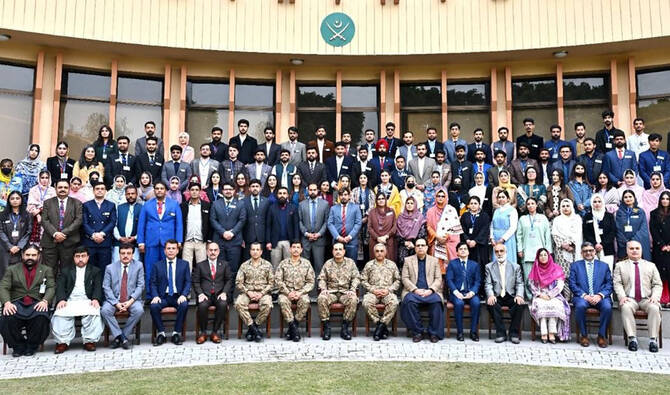
Pakistan’s Chief of Defense Forces (CFD) Field Marshal Syed Asim Munir (center front row) poses for a group photo along with the participants of the 18th National Workshop on Balochistan (NWB) at the General Headquarters of the military in Rawalpindi, Pakistan, on December 31, 2025. (ISPR)
Short Url
Updated 31 December 2025
Follow

Pakistan’s defense chief accuses ‘Indian-sponsored proxies’ of fueling violence in Balochistan

  • Field Marshal Syed Asim Munir speaks to participants of 18th National Workshop on Balochistan
  • Warns violation of Pakistan’s territorial integrity will be met with a “firm and decisive response”

ISLAMABAD: Pakistan’s Chief of Defense Forces (CFD) Field Marshal Syed Asim Munir on Wednesday blamed militant groups allegedly sponsored by India for fueling violence and disrupting development in the province, warning the military will foil their designs. 

Munir was speaking to participants of the 18th National Workshop on Balochistan (NWB) at the General Headquarters of the military in Rawalpindi. The NWB features discussions on Pakistan’s policies on security, development and other challenges related to Balochistan by officials, leaders and citizens. 

Pakistan accuses India of sponsoring militant groups in its southwestern Balochistan province, who demand independence from Islamabad. India rejects the allegations. These ethnic Baloch militant groups accuse Pakistan’s government and military of denying locals a share in the province’s mineral wealth, charges that both deny. 

“Highlighting the security challenges, the COAS & CDF remarked that Indian-sponsored proxies continue to propagate violence and disrupt development in Balochistan,” the Inter-Services Public Relations (ISPR), the military’s media wing, said in a statement.

“He reaffirmed that such inimical designs will be thwarted through stern actions by security forces to rid the province of terrorism and unrest.”

The Pakistani army chief lauded the federal and provincial governments’ initiatives for Balochistan’s development, underscoring a people-centric approach to unlock the province’s “vast economic potential.”

Munir appreciated the civil society for its constructive role in debunking propaganda, the military’s media wing said. 

“He stressed the importance of rejecting vested political agendas to ensure that Balochistan’s future is shaped by long-term prosperity for all its residents,” the ISPR said. 

The CDF reaffirmed Pakistan’s commitment to regional peace but stressed that any violation of the country’s territorial integrity will be met with a decisive response. 

Pakistan suffered a surge in militant attacks in its northwestern and Balochistan provinces this year. As per the Pakistan Institute for Conflict and Security Studies (PICSS) think tank, combat-related deaths in 2025 rose by 73 percent to 3,387, compared with 1,950 in 2024. 

These deaths included 2,115 militants, 664 security forces personnel, 580 civilians and 28 members of pro-government peace committees (combatants), the think tank said in a press release. 

“PICSS noted that most violence remained concentrated in Pashtun-majority districts of Khyber Pakhtunkhwa, including the tribal districts (erstwhile FATA), and in Balochistan,” the think tank said in its report on Sunday. 

Islamabad also accuses Afghanistan of sheltering militants who launch attacks on Pakistan soil. Kabul rejects these allegations and says it cannot be held responsible for Pakistan’s security lapses.


Pakistan showcases smart solutions, tech innovation at ITCN Asia expo in Lahore

Updated 18 January 2026
Follow

Pakistan showcases smart solutions, tech innovation at ITCN Asia expo in Lahore

  • ITCN Asia is Pakistan’s largest information and communications technology exhibition and conference
  • It highlights developments in cybersecurity, cloud computing, AI, e-commerce and digital governance

ISLAMABAD: Pakistan is showcasing its growing technology sector at the 27th edition of ITCN Asia at the Expo Center in Lahore, bringing together innovators, startups, investors and policymakers for one of the country’s premier technology exhibitions, Pakistani state media reported on Saturday.

ITCN Asia is Pakistan’s largest information and communications technology exhibition and conference, which is regularly held to highlight developments in fields including cybersecurity, cloud computing, artificial intelligence, e-commerce and digital governance.

The three-day event, which began on Saturday, focuses on networking, knowledge-sharing and lead generation, with conferences facilitating a learning environment for tech enthusiasts and professionals.

Speaking at the inauguration ceremony, Information Technology Minister Shaza Fatima Khawaja called ITCN Asia a “distinguished” global event showcasing tech advancement in Pakistan, the Radio Pakistan broadcaster reported.

“Pakistan’s use of cybersecurity has put the country on the forefront of technological advancement and strengthened global trust in our technology sector,” she was quoted as saying.

The exhibition features more than 850 booths, over 3,000 global brands, international delegates, investors and government leaders, according to the organizers.

Pakistan’s Special Technology Zones Authority (STZA) is showcasing electric vehicle and electronics assembly by global brands, including BYD, Samsung and Google at the exhibition.

The STZA has set up a national pavilion at the exhibition with facilitation from the Special Investment Facilitation Council (SIFC), according to a statement issued by the cabinet division.

The move is part of Pakistan’s efforts to boost foreign investment in its technology sector as the country’s startups and software houses have attracted global interest in recent years. Pakistan’s IT exports rose by $180 million to $1,057 million during

July-September last year, compared with $877 million in the same period of 2024, according to the information technology ministry.

Pakistan’s technology sector is also advancing in AI and cloud computing, marked by the launch of Pakistan’s first sovereign AI cloud in November, designed to keep sensitive data domestic and support growth in the broader digital ecosystem.