Qatar’s emir, Putin discuss Ukraine conflict’s impact on energy markets

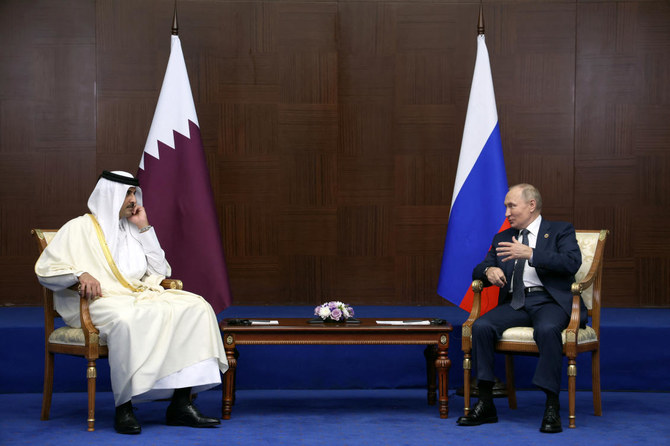
Qatar’s Sheikh Tamim bin Hamad Al-Thani, left, meets with Russia’s Vladimir Putin in Astana, Kazakhstan on Oct. 13, 2022. (Sputnik via Reuters)
Short Url
Updated 13 October 2022
Follow

Qatar’s emir, Putin discuss Ukraine conflict’s impact on energy markets

  • Meeting was meant as an attempt to smooth over tensions between Russia and Qatar

DOHA: Qatar’s emir and Russian President Vladimir Putin discussed the Ukraine crisis and its impact on energy markets during a meeting on the sidelines of a summit in Kazakhstan on Thursday, the emir’s office said.
Sheikh Tamim bin Hamad Al-Thani and Putin also discussed the conflict’s impact on food security as well as the situation in Libya, Syria and the Iran nuclear talks, the office added.
The meeting was meant as an attempt to smooth over tensions between Russia and Qatar, which have grown since the Ukraine crisis broke out earlier this year, a source familiar with the talks said on Wednesday.
Major gas-exporter Qatar has sought a largely neutral stance on the conflict but moves by the Gulf Arab state, including its recent criticism of Russia’s annexation of Ukrainian territory, have recently irked Moscow, the source said.
Qatar “needs cordial relations with Russia and others in the region,” in order to continue to play a role as a conflict mediator, the source said.
“Qatar’s Emir emphasized support for all international and regional efforts to find an immediate peaceful solution to the Ukraine crisis and affirmed the necessity of respecting the sovereignty of states,” the statement from the emir’s office said.


Syrian army declares a closed military zone east of Aleppo as tensions rise with Kurds

Updated 5 sec ago
Follow

Syrian army declares a closed military zone east of Aleppo as tensions rise with Kurds

ALEPPO, Syria: The Syrian army on Tuesday declared an area east of the northern city of Aleppo a “closed military zone,” potentially signaling another escalation between government forces and fighters with the Kurdish-led Syrian Democratic Forces.
Several days of clashes in the city of Aleppo last week that displaced tens of thousands of people came to an end over the weekend with the evacuation of Kurdish fighters from the contested neighborhood of Sheikh Maqsoud.
Since then, Syrian officials have accused the SDF of building up its forces near the towns of Maskana and Deir Hafer, about 60 km (37 mi) east of Aleppo city, something the SDF denied.
State news agency SANA reported that the army had declared the area a closed military zone because of “continued mobilization” by the SDF “and because it serves as a launching point for Iranian suicide drones that have targeted the city of Aleppo.”
On Saturday afternoon, an explosive drone hit the Aleppo governorate building shortly after two Cabinet ministers and a local official held a news conference on the developments in the city. The SDF denied being behind the attack.
The army statement Tuesday said armed groups should withdraw to the area east of the Euphrates River.
The tensions come amid an impasse in political negotiations between the central state and the SDF.
The leadership in Damascus under interim President Ahmad Al-Sharaa signed a deal in March with the SDF, which controls much of the northeast, for it to merge with the Syrian army by the end of 2025. There have been disagreements on how it would happen.
Some of the factions that make up the new Syrian army, formed after the fall of former President Bashar Assad in a rebel offensive in December 2024, were previously Turkiye-backed insurgent groups that have a long history of clashing with Kurdish forces.
The SDF has for years been the main US partner in Syria in fighting against the Daesh group, but Turkiye considers the SDF a terrorist organization because of its association with the Kurdistan Workers’ Party, or PKK, which has waged a long-running insurgency in Turkiye. A peace process is now underway.
Despite the long-running US support for the SDF, the Trump administration in the US has also developed close ties with Al-Sharaa’s government and has pushed the Kurds to implement the March deal.
Shams TV, a station based in Irbil, the seat of northern Iraq’s semi-autonomous Kurdish region, had been set to air an interview with Al-Sharaa on Monday but later announced it had been postponed for “technical” reasons without giving a new date for airing it.