

Latvia engaged in ‘brutal’ pushback against migrants: Amnesty International

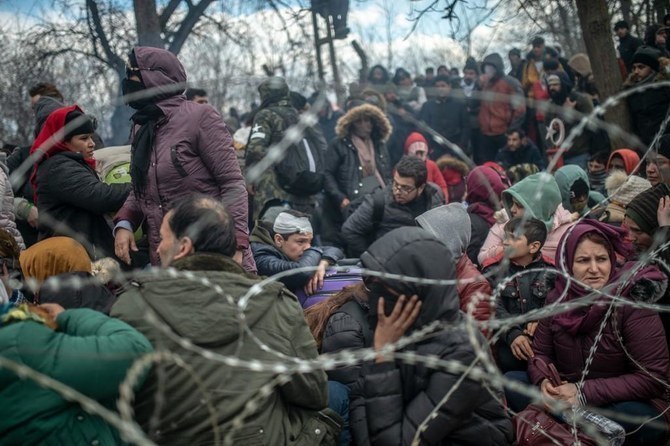
Migrants at border crossing between Turkey and Greece. Latvian authorities have “brutally treated” refugees and migrants trying to cross the Belarus border, reported Amnesty International. (AFP/File)
Short Url
Updated 13 October 2022
Follow

Latvia engaged in ‘brutal’ pushback against migrants: Amnesty International

  • Iraqis subjected to beatings, arbitrary detention, naked marches in snow, organization told
  • ‘These actions have nothing to do with border protection and are brazen violations of international and EU law’

LONDON: Authorities in Latvia have “brutally treated” refugees and migrants trying to cross the Belarus border, Amnesty International reported, warning that human rights violations have been committed, including arbitrary detention and torture.

Amnesty interviewed several Iraqi migrants who said they were subjected to violence, including beatings and electric shocks using tasers.

Eve Geddie, Amnesty International European Institutions Office director, said: “Latvia has given refugees and migrants a cruel ultimatum: Accept to return ‘voluntarily’ to their country, or remain stranded at the border facing detention, unlawful returns and torture. In some cases, their arbitrary detention at the border may amount to enforced disappearance.

“The Latvian authorities have left men, women and children to fend for themselves in freezing temperatures, often stranded in forests or held in tents.

“They have violently pushed them back to Belarus, where they have no chance of seeking protection.

“These actions have nothing to do with border protection and are brazen violations of international and EU law.”

Amnesty’s findings come a year after Latvia introduced emergency measures to cut the number of people arriving from the Belarus border.

The rules mean that Latvian authorities can deny arrivals the right to seek asylum — a violation of EU and international law.

Under the state of emergency, which has been continuously extended since its implementation, Latvian guards, police and military officials have engaged in a deliberate policy to violently return refugees and asylum seekers to Belarus, Amnesty warned.

Zaki, an Iraqi who stayed on the Latvian border, told Amnesty that he had been denied entry more than 150 times over the course of a three-month period.

Another Iraqi, Hassan, said: “They forced us to be completely naked. Sometimes they beat us when naked and then they forced us to cross back to Belarus, sometimes having to cross a river which was very cold. They said they would shoot us if we didn’t cross.”

Hassan was repeatedly threatened during his ordeal, and warned by a Latvian commando that he would be killed if he returned.

Another man, Omar, said he was beaten by an officer, who forced him to sign return papers: “He held my hand and said you should do the signature, and then with force, he made me do the signature.”

Latvian authorities also used makeshift tents to arbitrarily detain migrants, forcing them to stay in winter conditions outdoors where temperatures fall as low as -20 degrees Celsius.

Adil, from Iraq, told Amnesty: “We used to sleep in the forest on the snow. We used to light fire to get warm, there were wolves, bears.”

Amnesty also found that Latvian authorities regularly confiscated the mobile phones of arriving refugees and asylum seekers.

The organization warned that the combined phone-confiscation tactic and use of arbitrary detention could amount to a deliberate policy of enforced disappearance.

Geddie said: “Latvia, Lithuania and Poland continue to commit grave abuses under the pretext of being under a ‘hybrid attack’ from Belarus.

“As winter approaches and movements at the border have resumed, the state of emergency continues to allow Latvian authorities to unlawfully return people to Belarus.

“Many more could be exposed to violence, arbitrary detention and other abuses, with limited or no independent oversight.

“Latvia’s shameful treatment of people arriving at its borders presents a vital test for European institutions, which must take urgent measures to ensure that Latvia ends the state of emergency and restores the right to asylum across the country for everyone seeking safety, irrespective of their origin or how they crossed the border.”


Junta leader Gen. Mamdi Doumbouya is declared winner of Guinea’s election, provisional results show

Updated 31 December 2025
Follow

Junta leader Gen. Mamdi Doumbouya is declared winner of Guinea’s election, provisional results show

  • Mamady Doumbouya took power in 2021 coup

CONAKRY, Guinea: Guinea coup leader ​Mamady Doumbouya has been elected president, according to provisional results announced on Tuesday, completing the return to civilian rule in the bauxite- and iron ore-rich West African nation.
The former special forces commander, thought to be in his early 40s, seized power in 2021, toppling then-President Alpha Conde, who had been in office since 2010. It was one in a series of nine coups that have reshaped politics in West and Central Africa since 2020.
The provisional results announced ‌on Tuesday showed Doumbouya ‌winning 86.72 percent of the December 28 vote, ‌an ⁠absolute majority ​that allows ‌him to avoid a runoff.
The Supreme Court has eight days to validate the results in the event of any challenge.
Doumbouya’s victory, which gives him a seven-year mandate, was widely expected. Conde and Cellou Dalein Diallo, Guinea’s longtime opposition leader, are in exile, which left Doumbouya to face a fragmented field of eight challengers.
Doumbouya reversed pledge not to run
The original post-coup charter in Guinea barred junta members from running ⁠in elections, but a constitution dropping those restrictions was passed in a September referendum.
Djenabou Toure, the ‌country’s top election official who announced the results on ‍Tuesday night, said turnout was 80,95 percent. However ‍voter participation appeared tepid in the capital Conakry, and opposition politicians rejected ‍a similarly high turnout figure for the September referendum.
Guinea holds the world’s largest bauxite reserves and the richest untapped iron ore deposit at Simandou, officially launched last month after years of delay.
Doumbouya has claimed credit for pushing the project forward and ensuring Guinea benefits ​from its output.
His government this year also revoked the license of Emirates Global Aluminium’s subsidiary Guinea Alumina Corporation following a refinery dispute, ⁠transferring the unit’s assets to a state-owned firm.
The turn toward resource nationalism — echoed in Mali, Burkina Faso and Niger — has boosted his popularity, as has his relative youth in a country where the median age is about 19.
Political space restricted, UN says
Political debate has been muted under Doumbouya. Civil society groups accuse his government of banning protests, curbing press freedom and restricting opposition activity.
The campaign period was “severely restricted, marked by intimidation of opposition actors, apparently politically motivated enforced disappearances, and constraints on media freedom,” UN rights chief Volker Turk said last week.
On Monday, opposition candidate Faya Lansana Millimono told a press conference the election was marred by “systematic fraudulent practices” and ‌that observers were prevented from monitoring the voting and counting processes.
The government did not respond to a request for comment.