

Iran clamps down on school protests over compulsory hijab

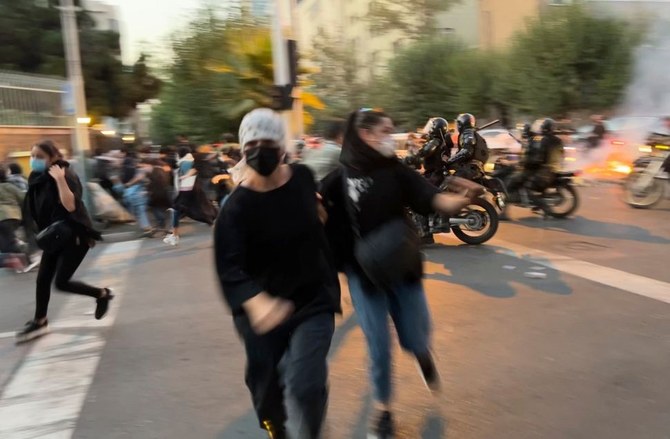
Young women run away from anti-riot police during a protest over the death in custody of 22-year-old student Mahsa Amini, Tehran, Iran, Sept. 19, 2022. (AP Photo)
Short Url
Updated 12 October 2022
Follow

Iran clamps down on school protests over compulsory hijab

  • Students arrested and taken to ‘psychological correctional facilities,’ says education minister
  • The protests were triggered by the death in custody of 22-year-old student Mahsa Amini

LONDON: Iran has begun arresting teenage schoolgirls and students who have taken part in anti-regime protests following the death of Mahsa Amini, according to The Times.

Students who have been protesting the compulsory wearing of the hijab have been arrested and taken to “psychological correctional facilities” for “reform,” said the Iranian education minister.

Police have begun turning up to schools and demanding to see lists of pupils who have taken part in protests, particularly girls. They have met with resistance from some schools, and at least one headmistress has been arrested for refusing to comply.

Yousef Nouri, the education minister, said in an interview with a reformist local newspaper, Sharq: “We don’t have any pupils in prison and those who have been arrested have been referred to psychological centers for correction and education to prevent them from becoming antisocial characters.”

Some of the most dramatic pictures from the last month of protest in Iran have been of schoolgirls and students at all-women universities demonstrating and holding their hijabs high in the air. The protests were triggered by the death in custody of 22-year-old student Mahsa Amini, who had been arrested by Iran’s morality police for not wearing her headscarf properly.

One parent said the head of a religious school in Tehran, who had been sympathetic to the girls, had been forced to summon a parents’ meeting. She said she had been told to report all absentees and protesting students.

“She told the parents she has not done so until now and trusts all her staff, too, but is fearful of others reporting them and she feels responsible for the well-being of every pupil,” the parent said.

The representative body of teachers’ unions said that one head was arrested on Tuesday for refusing to comply with similar demands. “Mrs Oghabneshin, the director of the Khamenei Girls’ school in Karaj, was arrested in front of the students, for refusing to hand over the CCTV footage to the officers and deleting it,” it said in a statement. “Her fate is unknown.”

At another Tehran school, a teacher described how the Basij, the paramilitary policing arm of the Revolutionary Guard, turned up after the head failed to respond to a request for names. “The Basij came to identify some of the students who stood out through the way they wore their uniform,” the teacher said.

The teachers’ union body had been harshly critical of the education ministry for expecting school leaders to become “the executive arm of the security forces” and backed heads who refused to comply with its demands, a sign of the openness with which the protests are being discussed in the country. It called for more information on what had happened to detained students.

It said at least 28 students had been killed in the wave of protests, though it did not break that down into school-age and university students. At least 23 minors are said to have been killed in the past month across the country, according to human rights groups based outside Iran, which put the total number of deaths from all protests at 201.

In a television appearance, the supreme leader, Ayatollah Ali Khamenei, repeated his earlier claims that the protests are being stirred up from abroad.

“The actions of the enemy, such as propaganda, trying to influence minds, creating excitement, encouraging and even teaching the manufacture of incendiary materials, are now completely clear,” he said.


Documentary highlights Israeli brutality

Updated 5 sec ago
Follow

Documentary highlights Israeli brutality

  • ‘American Doctor’ shows bravery of men voluntarily going to work in hospitals repeatedly hit by Israeli army
  • Despite a fragile ceasefire in place since October last year, there has been continued violence between Israeli forces and Hamas, which has seen Palestinian non-combatants killed, including dozens of children

PARK CITY, US: At the start of “American Doctor,” a new documentary about US medics working in hospitals in the Gaza Strip during the Israel-Hamas war, director Poh Si Teng initially declines to film pictures of dead Palestinian children that one of the doctors is trying to show her.

Teng worries that she will have to pixelate the gruesome scene to protect the dignity of the children.
“You’re not dignifying them unless you let their memory, their bodies, tell the story of this trauma, of this genocide. You’re not doing them a service by not showing them,” Jewish-American doctor Mark Perlmutter tells her.
“This is what my tax dollars did. That’s what your tax dollars did. That’s what my neighbor’s tax dollars did. They have the right to know the truth.
“You have the responsibility, as I do, to tell the truth. 
You pixelate this, that’s journalistic malpractice.”
Teng’s unflinching film follows Perlmutter and two other American doctors — one Palestinian American and the other a non-practicing 
Zoroastrian — as they try to treat the results of the unspeakable brutality visited on a largely civilian population in Gaza since Israel launched its retaliation for Hamas’s October 2023 attack.
Alongside the severed limbs and the open wounds, the doctors labor on with their Palestinian colleagues, we also see the trio’s attempts at advocacy — in Washington’s corridors of power and in Israeli and American media.
The documentary also depicts the practical difficulties they face — the surgical scrubs and antibiotics they have to smuggle across the border to get around the Israeli blockade, and the last-minute refusals of Israeli authorities to let them in.
And we see the bravery of men voluntarily going to work in hospitals that are repeatedly hit by the Israeli army.
Israel rejects accusations its numerous strikes against Gaza hospitals amount to war crimes, saying it is targeting “terrorists” in these facilities and claims Hamas operatives are holed up in tunnels underneath the hospitals.
The attacks include the so-called “double tap” strike on the Nasser Hospital in Khan Younis, in the south of the Strip, in August 2025 where the three men have worked.
Emergency responders and journalists who had rushed to the scene after a first projectile hit were killed when a second was fired at the same spot.
Feroze Sidwha, perhaps the most eloquent of the three doctors, repeatedly makes the case throughout the film that he has never seen any tunnels and that, in any case, even the presence of wounded fighters in a hospital does not make it a legitimate target.
“Americans deserve the opportunity to know what’s going on, what their money is being used for, and you know, just to decide. ‘Do you really want this being done?’,” he said at the Sundance Film Festival, where the film got its premiere on Friday.
“I’m pretty sure the answer is ‘no’. I just want to keep speaking out and letting people know they don’t have to be an accessory to child murder. But we all are, right now.”
The film is dedicated to the around 1,700 healthcare workers who have been killed since Israel launched its invasion in October 2023.
UN investigators have accused Israel of committing genocide in Gaza, a charge that Israel has denied as “distorted and false,” while accusing the authors of antisemitism.
Despite a fragile ceasefire in place since October last year, there has been continued violence between Israeli forces and Hamas, which has seen Palestinian non-combatants killed, including dozens of children, according to UNICEF.
Reporters Without Borders says nearly 220 journalists have died since the start of the war, making Israel the biggest killer of journalists worldwide for three years running.
The Sundance Film Festival runs until Feb. 1.