

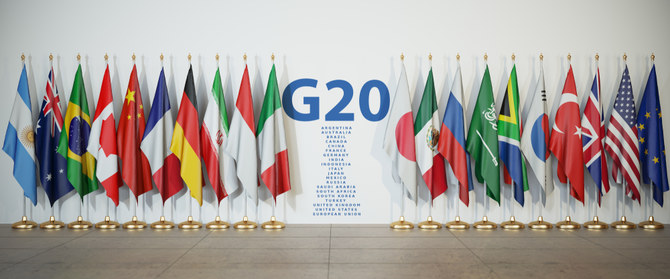
Saudi Arabia still fastest growing G20 economy despite economic headwinds: IMF

The US-based financial agency fixed its forecast for the Saudi economy’s growth during 2022 at 7.6 percent (Shutterstock)
Short Url
Updated 13 November 2022
Follow

Saudi Arabia still fastest growing G20 economy despite economic headwinds: IMF

RIYADH: Saudi Arabia will maintain its position as the fastest growing economy among the Group of 20 countries despite the turmoil caused by rising inflation and soaring interest rates, according to the International Monetary Fund.

In its latest report, the US-based financial agency fixed its forecast for the Saudi economy’s growth during 2022 at 7.6 percent — the same figure as in its April forecast.

Among Arab countries, the IMF expected that Iraq will be the fastest growing economy in 2022, with a 9.3 percent growth rate. 

“The IMF staff’s baseline fiscal projections are primarily based on its understanding of government policies as outlined in the 2022 budget,” according to the report. 

The forecast for Saudi Arabia is in contrast with the IMF’s expectations during January, which put an expected growth rate of the Kingdom’s gross domestic product at 4.8 percent. 

For the year 2023, the Fund has also kept its forecast for the Kingdom’s economic growth at 3.7 percent — the same as its previous outlook. 

India is ranked second among G20 nations for growth this year, with 6.8 percent, despite a reduction of 0.6 points from previous expectations in July. 

Following that comes Indonesia with 5.3 percent, Turkey at 5 percent, Argentina at 4 percent, Australia 3.8 percent, while the UK was expected to achieve 3.6 percent. 

Among Arab countries, Saudi Arabia is ranked third, behind Iraq, and Kuwait at 8.7 percent.

Egypt is placed fourth at 6.6 percent and the UAE at 5.1 percent.

On a global level, the Fund has downgraded its outlook for the world economy for 2023, citing a long list of threats that include Russia’s war against Ukraine, chronic inflation pressures, punishing interest rates and the lingering consequences of the global pandemic.

It forecast that the global economy would eke out growth of just 2.7 percent next year, down from the 2.9 percent it had estimated in July. 

The IMF left unchanged its forecast for international growth this year — a modest 3.2 percent, a sharp deceleration from last year’s 6 percent expansion.

“The global environment is fragile with storm clouds on the horizon,” the report stated.

The IMF warned that any sharp downturn would be acutely felt by emerging market economies, where they are grappling with a “multitude of risks” like high borrowing costs, high inflation, and volatile commodity markets. 

The IMF also cautioned that credit spreads have widened substantially in the corporate sector, and higher rates could adversely impact housing markets.


Saudi-Japanese Ministerial Investment Forum witnesses the signing of 12 MoUs

Updated 6 sec ago
Follow

Saudi-Japanese Ministerial Investment Forum witnesses the signing of 12 MoUs

RIYADH: The Saudi-Japanese Ministerial Investment Forum saw the signing of 12 memorandums of understanding across a wide range of sectors, including space,  finance and agriculture.

The event aimed to enhance bilateral investment and trade cooperation, facilitate access to new investment opportunities, and review joint initiatives in key industries, including energy, machinery, and equipment, according to the Saudi Press Agency.

This cooperation will further strengthen the investment partnership between Saudi Arabia and Japan, particularly within the framework of the Saudi-Japanese Vision 2030, which aims to deepen economic collaboration and foster long-term strategic ties between the two nations.

The Kingdom has long been a key partner for Japan from an energy security perspective, serving as a stable and reliable supplier of crude oil for many years.

This relationship aligns with Japan’s strong commitment to supporting Saudi Arabia through the sharing of expertise and the transfer of advanced technologies that contribute to sustainable economic development.

The forum also explored ways to strengthen efforts to develop economic ties between the two countries and enable the private sector to capitalize on investment opportunities.
 
The forum was held under the umbrella of “Invest in Saudi Arabia” in the presence of Prince Faisal bin Bandar bin Sultan, president of the Saudi Esports Federation, the Minister of Investment Khalid bin Abdulaziz Al-Falih, and the Minister of Communications and Information Technology Abdullah bin Amer Al-Swaha.

Among the attendees from Japan was the country’s Minister of Economy, Trade and Industry Ryosei Akazawa along with the participation of a number of government officials, as well as representatives from major Saudi and Japanese companies.

In an interview with Al-Ekhbariya, Al-Falih said: “Japan is our third largest trading partner and one of the largest investors in the Kingdom, with investments exceeding SR25 billion ($6.67 billion), if I recall correctly.

“However, our ambition is to see this mutual trade and investment, particularly Japanese investments in the Kingdom, grow.”

He added: “Specifically, we are looking to focus on promising sectors targeted by the new Japanese Prime Minister, sectors that align perfectly with the Kingdom’s Vision 2030: the technology sector, the gaming sector, electronics, and digital content; the green energy sector, and renewable energy, which the Japanese need.” 

The minister went on to note that the Kingdom was the first country to export carbon-free ammonia products to Japan.

In his speech during the forum, Al-Falih stated that Saudi Arabia is preparing to begin exporting green hydrogen to Japan soon, Al-Eqtisadiah reported.