

Pakistan announces plan to develop Port Qasim into climate-resilient industrial complex

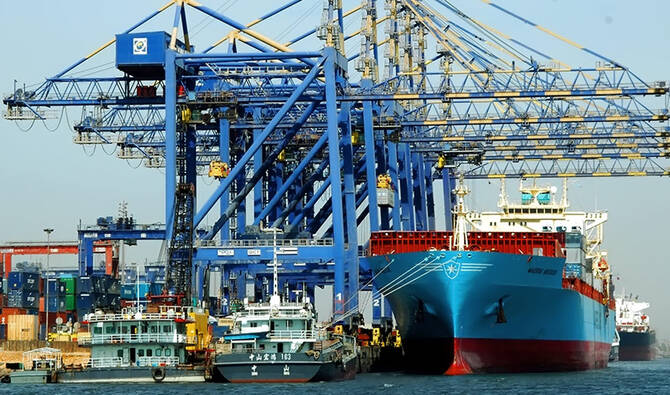
The undated pictures shows ships docked at Port Qasim in Karachi, Pakistan. (Port Qasim Authority)
Short Url
Updated 12 January 2026
Follow

Pakistan announces plan to develop Port Qasim into climate-resilient industrial complex

  • Port Qasim handles 51% of Pakistan’s sea trade, facilitates Islamabad’s trade with Central Asian states
  • Maritime affairs ministry says 833 industrial units currently operational at Port Qasim, with 40 under construction

KARACHI: Pakistan’s Maritime Affairs Ministry announced on Monday that it aims to develop Port Qasim into a climate-resilient industrial complex, saying the move would create jobs, usher in investment and ensure sustainable development for the country. 

According to its website, Port Qasim is one of the largest contributors to Pakistan’s economy, handling 51 percent of the country’s sea trade. The port also connects directly to Pakistan’s national highway and motorway network, facilitating trade between Afghanistan and the Central Asian Republics.

Pakistan has recently attempted to upgrade its port infrastructure to handle higher trade volumes and improve connectivity between sea lanes and landlocked Central Asian states, leveraging its geographic position at the crossroads of South and Central Asia. 

Maritime Affairs Minister Junaid Anwar Chaudhry chaired a meeting to discuss projects related to Port Qasim, the ministry said in a statement. 

“During the meeting, a long-term plan for a climate-resilient industrial complex at Port Qasim was announced,” the statement said. 

Chaudhry said Port Qasim would be developed into a global industrial and logistics hub, adding that it will become a “key gateway” for Pakistan’s national economy.

Officials briefed the minister that the development project for the port would cover an area of more than 14,000 acres. The port’s industrial complex has been divided into three distinct zones, with the eastern one designated for heavy industry and export-oriented units, and the northwestern zone for the promotion of value-added industries and port services.

The southwestern zone of the complex has been earmarked for special industrial and commercial activities, the ministry said. 

Chaudhry said 833 industrial units are currently operational at the port while 40 are under construction. He also reaffirmed the government’s commitment to modernizing port infrastructure and improving road and rail connectivity.

“Junaid Anwar Chaudhry said the Port Qasim Industrial Complex will emerge as a hub for employment generation, investment, and sustainable development,” the statement said. 

Pakistan seeks to upgrade streamline port operations and enhance trade relations with regional countries as it seeks to escape a prolonged macroeconomic crisis that has put a strain on its resources and triggered a balance of payments crisis in the country over the past few years. 


Pakistan finance chief calls for stronger emerging market voice during Saudi conference

Updated 12 February 2026
Follow

Pakistan finance chief calls for stronger emerging market voice during Saudi conference

  • Aurangzeb tells Saudi state media developing economies must assume larger global role
  • Minister says AlUla conference can strengthen coordination among emerging economies

KARACHI: Pakistan’s Finance Minister Muhammad Aurangzeb on Thursday called for developing economies to play a greater role in shaping global economic governance in an interview on the sidelines of the AlUla Conference for Emerging Market Economies in Saudi Arabia.

The conference, hosted by the Kingdom’s Finance Ministry, brings together top government functionaries, central bank governors and policymakers from emerging markets to discuss debt sustainability, macroeconomic coordination and structural reforms amid global economic uncertainty.

In a conversation with the Saudi Press Agency, Aurangzeb described the conference as a timely platform for dialogue at a moment of heightened geopolitical tensions, trade fragmentation and rapid technological change, including advances in artificial intelligence.

“It is not merely about discussions but about translating deliberations into concrete policy actions and execution over the course of the year,” he said, according to a statement circulated by the Finance Division in Islamabad.

The minister said emerging markets’ growing share of global output and growth should be matched by greater influence in international decision-making.

He noted these economies must strengthen collective dialogue and coordinated policy responses to address shared challenges, adding that the global landscape had evolved significantly since the inaugural edition of the conference.

Aurangzeb expressed confidence that the outcomes of the AlUla Conference would contribute to strengthening coordination among emerging economies and reinforcing their collective voice in shaping a more inclusive and resilient global economic order, the statement added.