OIC calls for global action to ensure access to education for refugees

1 / 3
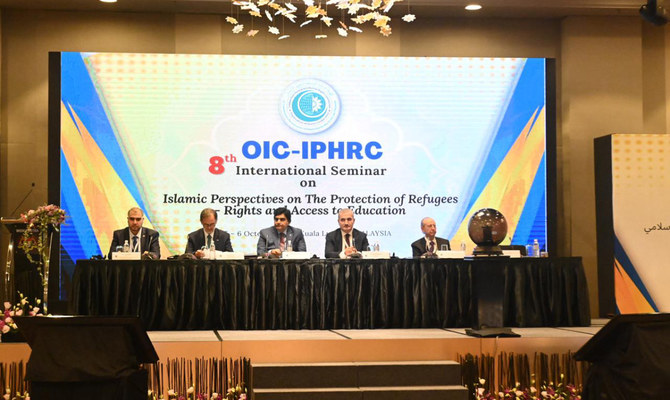
Speakers from a number of countries participate in a symposium organized by the OIC Independent Permanent Human Rights Commission hosted by Kuala Lumpur last week. (OIC/IPHRC)
2 / 3
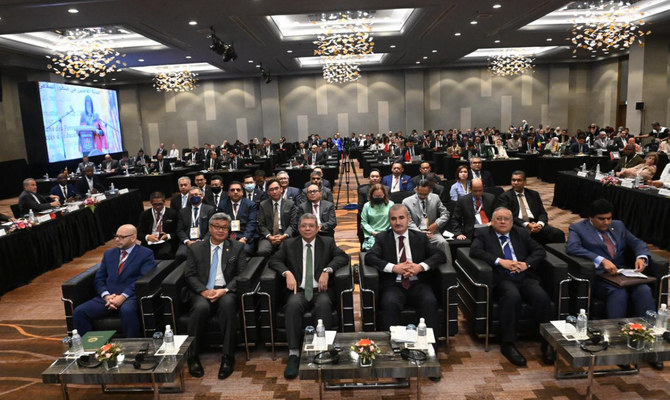
A large number of officials from many countries participated in the symposium organized by the OIC Independent Permanent Human Rights Commission in Kuala Lumpur last week. (OIC/IPHRC)
3 / 3
A group shot of several speakers at the symposium organized by the OIC Independent Permanent Human Rights Commission, held in Kuala Lumpur last week. (OIC/IPHRC)
Short Url
Updated 12 October 2022
Follow

OIC calls for global action to ensure access to education for refugees

  • IPHRC seminar stresses need for ‘identifying gaps, building capabilities of host countries’
  • Participants welcome creation of Global Islamic Refugee Fund

RIYADH: The Organization of Islamic Cooperation has urged the international community to protect the rights of refugees around the world, particularly with regard to their access to education.

The call was made at the end of the eighth annual seminar held by the OIC’s Independent Permanent Human Rights Commission. The two-day event, titled “Islamic Perspectives on Protection of Refugees: Rights and Access to Education,” was held in Kuala Lumpur in collaboration with the Malaysian government. It was attended by IPHRC members as well as experts from academia, multilateral and intergovernmental organizations, and representatives of OIC member and observer states.

The participants called for “identifying gaps and making proposals on ways forward, including building the capacities and capabilities of host countries, to provide the best educational opportunities for refugee children; addressing gender dimensions in refugee education, including online learning opportunities; strengthening national legislation and development plans; improve refugee access to education, and to identify ways to enhance international cooperation to address refugee issues.”

They recommended the adoption by the IPHRC of the “Kuala Lumpur Declaration on Refugee Rights and Access to Education” as the final document of the symposium. They also called for the establishment of a special institution, mechanism or fund within the OIC system through a mandate by the OIC Council of Foreign Ministers with the aim of laying a methodological basis for improving the welfare of refugee communities in OIC countries based on a burden-sharing approach.

IPHRC Chairman Haci Ali Acikgul stressed the need to develop cooperative links between all OIC member states and the commission to promote best practices to ensure the full protection of refugees’ rights in accordance with Islamic teachings and international human rights law. 


Dr. Abdualraheem Almoghathawi

The attendees also welcomed the establishment of the Global Islamic Refugee Fund “as an innovative Shariah-compliant instrument to invest in the humanitarian response to forced displacement,” which was adopted by the Islamic Solidarity Fund for Development — the humanitarian arm of the Islamic Development Bank — in partnership with the UN High Commissioner for Refugees. They also urged OIC member states to support the initiative to address refugee issues and protect their welfare, including the coordination of resources for the purpose of providing education, health services and livelihoods for refugees.

Malaysian Foreign Minister Dato’ Sri Saifuddin bin Abdullah proposed the establishment of an OIC Refugee Education Foundation to design, facilitate and develop interventions in all relevant areas for refugees’ education.

According to UNHCR figures there were about 27.1 million refugees and 4.6 million asylum-seekers worldwide at the end of last year. UNESCO says that 50 percent of the world’s refugees and asylum-seekers are under the age of 18.

Dr. Abdualraheem Almoghathawi, a former professor of graduate studies at the Islamic University of Madinah, said: “Refugees are in a state of alienation and distance from their families, friends and relatives, and therefore they are in an abnormal condition and not qualified to live a decent life.”

Providing educational opportunities at all levels and in accordance with refugees’ needs was one of their most basic rights, he added.

“There are many ways and means to activate this lofty goal, including the formation of a fund for the education of refugees in the world, and its support must be from several reliable bodies.”


Carved by time: Saudi Arabia's hidden geotourism gem of Razan

Updated 4 sec ago
Follow

Carved by time: Saudi Arabia's hidden geotourism gem of Razan

  • Long before modern engineering, the geology of Razan functioned as effective natural infrastructure, sustaining life in an arid environment
  • This utility made Razan a strategic landmark, playing a vital role in the ancient Yemeni Hajj Road

AL-LITH: Sixty kilometers north of Al-Lith governorate in the Kingdom's west, rising above the shifting sands and valleys of the Makkah region, lies a place where the earth itself tells a story. This is Razan, a geological wonder where history is not written in ink, but etched into the stone by the patient hands of wind, water, and time.

Perched atop a high rocky mass and flanked by valleys to the northwest and southeast, Razan stands in natural isolation. This geographic solitude has acted as a guardian, preserving a landscape that feels almost otherworldly — a pristine stage set by nature over millennia.

The place is defined by its striking rock formations: dense clusters of stone, stepped ridges that resemble ancient staircases, and natural ceilings sculpted by the relentless flow of seasonal torrents.

The visual impact is one of dramatic contrast — the heaviness of solid rock balanced against open, airy spaces carved by erosion. Fine channels and intricate flow patterns mark the stone, serving as fossilized evidence of the water that once rushed through these corridors, shaping the land into a rugged work of art.
 

In the quiet majesty of Razan, the past is preserved. (SPA)

Nature’s infrastructure 

But Razan is more than just a scenic marvel; for centuries, it served as a lifeline. The same forces that sculpted the cliffs also hollowed out natural rock basins. These geological depressions acted as seasonal reservoirs, catching rainwater and supplementing nearby wells. Long before modern engineering, the geology of Razan functioned as effective natural infrastructure, sustaining life in an arid environment.

This utility made Razan a strategic landmark, playing a vital role in the ancient Yemeni Hajj Road. The sturdy, elevated terrain provided a natural pathway for pilgrims, offering stability and protection on their spiritual journey toward Makkah.

Today, Razan stands at the intersection of heritage and opportunity. No longer just a passage for pilgrims, it is emerging as a valuable asset for geotourism. Its unique topography offers a visual feast for travelers and a treasure trove for scientists studying geological history.

As Saudi Arabia moves toward the goals of Vision 2030, sites like Razan are finding new purpose. By transforming this geological narrative into a tourism destination, the region aims to preserve its natural heritage while breathing new life into the local economy.