

Nobel laureate Malala Yousafzai returns to Pakistan to visit flood-hit areas

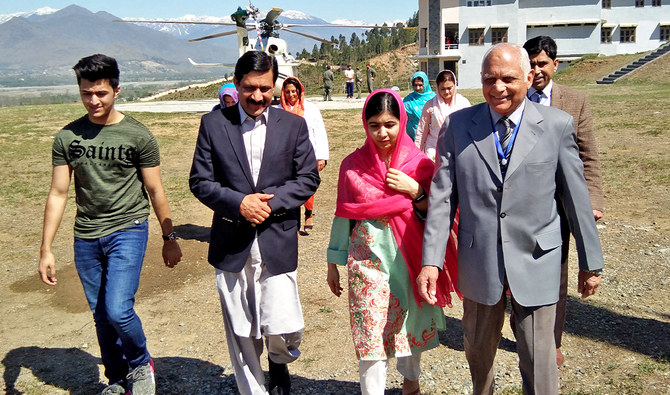
Pakistani activist and Nobel Peace Prize laureate Malala Yousafzai (C), arrives along with her father Ziauddin Yousafzai (2L), brother Atal Yousafzai (L) and the principal of all-boys Swat Cadet College Guli Bagh, during her hometown visit on March 31, 2018. (AFP/File)
Short Url
Updated 11 October 2022
Follow

Nobel laureate Malala Yousafzai returns to Pakistan to visit flood-hit areas

  • Yousafzai was shot in the head by a Pakistani Taliban in 2012 in her native town of Swat for campaigning for girls’ education
  • The details of her visit to Pakistan are still not clear, though her arrival in Karachi was confirmed by the Civil Aviation Authority

ISLAMABAD: Pakistan’s Nobel Peace Prize winner Malala Yousafzai returned to her country on Tuesday, confirmed the Civil Aviation Authority (CAA), to visit flood-hit areas and raise international awareness about the extent of the massive calamity.

Yousafzai was shot in the head by a Pakistani Taliban in 2012 in her native town of Swat for campaigning for girls’ education.

Soon after that, she was flown to the United Kingdom where she received medical treatment and continues to reside.

“Malala Yousafzai arrived in Karachi at 01:45 AM [Tuesday] on Qatar Airways flight 604,” the CAA confirmed in a brief statement.



Pakistan’s Nobel Peace Prize winner Malala Yousafzai (center) is pictured at Jinnah International Airport in Karachi, Pakistan, on October 11, 2022. (Civil Aviation Authority)

According to the local media, the young Nobel laureate is expected to visit flood-affected areas in her country, though the details of her stay in Pakistan have yet not been revealed.

Torrential rains and melting glaciers triggered massive floods in Pakistan that swept away homes, key infrastructure, livestock and crops while affecting the lives of over 33 million people since mid-June.

Pakistan’s Sindh and Balochistan provinces have suffered the most due to the rains and floods.

The erratic weather pattern this year has been widely attributed to the challenge of global climate change.

According to official estimates, Pakistan has lost billions of dollars in the wake of the floods and will need significant international support to carry out the rehabilitation activities.

The United Nations General Assembly recently expressed solidarity with the country while asking the international community to increase aid to support its long-term recovery.

UN chief António Guterres, who also visited Pakistan and witnessed all the devastation, warned in a recent statement the situation was “going from bad to worse” since the country was “on the verge of a public health disaster” after the recent climate catastrophe.


Pakistan PM calls for faster CPEC implementation, pledges security for Chinese workers

Updated 27 February 2026
Follow

Pakistan PM calls for faster CPEC implementation, pledges security for Chinese workers

  • Shehbaz Sharif pushes expanded cooperation in agriculture, IT and mining under CPEC phase two
  • Chinese envoy reaffirms Beijing’s support for Pakistan’s sovereignty and economic development

ISLAMABAD: Prime Minister Shehbaz Sharif on Friday called for speeding up projects under the China-Pakistan Economic Corridor (CPEC) and pledged stronger security guarantees for Chinese workers and investments, during a meeting with China’s ambassador in Islamabad.

Sharif made the remarks as the two countries strive to launch the second phase of CPEC, a multibillion-dollar infrastructure and energy initiative launched in 2015 as part of China’s Belt and Road Initiative (BRI).

CPEC’s first phase focused largely on power generation and transport infrastructure aimed at easing Pakistan’s chronic energy shortages and improving connectivity. The second phase seeks to expand cooperation into industrial development, with an emphasis on special economic zones and export-oriented growth.

“While highlighting the importance of accelerating ongoing CPEC projects, the Prime Minister stressed on the need to enhance cooperation in agriculture and IT and mining & minerals,” said a statement circulated by the PM Office after the meeting.

“He also underscored Pakistan’s resolve to provide a secure and conducive environment for Chinese personnel, investments, and institutions in Pakistan,” it added.

Chinese nationals and projects in Pakistan have faced security threats in the past, including attacks by militant groups targeting infrastructure sites and convoys. Islamabad has repeatedly vowed to tighten security and has deployed special protection units for Chinese workers.

China is Pakistan’s closest ally in the region and a key economic partner, with CPEC widely regarded by Islamabad as central to long-term economic growth.

During the meeting, the prime minister conveyed greetings to Chinese President Xi Jinping and Premier Li Qiang, particularly on the occasion of the Chinese New Year.

China’s Ambassador to Pakistan, Jiang Zaidong, reiterated Beijing’s support for Pakistan’s sovereignty and socioeconomic development, according to the statement. Both sides also exchanged views on regional and international issues and agreed to maintain close coordination.