Putin makes Chechnya’s Kadyrov an army general

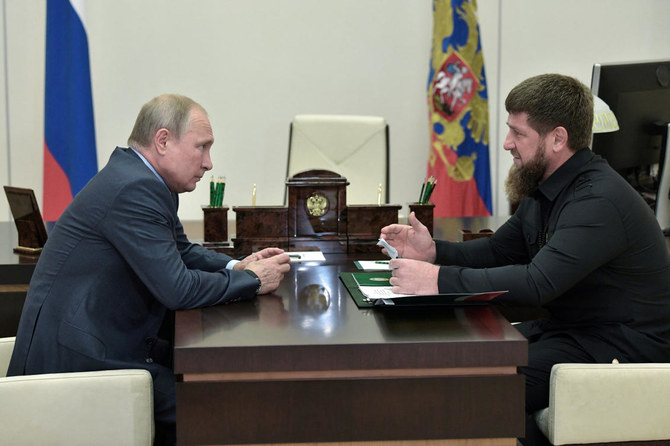
Russia’s President Vladimir Putin meets with head of the Chechen Republic Ramzan Kadyrov at his residence near Moscow in August 2019. (Reuters/File)
Short Url
Updated 05 October 2022
Follow

Putin makes Chechnya’s Kadyrov an army general

  • Kadyrov said Putin had "personally" informed him of the decision
  • "The President of Russia awarded me the rank of colonel general," Kadyrov said on Telegram

MOSCOW: Chechen leader Ramzan Kadyrov, an ally of President Vladimir Putin, said Wednesday he was granted a top rank in Russia’s army, just as Moscow’s forces suffer a series of defeats in Ukraine.
The 46-year-old Chechen leader — one of the most outspoken voices in Russia backing Putin’s Ukraine offensive — said it was a “huge honor” for him.
Kadyrov, a former warlord who rules Chechnya with widespread violations of human rights, said Putin had “personally” informed him of the decision.
“The President of Russia awarded me the rank of colonel general,” Kadyrov said on Telegram. “This is a promotion for me.”
The rank of colonel general is the third highest command rank in the Russian military hierarchy.
Kadyrov’s appointment to the rank came as the Ukrainian army pushed back Moscow’s forces in areas that the Kremlin proclaimed to be “Russian forever.”
The Chechen leader said he would do “everything to end the special military operation quickly” — using the Kremlin’s term for its Ukraine campaign.
Chechen units — including Kadyrov’s own militia with a sinister reputation, the “Kadyrovtsi” — are fighting alongside regular Russian forces in Ukraine.
Kadyrov has thrown his full backing behind Putin’s campaign, regularly calling for the most drastic tactics to be used in Ukraine.
This week he called on Moscow to use low-yield nuclear weapons in Ukraine after Russian troops were forced to retreat from the town of Lyman.
He then said he was sending three of his teenage sons — aged 14,15 and 16 — to the front.


France to vaccinate cattle for lumpy skin disease as farmers protest against cull

Updated 57 min 18 sec ago
Follow

France to vaccinate cattle for lumpy skin disease as farmers protest against cull

  • The announcement comes after several outbreaks of the highly contagious disease prompted authorities to order the culling of entire herds

PARIS: France will vaccinate 1 million head of cattle in the coming weeks against lumpy skin disease, Agriculture Minister Annie Genevard said on Saturday, as protesting farmers blocked roads in opposition to the government’s large-scale culling policy.
The announcement comes after several outbreaks of the highly contagious disease prompted authorities to order the culling of entire herds, sparking demonstrations by farmers who consider the measure excessive.
Lumpy skin disease is a virus spread by insects that affects cattle and buffalo, causing blisters and reducing milk production. While not harmful to humans, it often results in trade restrictions and severe economic losses.
“We will vaccinate nearly one million animals in the coming weeks and protect farmers. I want to reiterate that the state will stand by affected farmers, their losses will be compensated as well as their operating losses,” Genevard told local radio network ICI.
France says that total culling of infected herds, alongside vaccination and movement restrictions, is necessary to contain the disease and allow cattle exports. If the disease continues to spread in livestock farms, it could kill “at the very least, 1.5 million cattle,” Genevard told Le Parisien daily in a previous interview.
A portion of the A64 motorway south of Toulouse remained blocked since Friday afternoon, with about 400 farmers and some 60 tractors still in place on Saturday morning, according to local media.
The government, backed by the main FNSEA farming union, maintains that total culling of infected herds is necessary to prevent the disease from spreading and triggering export bans that would devastate the sector.
But the Coordination Rurale, a rival union, opposes the systematic culling approach, calling instead for targeted measures and quarantine protocols.
“Vaccination will be mandatory because vaccination is protection against the disease,” Genevard said, adding that complete culling remains necessary in some cases because the disease can be asymptomatic and undetectable.
France detected 110 outbreaks across nine departments and culled about 3,000 animals, according to the agriculture ministry. It has paid nearly six million euros to farmers since the first outbreak on June 29.