- Three 44-seater buses will cover routes in Gilgit and Skardu, official
- GB government says will triple number of buses by January or February 2023
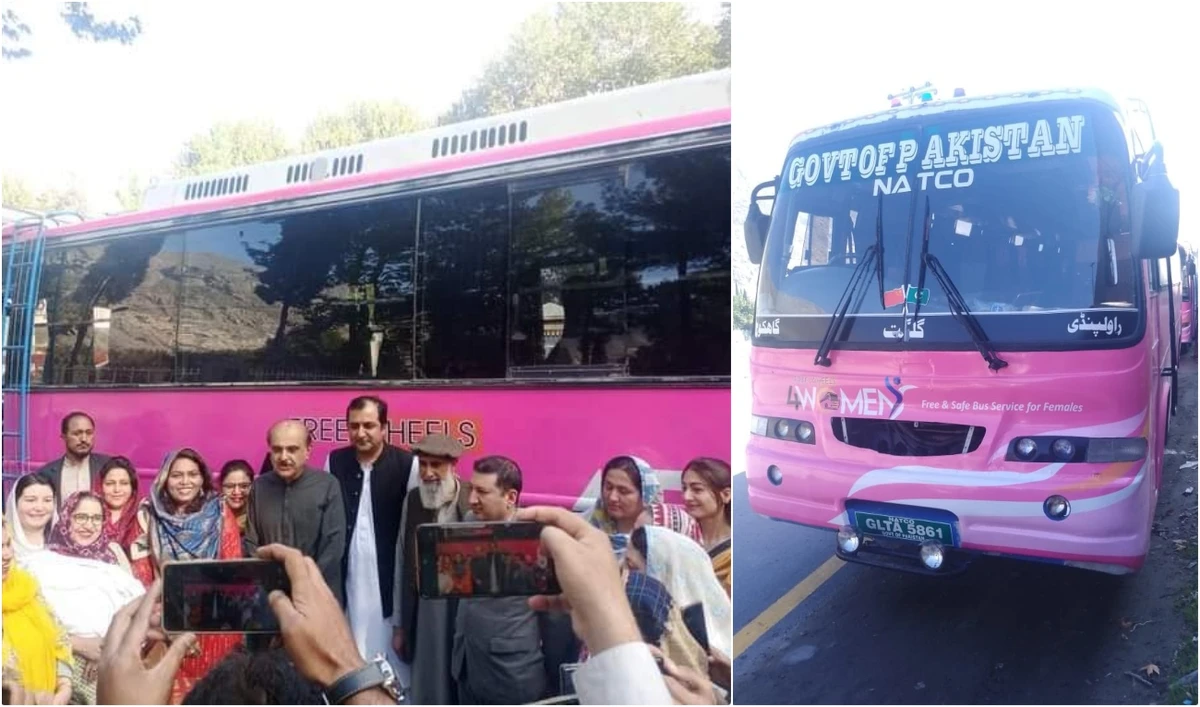
KARACHI: In a first, women in Pakistan’s northern Gilgit-Baltistan (GB) region availed a free-of-cost bus service on Wednesday, dedicated exclusively for women’s transport.
GB Chief Minister Khalid Khurshid launched the ‘Pink Bus Service’ on Tuesday, October 4 to ensure women could avail free and safe transport in the region.
“It’s a first in the history of Pakistan that a free-of-cost bus service has been launched for women in Gilgit-Baltistan,” Mohyuddin Ahmad Wani, GB chief secretary, told Arab News in a telephonic conversation on Wednesday.
Wani said it took him only 10 days to launch the service, from conceiving the idea to its execution. “We renovated the buses we already had, but I plan to buy new ones in the future,” he added.
Wani recalled how he disliked seeing young women suffer as they waited for transport on various roads in GB to commute in the mornings. He said males were forced to drop women at various locations and as a result, had to pay fares for multiple people.
“The Pink Bus Service improves access, reduces financial burden and provides security,” he explained. “It is spacious with 44 seats and covers 80 percent of the routes while it will be operating in rush hours,” Wani added.
Delving into the details of the project, Wani said three buses will travel in the Gilgit and Skardu regions. He said the government plans to expand the service to more areas in the region.
Buses will travel twice a day and between four routes. The Pink Bus Service timings are 06:00 am to 09:00 am and then from 01:00 p.m. to 03:00 pm.
“Students, doctors, teachers, lawyers, and women from various fields of work will benefit from the service,” Wani said. “I have directed the traffic police to facilitate these buses on the roads and I am gathering feedback from women using the service to be able to expand the service,” he added.
“I will triple the number and routes by January or February 2023,” Wani said.
He said women who attended the inauguration and used the buses felt comfortable and secure.
“There has never been such an initiative or a bus service for the general public [in Gilgit Baltistan], let alone women,” Muheen Zaman, a 23-year-old journalist, told Arab News.
“Women in GB used taxis or Suzuki [vehicles] to commute which is quite unsafe and expensive. It’s a good initiative from the GB government,” Zaman added. She hails from GB’s Ghizer District.
Journalist Kiran Qasim, 29, told Arab News women often faced harassment while commuting in vans as two women often had to share the front seat with the driver.
Qasim, who is from Gilgit, said while no action was taken against harassment complaints, it is a relief that women can now travel safely in spacious buses. “The routes are also quite good as women have long commutes for work so they can have a comfortable ride,” she added.
While the bus was launched officially yesterday, the service has begun its operations from today, Wednesday.
Shereen Karim, 27, a freelance journalist based in GB, appreciated the initiative. However, she said the timings aren’t suitable for professionals other than teachers.
“The timings aren’t suitable for working women; these timings, I suppose, are fixed for college and university students,” Karim told Arab News.
“So, it’s a good facility for students who cannot afford transport but not for working women. It would be good if the timings can be extended,” she added.