

Lebanon suggests amendments to maritime border deal with Israel

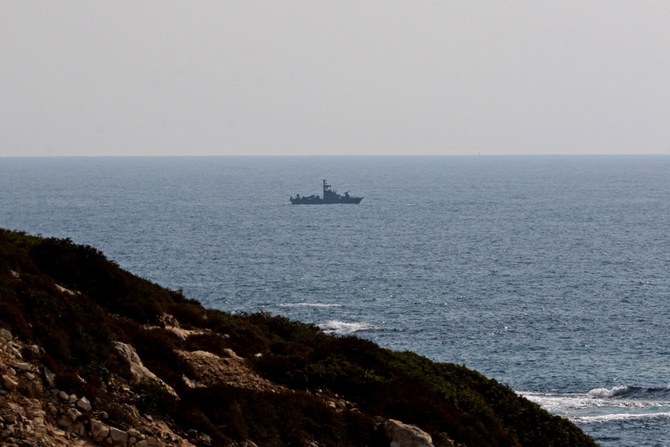
An Israeli Navy vessel patrols in the Mediterranean Sea at the maritime border between Israel and Lebanon, off the southern Lebanese town of Naqoura. (AFP)
Short Url
Updated 05 October 2022
Follow

Lebanon suggests amendments to maritime border deal with Israel

BEIRUT: Lebanon has submitted to the US a list of changes it would like to see in a proposal on how to delineate a contested maritime border with Israel, a top Lebanese official said on Tuesday.
US envoy Amos Hochstein has shuttled between Lebanon and Israel since 2020 to seal a deal that would pave the way for offshore energy exploration and defuse a potential source of conflict between Israel and Iran-backed Lebanese group Hezbollah.
Hochstein sent a draft proposal to Beirut last week. It was discussed on Monday by President Michel Aoun, Prime Minister Najib Mikati and Parliament Speaker Nabih Berri.
Deputy speaker of parliament Elias Bou Saab said he had earlier that day submitted to the US ambassador in Lebanon the amendments Beirut would like to see, without providing details.


SPOTLIGHT

Will maritime-border settlement imply Lebanon’s indirect recognition of Israel?


He said he does not think the proposed changes would derail the deal and that, while the response did not signify approval of the draft, talks were so advanced that “we are done negotiating.”
Speaking to local broadcaster LBCI, he said the draft deal had been produced by thinking “outside of the box.”
“We started to talk about it as a business deal,” Bou Saab said.
The 10-page draft appears to float an arrangement whereby gas would be produced by a company under a Lebanese license in the disputed Qana prospect, with Israel receiving a share of revenues.

Opinion

This section contains relevant reference points, placed in (Opinion field)

While that company has been officially named, Lebanese officials have publicly suggested a role for TotalEnergies SE . A top Israeli official was meeting company representatives in Paris on Monday, according to a source briefed on the matter.
Bou Saab on Tuesday said that, according to the draft deal, Lebanon had secured all of the maritime blocs it considered its own.
He added that Lebanon will not pay one cent from its share of Qana to Israel.


A Cup of Gahwa
The taste and traditions of Saudi coffee

Enter


keywords


Lebanon condemns deadly Israeli strikes on south and east

Updated 5 sec ago
Follow

Lebanon condemns deadly Israeli strikes on south and east

BEIRUT: Lebanon’s president on Saturday condemned deadly Israeli attacks on his country carried out a day prior, the latest despite a ceasefire with militant group Hezbollah.
In a statement, Joseph Aoun called the attacks “a blatant act of aggression aimed at thwarting diplomatic efforts” by the United States and other nations to establish stability.
A lawmaker from Hezbollah called on Beirut to suspend meetings of a multinational committee tasked with monitoring the truce.
Washington is one of five members on the committee overseeing the ceasefire implemented in November 2024, with the body scheduled to meet again next week.
Israel has repeatedly bombed Lebanon despite the ceasefire, usually saying it is targeting Hezbollah but occasionally also the group’s Palestinian ally Hamas.
The Friday attacks on southern and eastern Lebanon killed 12 people, according to the health ministry, 10 of them in the east of the country.
Israel’s military said it struck “several terrorists of Hezbollah’s missile array in three different command centers in the Baalbek area.”
Hezbollah said a commander was killed in the raids. Its lawmaker Rami Abu Hamdan said on Saturday the group “will not accept the authorities acting as mere political analysts, dismissing these as Israeli strikes we have grown accustomed to before every meeting of the committee.”
He called on Beirut to “suspend the committee’s meetings until the enemy ceases its attacks.”
Hezbollah, while weakened following war with Israel, remains a strong political force in Lebanon represented in parliament.
Lebanon’s government last year committed to disarming the group, with the army saying last month it had completed the first phase of the plan covering the area near the Israeli border.
Israel, which accuses Hezbollah of rearming since the war, has called the Lebanese army’s progress on disarming the militant group insufficient.