
BEIRUT: A maritime border dispute between Lebanon and Israel has returned to the fore following a security development on Saturday night.
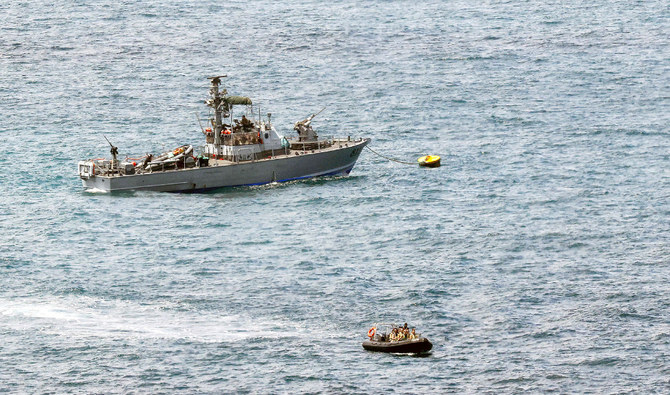
Israel’s army spokesman Avichay Adraee said warplanes and an Israeli missile ship had intercepted three drones that approached from Lebanon’s side toward the airspace over Israel’s economic waters.
Hezbollah’s military wing, the Islamic Resistance, confirmed the incident in a statement: “A group affiliated with martyrs Jamil Skaff and Mahdi Yaghi launched three drones of different sizes toward the disputed area, over the Karish gas field, to carry out reconnaissance missions. The mission was accomplished and the message was conveyed.”
Lebanon mostly stayed silent on the development, although caretaker Foreign Minister Abdallah Bou Habib said there was a possibility of reaching an agreement on the border issue in September and that information from the US and UN showed there was progress in the negotiations.
FASTFACT
Israel’s army spokesman Avichay Adraee said warplanes and an Israeli missile ship had intercepted three drones that approached from Lebanon’s side toward the airspace over Israel’s economic waters.
US mediator Amos Hochstein sent a proposal to Lebanon in March on the demarcation starting from Line 23, which was drawn in a zigzag form.
Lebanon handed him an oral response, which he did not reveal, pending the Israeli response.
Lebanon has been unable to confirm that Line 29 — which includes the Karish gas field — is the maritime border of Lebanon due to the failure of President Michel Aoun to sign a draft amendment to Decree 6433.
It was issued in 2011 and specified that Line 23 was the point for negotiations with Israel to demarcate the maritime borders. However, Aoun considers Line 29 to be the point for negotiations.
Line 29 gives Lebanon an additional area estimated at 1,430 square km while, according to the decree deposited with the UN, Lebanon only gets 860 square km of the disputed area.
Mohammed Yazbeck, Ayatollah Khamenei’s legal representative in Lebanon, said on Sunday: “Lebanon’s preservation of its wealth can only be achieved by informing the enemy that we are strong. The message was delivered by drones. This message is not only for the Israeli enemy but also for the American mediator, to understand that Lebanon’s rights cannot be underestimated or ridiculed.”
Former MP Fares Souaid said: “Hezbollah’s drones over Karish are aimed at reminding all parties that Iran is present in the ongoing negotiations between Lebanon and Israel over border demarcation under American auspices and at the expense of the Lebanese interest.
“The incident confirmed by Hezbollah may take place once again, and more serious incidents may occur. Therefore, we call on the nation’s representatives to raise the issue of Iran’s occupation within Parliament.”
On Sunday, Israeli Prime Minister Yair Lapid said that Hezbollah constituted an “obstacle” to an agreement between Lebanon and Israel.
“The party continues to walk the path of terrorism and undermines Lebanon’s ability to reach an agreement on the maritime borders.”
He said Israel would continue to protect itself, its citizens, and its interests.
Israel’s army said Hezbollah was trying to undermine the country’s sovereignty on the ground, in the air, and at sea. “The economic waters are part of Israel and are not a conflict zone. No discussion is necessary,” it added.
Israeli newspaper Yedioth Ahronoth reported that the drones were flown near the Karish gas field. One was downed by a fighter jet, and the other two were taken out by Barak 8 missiles launched from a missile ship.
It said Hezbollah had sent out different types of drones that flew at low altitudes. They were monitored and intercepted through coordination between the naval and air forces.
The newspaper quoted the Israeli army as saying: “Initial assessments indicated that the drones were not armed and did not pose any threat. This is an attempt to undermine negotiations with Lebanon regarding the maritime border, and Hezbollah wants to destroy Lebanon.”
The report said Hezbollah had previously sent out drones to Israeli territory, but Saturday night’s development was the first time that such an operation had been carried out on the floating gas platform in Karish, where no gas had yet been extracted.
“The incident is a message to Israel that Hezbollah can carry out the threats made by its leader, Hassan Nasrallah, in recent weeks. By launching these drones, Hezbollah acted against the Lebanese interest, despite the progress made in the file of demarcating the maritime borders through the efforts of American mediator Amos Hochstein," it said. "What happened not only violates the negotiations but also indicates that Hezbollah violated its position regarding not taking any action without a Lebanese national agreement or consensus.”