

Pakistan can’t afford flood recovery, seeks help – climate change minister

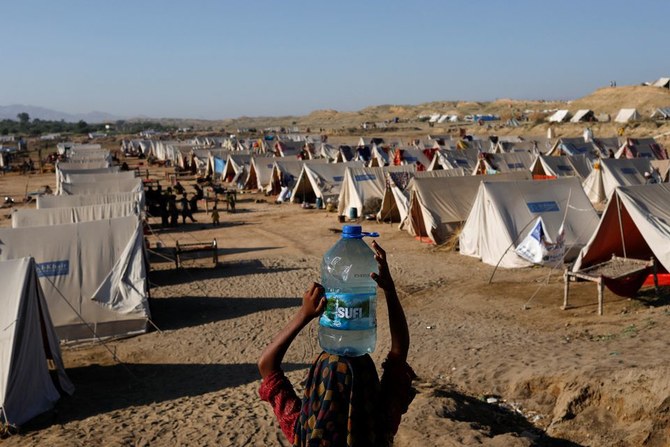
A displaced girl carries a bottle of water she filled from nearby stranded flood-waters, as her family takes refuge in a camp, in Sehwan, Pakistan, September 30, 2022. (REUTERS)
Short Url
Updated 04 October 2022
Follow

Pakistan can’t afford flood recovery, seeks help – climate change minister

  • UN revises up its humanitarian appeal for Pakistan five-fold to $816 million from $160 million
  • Pakistan was “on the verge of a public health disaster,” World Health Organization chief says

ISLAMABAD: Pakistan cannot afford to spend more on recovering from devastating floods blamed on climate change, its climate change minister said on Tuesday, as she called for faster international help at the launch of a new UN appeal for aid.
The United Nations revised up its humanitarian appeal for Pakistan five-fold, to $816 million from $160 million, as a surge of water-borne diseases and fear of growing hunger posed new dangers after weeks of unprecedented flooding.
“We have no space to give our economy any stimulus ... the developed world should accelerate funding for climate hit disasters,” the climate change minister, Sherry Rehman, told a news conference on aid for Pakistan in Geneva.
The floods have submerged huge swathes of the South Asian country and killed nearly 1,700 people. Hundreds of thousands of displaced people are living in the open.
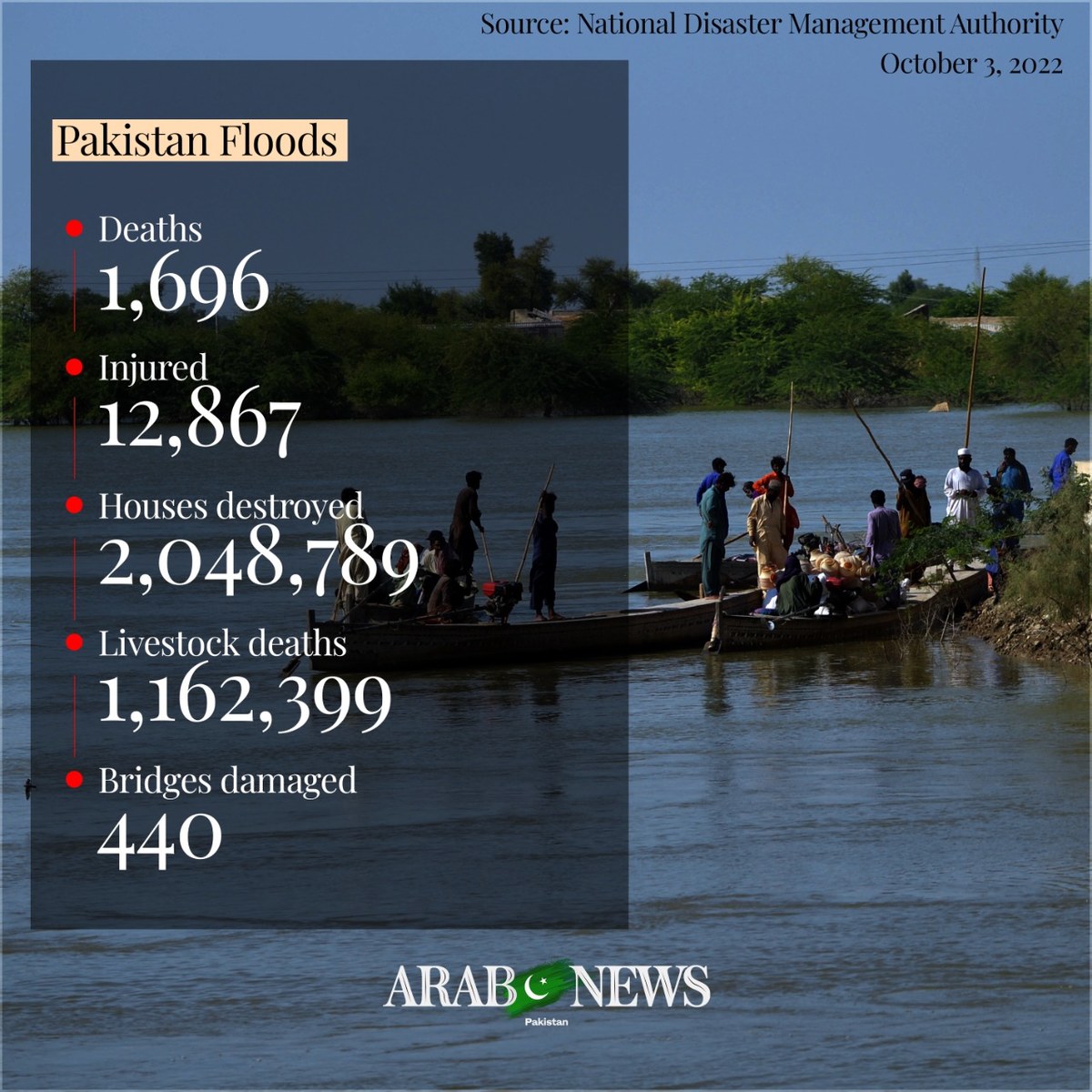

The deluge, brought by record monsoon rains and heavy glacial melt in northern mountains, has impacted 33 million people out of a population of 220 million caused damage the government estimates at $30 billion.
The government and the United Nations have blamed climate change for the disaster.
Julien Harneis, the UN resident coordinator and humanitarian coordinator in Pakistan, said the $816 million target for the appeal was “absolutely not enough.”
Rehman said Pakistan was in urgent need of medicines for 8.2 million people and would need to import extra supplies of food.
Tedros Adhanom Ghebreyesus, director general of the World Health Organization, told the meeting Pakistan was “on the verge of a public health disaster.”


Pakistan’s seafood exports to China rise 24% to $240 million in 2025

Updated 17 sec ago
Follow

Pakistan’s seafood exports to China rise 24% to $240 million in 2025

  • The Chinese embassy cites strong growth in agricultural trade with Pakistan
  • Islamabad aims to expand food exports amid effort to boost foreign reserves

ISLAMABAD: Pakistan’s seafood exports to China rose 24% year-on-year to $240 million in the first 11 months of 2025, the Chinese embassy in Islamabad said on Wednesday, highlighting growing agricultural trade between the two countries.

China is one of Pakistan’s largest seafood export markets, alongside destinations such as Thailand, Vietnam and countries in the Middle East. Pakistan exports fish, shrimp and other marine products sourced from coastal areas in Balochistan and Sindh, including Gwadar, Pasni and Karachi, with shipments typically consisting of frozen fish, frozen shrimp and a smaller volume of processed seafood.

The figure cited by the Chinese embassy fits into a longer upward trend, supported by rising Chinese demand, improvements in cold-chain logistics and market access approvals for Pakistani exporters.

“Pakistan’s seafood exports to China hit [nearly] $240 million from Jan-Nov 2025, soaring by 24% compared with the same period in 2024, which fully shows the strong vitality of the agricultural trade between China & Pakistan,” the embassy said. “[China looks] forward to more export of high-quality Pakistani products to China in the future.”

China is Pakistan’s closest regional ally and a key destination for its agricultural and food exports, which Islamabad has been seeking to expand to bolster foreign exchange earnings.

The two countries enjoy strong strategic and economic cooperation, with Chinese support seen as vital to Pakistan’s efforts to diversify its export base beyond textiles and reduce reliance on external financing.

Beijing and Islamabad are also working closely on energy and infrastructure projects as part of broader efforts to enhance regional connectivity and support industrial development in Pakistan.