

Pakistan's first blockchain property platform gets over $2mln commitments at Dubai exhibit

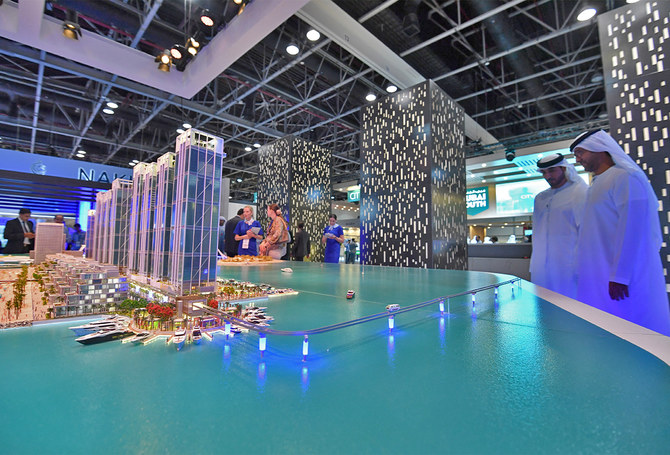
Visitors attend the Cityscape Global exhibition, Dubai's premier property show, in Dubai, UAE on September 11, 2017. (AFP/File)
Short Url
Updated 04 October 2022
Follow

Pakistan's first blockchain property platform gets over $2mln commitments at Dubai exhibit

  • DAO PropTech’s blockchain-based solution offers transparency to real estate investors for informed decision-making
  • Official says overseas Pakistanis are much concerned about lack of transparency in real estate dealings back home

KARACHI: DAO PropTech, Pakistan’s first blockchain-based real estate platform, has attracted investment commitments worth around Rs500 million ($2.2 million) by showcasing its innovative digital ledger system at a property exhibition held in Dubai last month, company officials said on Monday. 

The fourth edition of the Pakistan Property Show was held at the Dubai World Trade Center in the second week of September. It was attended by more than 20,000 visitors, including Pakistanis living in the Emirates. 

“The experience and response in Dubai was overwhelming for us because of our system and we have received pledges worth Rs500 million from overseas Pakistanis,” Muhammad Yahya Chaudhry, a partner and head of marketing at the PropTech decentralized autonomous organization (DAO), told Arab News in an interview on Monday.  

“The system offers a solution to the concerns of overseas Pakistanis who want to invest in Pakistan, but are reluctant due to lack of transparency in real estate dealings.”



DAO PropTech team poses for a picture at Pakistan Property Show at the Dubai World Trade Center in UAE on September 18, 2022. (DAO PropTech)

Formed in 2020, the DAO PropTech real estate investment platform claims to be the first of its kind in Pakistan that enables every Pakistani to invest in real estate as per affordability, promising unmatched transparency, a scientific pricing methodology that ensures added value is transferred to the end user, real-time construction tracking, and a personalized portfolio dashboard. 

There is a huge demand for real estate investment in Pakistan from expats but lack of transparency, including timely delivery, makes it difficult and discourages them to invest in their home country.  

“Overseas Pakistanis were much concerned about the transparency of projects in Pakistan due to bad experiences of their relatives or themselves while investing in Pakistan,” Chaudhry said. 

“However, we addressed their concerns through our 100 percent digital system that offers utmost transparency.” 

Participation in the Dubai property expo was the first appearance of the company outside of Pakistan which, according to Chaudhry, allowed them to introduce a decentralized real estate investment platform abroad. 

Chaudhry said the platform connects developers and investors for a project that makes it to the platform after a thorough vetting process. 

“We have some 72 different scoring matrix – we look at the project through different lenses, including demand, need, actual value, transaction value, history of developers and its legal backing,” he said. “We call it an institutionally qualified project.” 

The South Asian nation is facing a housing shortage but the actual required number of homes remains controversial. Some figures, quoted by the World Bank, suggest that Pakistan is facing a deficit of 10 million housing units, while the Pakistan Credit Rating Agency (PACRA) put the number at around 35.30 million, based on the current and projected population, in its report released in May.  

However, the Pakistan Institute of Development Economics (PIDE) in June ruled out the shortage of housing in Pakistan: “There may be ‘inadequate housing’ in the country, but not ‘housing shortage.’ The deficit is in the quality of life in the houses, not the absence of housing units.” 

In Pakistan, Chaudhry said, the average age to own a first home is 55 years as compared to the other developed countries, where a young person can buy their first house at 26-30 years of age. 

“With proper planning and utmost transparency, housing and other real estate solutions could be provided to investors. If we empower investors to take decisions on the basis of information that could address investment concerns in Pakistan to a large extent,” he said. 

“Many buildings are laying vacant because the purpose of the construction was to invest to reap profits instead of constructing buildings as per requirements.” 

A substantial contribution to the South Asian economy comes from the real estate sector that was around 5.4 percent of the gross domestic product (GDP) in the fiscal year 2020-21, according to PACRA.


Pakistan orders four-day workweek, shuts schools to save fuel amid Middle East oil crisis

Updated 32 min 13 sec ago
Follow

Pakistan orders four-day workweek, shuts schools to save fuel amid Middle East oil crisis

  • The development comes as ongoing US-Israeli strikes on Iran disrupt oil supplies in Strait of Hormuz, push prices past $119 a barrel
  • Islamabad bans government purchases, cuts fuel allocation for vehicles as well as workforce in public and private offices by 50 percent

ISLAMABAD: Prime Minister Shehbaz Sharif on Monday announced austerity measures, including a four-day work week, cuts in government expenditures and closure of schools, to offset the impact of rising global oil prices due to an ongoing conflict in the Middle East.

Global fuel supply lines have been disrupted in the Strait of Hormuz, which supplies nearly a fourth of world oil consumption, after Tehran blocked it following United States-Israeli strikes on Iran and counterattacks against US interests in the Gulf region.

Oil prices surged more than 25 percent globally on Monday to $119.50 a barrel, the highest levels since mid-2022, as some major producers cut supplies and fears of prolonged shipping disruptions gripped the market due to the expanding US-Israeli war with Iran.

In his televised address on Sunday night, Sharif said global oil prices were expected to rise again in the coming days but vowed not to let the people bear their brunt, announcing austerity measures to lessen the impact of fuel price hikes.

“Fifty percent staff in public and private entities will work from home,” he announced, adding this would not be applicable to essential services. “Offices will remain open for four days a week. One-day additional off is being given to conserve oil, but it would not be applicable to banks.”

Sharif didn’t specify working days of the week and the government was likely to issue a notification in this regard.

He said a decrease of 50 percent was being made in fuel allocation for government vehicles immediately for the next two months, but they would not include ambulances and public buses.

“Cabinet members, advisers and special assistants will not draw salaries for the next two months, 25 percent salaries of parliamentarians are being deducted, two-day salaries of Grade 20 and above officers, or those who are paid Rs300,000 ($1,067) a month, are being deducted for public relief,” he said.

Similarly, there will be 20 percent reduction in public department expenses and a complete ban on the purchase of cars, furniture, air conditioners and other goods, according to the prime minister.

Foreign trips of ministers and other government officials will also be banned along with government dinners and iftar buffets, while teleconferences and online meetings will be given priority.

“All schools will be off for two weeks, starting from the end of this week, and all higher education institutions should immediately begin online classes,” he said.

Sharif’s comments were aired hours after Pakistani authorities said the country had “comfortable levels” of petroleum stocks and the supply chains were functioning smoothly, despite intensifying Middle East conflict.

Petroleum Minister Ali Pervaiz Malik said three oil shipments were due to reach Pakistan this week, state media reported.

Meanwhile, Pakistan Navy (PN) launched ‘Operation Muhafiz-ul-Bahr’ to safeguard national energy shipments, the Pakistani military said on Monday, amid disruptions to critical sea lanes due to the conflict.

The navy is conducting escort operations in close coordination with the Pakistan National Shipping Corporation (PNSC), according to the Inter-Services Public Relations (ISPR), the military’s media wing. It is fully cognizant of the prevailing maritime situation and is actively monitoring and controlling the movement of merchant vessels to ensure their safe and secure transit.

“With approximately 90 percent of Pakistan’s trade conducted via sea, the operation aims to ensure that vital sea routes remain safe, secure, and uninterrupted,” the ISPR said on Monday. “Currently, PN ships are escorting 2 x Merchant Vessels, one of which is scheduled to arrive Karachi today.”