

Japan energy minister emphasizes importance of Saudi and Arab suppliers

Short Url
Updated 04 October 2022
Follow

Japan energy minister emphasizes importance of Saudi and Arab suppliers

  • Japan depended on the Middle East for 95 percent of its oil in August and 98 percent in July

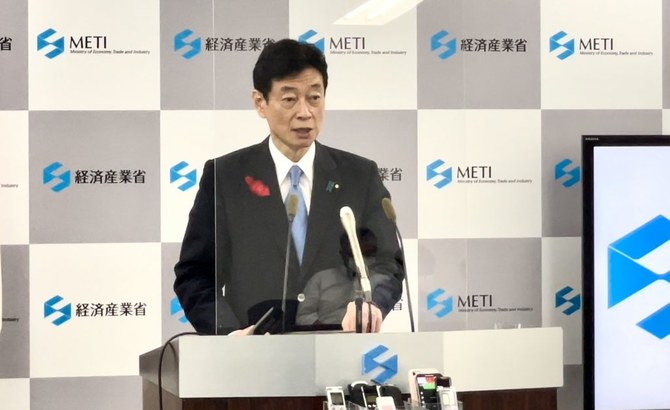
TOKYO: Japan’s Minister of Economy, Trade and Industry NISHIMURA Yasutoshi requested Saudi Arabia and other Arab countries to guarantee stable supply of oil.

Nishimura said he had met with executives from Aramco and has proposed talks with Saudi Arabia’s Energy Minister Abdulaziz bin Salman Al Saud.

He also met recently with Sultan Al-Jaber, UAE Minister of Industry and Advanced Technology and CEO of Abu Dhabi National Oil Company (ADNOC), as well as Talal Al-Awfi, Oman’s Minister of Energy and Minerals.

“I requested a stable supply of oil and LNG,” Nishimura said at a press conference at the ministry in reply to a question from Arab News Japan. “I got the reply that they will continue to cooperate with us.”

In the absence of imports from Iran and Russia due to sanctions enforced by the US, more than 90 percent of Japan’s supplies now come from Arab sources.

“It is important for Japan, which lacks resources, to promote a stable supply of crude oil,” Nishimura said. “It is true that oil imports from Russia have stopped and dependence on the Middle East is increasing. We are making decisions on specific sources of crude oil from the perspective of the market.”

“Japan depended on the Middle East for 95 percent of its oil in August and 98 percent in July, so we recognize the region as extremely important in terms of energy security and a stable supply of crude oil.”

Japan is looking to expand its energy business with the Middle East to include clean energy as well as oil and gas.

“We believe that the Middle East is also playing an important role in building the hydrogen and ammonia supply chain,” Nishimura said. “I hope such cooperative relationships will also be strengthened. Furthermore, Japan will strive to diversify its supply sources from the viewpoint of stable supply and security, and domestically also pursue all options, including the utilization and diversification of renewable energy and nuclear energy.”


Saudi Arabia leads outcome-based education to prepare future-ready generations: Harvard Business Review

A Harvard sign is seen at the Harvard University campus in Boston, Massachusetts, on May 27, 2025. (AFP)
Updated 10 February 2026
Follow

Saudi Arabia leads outcome-based education to prepare future-ready generations: Harvard Business Review

  • The Riyadh-based school group developed a strategy that links every classroom activity to measurable student competencies, aiming to graduate learners equipped for the digital economy and real-world contexts

RIYADH: Saudi Arabia’s education system is undergoing a sweeping transformation aligned with Vision 2030, shifting from traditional, input-focused methods to outcome-based education designed to equip students with future-ready skills, Harvard Business Review Arabic reported.

The transformation is being adopted and spearheaded by institutions such as Al-Nobala Private Schools, which introduced the Kingdom’s first national “learning outcomes framework,” aimed at preparing a generation of leaders and innovators for an AI-driven future, the report said.

Al-Nobala has leveraged international expertise to localize advanced learning methodologies.

The Riyadh-based school group developed a strategy that links every classroom activity to measurable student competencies, aiming to graduate learners equipped for the digital economy and real-world contexts. The school’s group approach combines traditional values with 21st-century skills such as critical thinking, communication, innovation and digital fluency.

According to the report, the shift addresses the growing gap between outdated models built for low-tech, resource-constrained environments and today’s dynamic world, where learners must navigate real-time information, virtual platforms, and smart technologies.

“This is not just about teaching content, it’s about creating impact,” the report noted, citing how Al-Nobala’s model prepares students to thrive in an AI-driven world while aligning with national priorities.

The report noted that Saudi Arabia’s Ministry of Education has paved the way for this shift by transitioning from a centralized controller to a strategic enabler, allowing schools such as Al-Nobala to tailor their curriculum to meet evolving market and societal needs. This is part of the long-term goal to place the Kingdom among the top 20 global education systems.

Al-Nobala’s work, the report stated, has succeeded in serving the broader national effort to link education outcomes directly to labor market demands, helping to fulfill the Vision 2030 pillar of building a vibrant society with a thriving economy driven by knowledge and innovation.

Last February, Yousef bin Abdullah Al-Benyan, Saudi Arabia’s minister of education, said that the Kingdom was making “an unprecedented investment in education,” with spending aligned to the needs of growth and development. He said that in 2025, education received the second-largest share of the state budget, totaling $53.5 billion.