


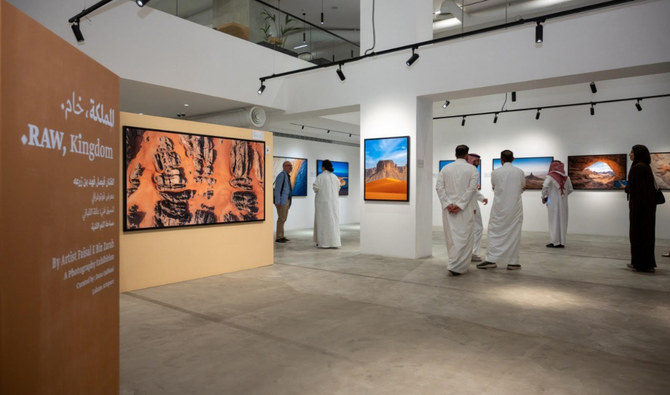

RIYADH: Photographer Faisal bin Zarah’s first three-day solo exhibition, “Raw Kingdom,” transformed Lakum Art Space in Riyadh into a vivid love letter to Saudi Arabia — a result of 15 years of hard work.
The exhibition, which took place from Sept. 27 to Oct. 2, showcased photos of the vast spaces of the northern region to AlUla in the west, and the beautiful landscapes of Riyadh in the central region.
“Every Saudi knows his work, but they don’t realize it’s Faisal,” Dana Qabbani, the exhibition’s curator, told Arab News. “His photos are in the passport sector, in the Absher app, all the ministries that you think of. His commercial work is very known.”
Spending a large part of his life photographing for commercial purposes, Bin Zarah found that the copious amounts of time and effort spent on his unique shots made them more valuable than a mere business transaction.
He views his work as something to be contemplated and reflected upon. In a single exhibition, he rerouted his path from corporate to creative.
“A photo that took me two years in the making should not be posted on a website or used for commercial or advertisement purposes. A better use of it is to consider it as a piece of fine art,” Bin Zarah told Arab News.
But how does one transform a commercial photographer’s work into an art piece? For the exhibition’s curator, the challenge was not within the content, but the presentation.
“We chose the best materials to showcase his work and we chose a certain sequence for these (photographs), we sort of gave his work a timeline. We took you on a trip,” Qabbani said.
“I did this art gallery because everything you see is our limited edition prints exclusively for collectors and art enthusiasts,” he added.

Photographer Faisal Bin Zarah, for only three days in his first solo exhibition “.RAW KINGDOM,” has transformed Lakum Art Space into a vivid love letter to Saudi Arabia, a result 15 years in the making. (Lakum Art Space/Mohammad Fattal)
Bin Zarah believes that the widespread use of his images for social media or commercial advertising purposes will degrade the value of his work.
“To me, a photo is much deeper than a click of a shutter and you’re able to see it. It’s a message. It’s an idea. It’s a story. I am a storyteller,” Bin Zarah said.
The story of this long-awaited love letter springs from love itself: Bin Zarah began his journey with photography when his wife gifted him his first camera in 2007 and taught him the basics, which he proudly proclaims.
He began to visually feed his eye through photo-sharing websites like Flickr until he found his style, gravitating towards land and cityscape photography.
His work is two-fold: One aspect of it focuses on the growing civilization and the other industrialization in Riyadh.
He describes his shot of the full moon rising over Faisaliyah Tower in his work titled “Lift Off” as a “moment of joy.”
For someone working in the telecommunications field during the day and taking caring for four children, he sees his photography escapades as a getaway from all the stress and negativity.
“This time is enjoyment to me. This is what drives me … When you create something, anything— even Lego or puzzles — once you finish, there’s a reward, you get the sense of achievement and completion. This is what I get when I complete a project,” Bin Zarah said.
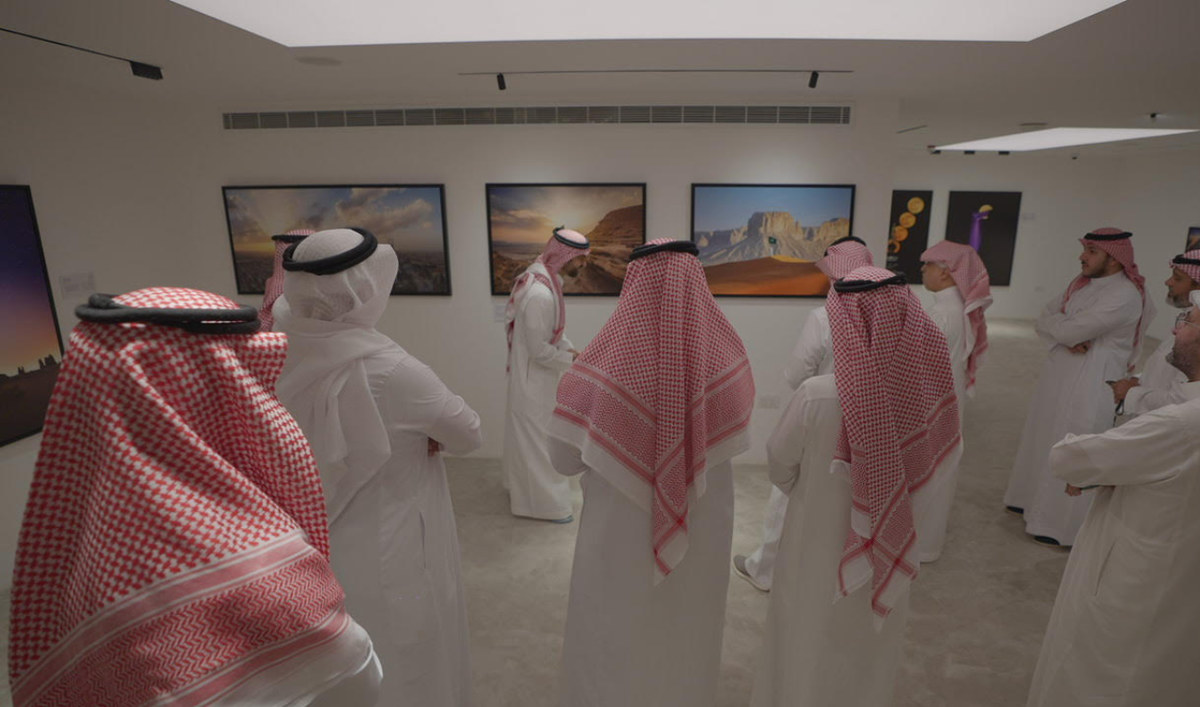
The exhibition, which took place from Sept. 27 to Oct. 2, showcased photos of the vast spaces of the northern region to AlUla in the west, and the beautiful landscapes of Riyadh in the central region.
(Lakum Art Space/Mohammad Fattal)
His unique angles even impressed the owner of the Kingdom Tower, Prince Al-Waleed bin Talal, who has the photo of it hanging in his office.
At Lakum Art Space, it was showcased as part of Bin Zarah’s “Dawn to Dusk” photo series, which takes you on a trip to various sites in Riyadh through the turning of the sun.
His dedication is apparent in his work. Bin Zarah spent two years awaiting the full moon every month to capture the perfect moment as it grazed both the Faisaliah and Kingdom towers in his moon series.
“His work ethics really made this a piece of cake to curate, to install, so what I loved is that it wasn’t just a photography exhibition, it’s basically taking someone’s career from A to Z, a different destination,” Qabbani said.
The other aspect of his work pursues his love for traveling to discover gems within the Kingdom. With that, he hopes to inspire people to venture into these spaces and appreciate their beauty.
“My message is: We have an amazing vibrant Kingdom from north to south, east to west, and it has so many undiscovered jewels, untouched by humans or others. I’m only a person that’s showing one side of the beauty. The real beauty is when you visit the place physically and see it,” Bin Zarah said.
In his AlUla collection, he features various self-portraits taken under the night sky of the city’s northern part, Al-Gharamil, encapsulating all the stars within single shots, found in his works “Interstellar” and “Message to the Galaxy.”
Bin Zarah uses a Sony A7R Mark IV, a 60 megapixel camera, with a variation of zoom and wide lenses to capture even the smallest of details. Standing parallel to his work easily gives the audience the instinct to reach out and feel the texture.
He quite frequently uses drones and stitching methods to ensure that the details are vibrant enough even for the human eye to spot.
“I am going to usual places and trying to capture them in an unusual way … By design, the drone camera is wide. So it will capture the whole thing even if you are at 200 meters, but nobody used it to cover a 4 square km area. I did a sky scan in order for me to show these amazing details,” he said.
In his astonishing “Earth’s Veins,” he took 21 photos from a 500 meter distance, stitched together to reveal the red dunes and mountains near Thadig, a historical city north of Riyadh.
The unusual landscape scene stretches across 3 km formed by wind and rainwater that pushed through the crevices of the land.
As a photographer who’s been traveling across the Kingdom for years, his work acts as documentations of the landscape before the initiation of several giga projects under Vision 2030, such as NEOM and Qiddiya.
He sees the projects as elevations to these spaces, not tampering with the environment. They actually reflect the underlying history of the region.
“NEOM, which is The Line, is mirror. So it will not intervene with the environment. It will be within it … Saudi Arabia is the land of civilization. The history of the whole earth started from the Arabian peninsula,” Bin Zarah said.
“The new projects are good for the citizens, and I’m so happy that they are putting in mind the environment. They’re not destroying anything and are actually conserving it.”


