

Pakistan PM says ‘deeply obliged’ to China for increase in volume of flood aid

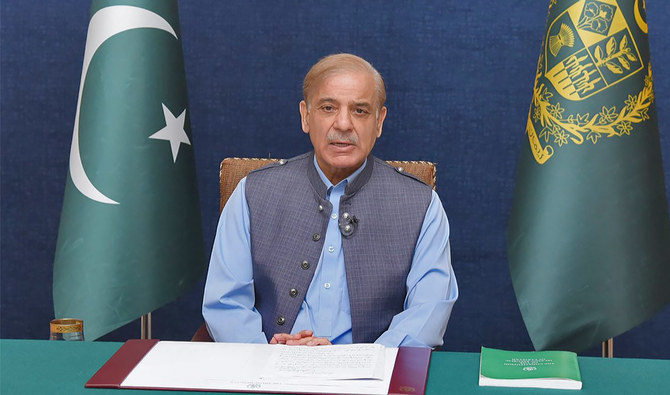
Pakistan Prime Minister Shehbaz Sharif addresses nation in Islamabad, Pakistan, on May 27, 2022. (Government of Pakistan/FILE)
Short Url
Updated 03 October 2022
Follow

Pakistan PM says ‘deeply obliged’ to China for increase in volume of flood aid

  • Pakistan is reeling from the aftermath of deadly floods that have cost an estimated $30 billion 
  • Deluges have affected 33 million people, forced Islamabad to seek debt relief from the world 

ISLAMABAD: Pakistan Prime Minister Shehbaz Sharif on Sunday said he was “deeply obliged” to the Chinese government for helping flood-affected people in the South Asian country, increasing the aid volume to RMB644 million ($90 million). 

Pakistan is reeling from the aftermath of catastrophic floods that have killed nearly 1,700 people since the onset of monsoon season in mid-June. 

The deluges have affected more than 33 million people, washed away crops on millions of acres and cost an $30 billion in economic losses, with hundreds of thousands forced to stay in shelters and out in the open. 

On Sunday, PM Sharif thanked the Chinese government, Communist Party of China (CPC), Red Cross Society of China and the People’s Liberation Army for the relief assistance. 

“Our Chinese friends continue helping the flood victims in Pakistan,” the Pakistan premier said in a Twitter post. “Total volume of aid has increased from 400 million RMB to 644 million RMB.” 

China is a key economic and political partner of Pakistan, pushing ahead with a $54 billion economic corridor that will build infrastructure and give Beijing an outlet to the Indian Ocean, although Chinese interests have also faced attacks from separatists. 

Last week, US Secretary of State Antony Blinken also called on Pakistan to seek debt relief from China. The South Asian country owes about 30 percent of its external debt to Beijing. 

Pakistan’s economy is facing a balance of payments crisis, a widening current account deficit, a slide in its currency to historic lows, and inflation crossing 27 percent. 

PM Sharif last month appealed to the world and rich nations for immediate debt relief, saying what had been done was commendable, but “it’s far from meeting our needs.” 

Sharif, who was in New York to attend the UN General Assembly, said Pakistan had taken up the debt relief issue with UN Secretary-General Antonio Guterres and world leaders. 


Pakistani president arrives in Iraq to deepen trade, energy cooperation

Updated 20 December 2025
Follow

Pakistani president arrives in Iraq to deepen trade, energy cooperation

  • Visit follows recent high-level contacts as Islamabad seeks to expand limited commercial ties with Baghdad
  • Talks are expected to cover investment, manpower and facilitation of Pakistani pilgrims visiting holy sites in Iraq

ISLAMABAD: President Asif Ali Zardari arrived in Iraq on Saturday on an official visit aimed at expanding cooperation in trade, energy and investment, as Pakistan seeks to deepen ties with Baghdad after years of limited engagement.

Pakistan and Iraq established diplomatic relations in 1947 and have traditionally maintained cordial ties, though commercial links remain modest, with officials and business groups identifying scope for cooperation in construction services, pharmaceuticals, manpower and agricultural exports.

“President Asif Ali Zardari arrived in Baghdad on a four-day official visit to Iraq,” his office said in a post on X. “He was received by Culture Minister Dr. Ahmed Fakkak Al-Badrani. During the visit, meetings with senior Iraqi leadership are expected to advance cooperation and further strengthen Pakistan-Iraq relations.”

Zardari’s visit follows a series of recent high-level contacts between the two countries, reflecting efforts to broaden bilateral engagement beyond traditional diplomatic ties and explore collaboration across economic, political and people-to-people domains.

According to Pakistan’s foreign office, the president is expected to hold meetings with Iraq’s senior leadership to discuss cooperation in various areas such as trade and investment, energy, technology, education and manpower.

He is also expected to discuss regional and international issues with Iraqi officials.

Earlier this month, Pakistan’s Interior Minister Mohsin Naqvi met his Iraqi counterpart, Abdul Ameer Al-Shammari, on the sidelines of meetings in Brussels, where both sides agreed to enhance cooperation on security and facilitate travel for Pakistani Shia pilgrims to Najaf and Karbala.

The two officials discussed measures to ensure the smoother movement of these pilgrims and their compliance with visa regulations.