

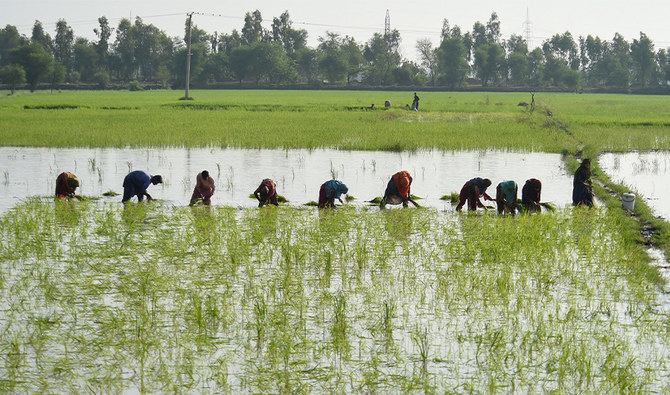

ISLAMABAD: The Pakistani government has decided to allocate around $500 million to provide free seeds and fertilizer to farmers in flood-affected areas for sowing wheat and other crops on an additional 1.6 million acres of land to ensure food security of 220 million Pakistanis, an official said on Sunday.
Pakistan is facing a looming food security crisis as large swathes of farmland in Sindh and Balochistan provinces are still underwater after the deadly monsoon floods that have cost the country an estimated $30 billion.
Since July, the rains and deadly floods have damaged rice and cotton crops, along with vegetables like onions and tomatoes, on an area of 9.461 million acres amid a 47-year high inflation at 27.3 percent, according to the finance ministry’s monthly economic outlook for September.
Hundreds of farmers this week also marched on Islamabad, where they have been holding a sit-in to protest the high cost of electricity and fertilizers.
“The government has finalized a plan of Rs114 billion ($500 million) intervention to provide free of cost seed and fertilizer to farmers in flood-hit areas to ensure sowing of wheat and oilseed crops on maximum area,” Dr. Muhammad Ali Talpur, an economic consultant at Pakistan’s national food security ministry, told Arab News.
“This will help growers plant crops on an additional 1.6 million acres of land in flood-affected areas of all four provinces, ensuring food security for the nation.”
Under the project, farmers across Sindh and Balochistan provinces as well one flood-hit district each in Punjab and Khyber Pakhtunkhwa provinces will be provided with free seeds for wheat and oilseed crops, including mustard and sesame, along with Di-ammonium Phosphate, popularly known as DAP fertilizer, to grow crops.
“Currently, work on dewatering Sindh and Balochistan provinces is underway to prepare maximum area of agricultural land for the crops,” Talpur said, adding the federal government was closely working with the provincial governments to implement the project.
The deadly floods have damaged rice crop on more than one million acres of land and cotton on 1.7 million acres in both Sindh and Punjab provinces, along with vegetables and pulses on millions of acres, valuing at Rs550 billion ($2.4 billion), according to the official data.
Talpur said provincial governments would be contributing 50 percent of the $500 million project to reach maximum number of farmers in their respective areas. “The federal government has finalized the project after consultation with the provincial governments,” he added.
The provincial governments are working on getting the projects approved by their respective cabinets and will then give a green signal to the federal government, according to Talpur.
“We will be implementing it fully after getting an approval from the ECC [Economic Coordination Committee of the cabinet] in the coming days,” he said.
The consultant said the government had also finalized a transparent mechanism for distribution of fertilizer and seeds among farmers in flood-hit areas, which would be conducted with the help of district administrations and agricultural departments.
“The stock of food grains is enough to fulfil the requirement till the next harvest of wheat and oilseed crops,” he said. “There is no serious issue of food security so far, but the situation can change if we fail to achieve the sowing target.”


