

Arab envoys urge UK PM to rethink Jerusalem embassy move

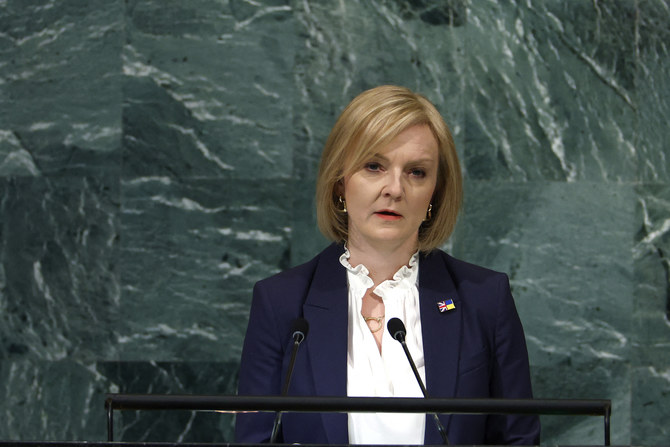
Liz Truss pledged to the Conservative Friends of Israel during her leadership campaign that she would open a review into the location of the UK Embassy. (File/AFP)
Short Url
Updated 30 September 2022
Follow

Arab envoys urge UK PM to rethink Jerusalem embassy move

  • Letter signed by all Arab states, including those that signed Abraham Accords with Israel
  • Liz Truss warned that embassy move could jeopardize free-trade agreement with GCC

LONDON: Arab ambassadors have urged Prime Minister Liz Truss to backtrack on “an illegal and ill-judged” plan to move the UK Embassy in Israel from Tel Aviv to Jerusalem, warning that it could jeopardize a free-trade agreement with the Gulf Cooperation Council, The Guardian reported on Friday.

The comments were made in a private letter sent before her trip to the UN last week. It was signed by all Arab states, including those that signed the 2020 Abraham Accords with Israel.

Palestinian Ambassador Husam Zomlot said: “Any embassy move would be a blatant violation of international law and the UK’s historic responsibilities.

“It undermines the two-state solution and inflames an already volatile situation in Jerusalem, the rest of the occupied territories, and among communities in the UK and worldwide. It would be disastrous.”

It is the understanding that some of the states most inclined to the accords are those particularly concerned, believing that the accords could be thrown into disrepute by the claim that they paved the way for the embassy move.

Given that the pending UK-GCC FTA is seen as central to Truss’s foreign policy for the region, any worries that this may be thrown into doubt could cause a backtrack.

Allies in Europe have also questioned the move, letting the UK know that they consider it unwise, while others have privately speculated that Truss’s decision is based as much on her desire to be perceived as a “disruptor” as it is anything to do with her close ties with Israel.

A former British diplomat told The Guardian: “She seems to think she should ape (former President) Donald Trump (who moved the US Embassy to Jerusalem in 2018). The difference is that the US is big enough to get its way in the Middle East. The UK is not.”

The former diplomat added: “If the UK shifted its embassy it would … damage British interests in the Arab world.”

Truss pledged to the Conservative Friends of Israel during her leadership campaign that she would open a review into the location of the UK Embassy, instituting the review last week during a meeting at the UN with Israeli Prime Minister Yair Lapid.

Details of how the review is being conducted inside the Foreign Office have yet to be made public.


Lebanon signs gas exploration deal with French-Qatari-Italian consortium

Updated 6 sec ago
Follow

Lebanon signs gas exploration deal with French-Qatari-Italian consortium

  • France’s TotalEnergies, Qatar Energy and Italy’s Eni signed for Block 8, planning a 1,200 sq. km 3D seismic survey to assess potential
  • Previous searches in Block 4 and 9 did not yield any discoveries

BEIRUT: Lebanon on Friday signed a gas exploration deal for Block 8 with a consortium comprising France’s TotalEnergies, Qatar Energy and Italy’s Eni, in a ceremony held at the Prime Minister’s Office and attended by Prime Minister Nawaf Salam.

According to Gaby Daaboul, board member at the Lebanese Petroleum Administration, the agreement stipulates that the consortium will carry out a 3D seismic survey in Block 8, which spans 1,200 sq. km, in preparation for exploratory drilling based on analysis of the survey data.

In 2023, Lebanon marked the resumption of oil and gas exploration in its territorial waters, as a consortium that included Qatar Energy drilled an exploratory well in Block 9.

However, all activities were halted, ostensibly due to the lack of oil or gas. The companies’ cessation of operations coincided with the outbreak of hostilities between Israel and Hezbollah.

Earlier hopes were dashed when gas was not found in Block 4, leaving many Lebanese disappointed.

Lebanese Minister of Energy and Water Joe Saddi, who signed the agreement on behalf of the state, described the move as “a confirmation of the consortium’s commitment to continue exploration activities in Lebanon despite all challenges, and a reflection of continued confidence in the petroleum potential of Lebanese territorial waters.

“We look forward to the consortium coordinating and promptly implementing the 3D seismic survey campaign. This will enhance geological and technical understanding of Block 8 and allow for a more accurate assessment of the opportunities available,” the minister said.

He announced the preparation of a file for launching the fourth licensing round, aiming at attracting international companies to invest in open offshore blocks and boost exploration and production activity in Lebanon.

Asked whether there are guarantees that the consortium operating in Block 8 will provide Lebanon with an official technical report, Saddi explained that “for Block 9, an official report was submitted to the Ministry and the Petroleum Sector Administration.” 

He noted that oil companies do not spend tens of millions of dollars without expecting results.

“No oil was found in the Block 9 drilling area, but a full report is available. This highlights the importance of the seismic survey in Block 8 to understand the block’s detailed geology, which will guide future exploration,” he said.

Saddi stressed that regional and domestic stability will be key to accelerating the exploration process.

The agreement was signed by Romain de La Martiniere, managing director of Total Lebanon, on behalf of Total Energies; Ali Abdulla Al-Mana, head of exploration at Qatar Energy; and Andrea Cozzi, managing director for Eni’s Lebanon division.

“Lebanon looks forward to continuing its exploration efforts by promoting non-obligatory blocks, with the aim of intensifying exploration activities and achieving a commercial discovery that will boost the national economy and support sustainable development,” Daaboul said.

Lebanon’s offshore oil and gas exploration centers on 10 blocks in its exclusive economic zone, with Blocks 4, 8, 9, and 10 most relevant near the maritime border with Israel.

A 2022 US-brokered maritime border agreement resolved a long dispute, granting Israel full control of the Karish field while assigning Qana Prospect (Block 9) to Lebanon. However, Israel is poised to receive royalties from any future production there.

Lebanon is racing against time to resume exploration after Total’s 2023 drilling in Block 4 yielded negative results, prompting the company to return the block to the Lebanese state. Meanwhile, Israel began commercial production in the area roughly four months later.

Although the company was expected to resume drilling in Block 4 from a different location, it chose to return the block to the Lebanese state, where it will later be included among the blocks offered for exploration.

In 2018, Lebanon signed its first exploration contracts with three companies — Total, Eni, and Russia’s Novatek — to search for oil and gas in two blocks within its territorial waters, Blocks 4 and 9. Of the 10 blocks Lebanon has designated for oil and gas exploration, three are located in its exclusive economic zone.

Lebanese citizens are pinning their hopes on the exploration, anticipating the discovery of oil wells to help revive the struggling economy.