

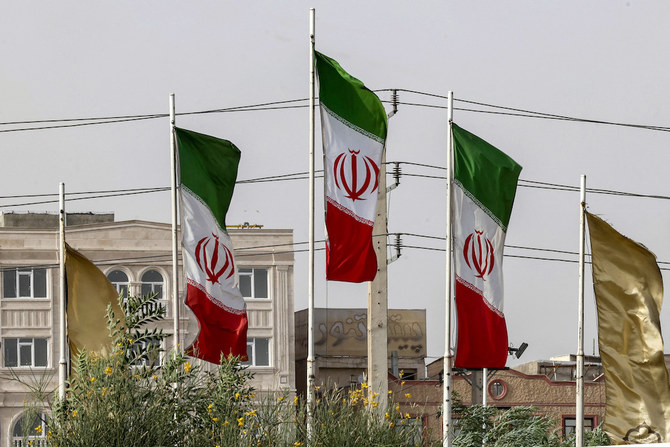
US imposes new sanctions on Iran oil exports, targets Chinese firms

Short Url
Updated 29 September 2022
Follow

US imposes new sanctions on Iran oil exports, targets Chinese firms

  • The US Treasury Department also slapped sanctions on a network of companies

WASHINGTON: The United States on Thursday imposed sanctions on companies it accused of involvement in Iran’s petrochemical and petroleum trade, including five based in China, pressuring Tehran as it seeks to revive the 2015 Iran nuclear deal.
Washington has increasingly targeted Chinese companies over the export of Iran’s petrochemicals as the prospects of reviving the nuclear pact have dimmed. Indirect talks on the accord, formally known as the Joint Comprehensive Plan of Action (JCPOA), have broken down.
“So long as Iran refuses a mutual return to full implementation of the Joint Comprehensive Plan of Action, the United States will continue to enforce its sanctions on the sale of Iranian petroleum and petrochemical products,” the Treasury’s Under Secretary for Terrorism and Financial Intelligence Brian Nelson said in a statement.
The Iranian mission to the United Nations in New York did not immediately respond to a request for comment.
US Secretary of State Antony Blinken said in a separate statement that the State Department designated two China-based companies, Zhonggu Storage and Transportation Co. Ltd. and WS Shipping Co. Ltd.
Blinken accused Zhonggu Storage and Transportation Co. Ltd. of operating a commercial crude oil storage facility for Iranian petroleum and WS Shipping Co. Ltd. of being a ship manager for a vessel that has transported Iranian petroleum products.
The US Treasury Department also slapped sanctions on a network of companies involved in what it said was the sale of hundreds of millions of dollars worth of Iranian petrochemical and petroleum products to South and East Asia.
The action targeted Iranian brokers and front companies in countries including Hong Kong and India, the Treasury said.
Washington warned that it would continue to accelerate enforcement of sanctions on Iran’s petroleum and petrochemical sales so long as Tehran continues to accelerate its nuclear program.
Crippled economy
The 2015 nuclear agreement limited Iran’s uranium enrichment activity to make it harder for Tehran to develop nuclear arms, in return for lifting international sanctions.
But then-US President Donald Trump ditched the deal in 2018, saying it did not do enough to curb Iran’s nuclear activities, ballistic missile program and regional influence, and reimposed sanctions that have crippled Iran’s economy.
“These enforcement actions will continue on a regular basis, with an aim to severely restrict Iran’s oil and petrochemical exports,” Blinken said.
Anyone involved in such sales and transactions should stop immediately if they wish to avoid being subjected to US sanctions, he said.

A Cup of Gahwa
The taste and traditions of Saudi coffee

Enter


keywords

What will the new Israeli measures change in the West Bank?

A Palestinian policeman directs the traffic in Hebron in the Israeli-occupied West Bank, February 9, 2026. (REUTERS)
Updated 7 sec ago
Follow

What will the new Israeli measures change in the West Bank?

  • The measures expand Israeli control over two major religious sites in the southern West Bank: Rachel’s Tomb near Bethlehem and the Cave of the Patriarchs in Hebron, both holy to Jews, Christians and Muslims
  • More than 500,000 Israeli settlers live among three million Palestinians in the West Bank

RAMALLAH, Palestinian Territories: New Israeli measures for the occupied West Bank, announced over the weekend, are expected to accelerate the territory’s annexation, ease land purchases by settlers and push Palestinians into increasingly isolated enclaves.
The full text of the latest decisions remains classified, but some details were disclosed in a statement. While it was unclear when the new rules would take effect, they do not require further approval.
Below are key changes that are expected to reshape the West Bank.

- Easy land purchases by settlers? -

Far-right Finance Minister Bezalel Smotrich, a member of the security cabinet who himself lives in a settlement, said the moves would make it easy for settlers to purchase land in the West Bank, occupied by Israel since 1967.
Until now, land acquisitions for settlers were typically carried out through intermediary companies.
The new measures repeal a decades-old law that barred Jews from directly purchasing land in the West Bank.
“This will allow Jews to purchase land in Judea and Samaria exactly as they do in Tel Aviv or Jerusalem,” Smotrich said.
Under the new rules, Israelis or companies registered in their name will no longer require a special permit from the state to complete land transactions.
Peace Now, an Israeli anti-settlement watchdog, said the permit system had been intended “to prevent forgeries and to curb settlers’ real-estate initiatives that contradict government policy.”
More than 500,000 Israeli settlers live among three million Palestinians in the West Bank.
Members of Netanyahu’s coalition like Smotrich or fellow far-right National Security Minister Itamar Ben Gvir are ardent supporters of the settlement movement, and have long advocated annexing the West Bank.
“Smotrich, Ben Gvir and the rest of them have been telling us that this is their policy,” Palestinian political scientist Ali Jarbawi told AFP.
“Now it has come to fruition.”
The current Israeli government has fast-tracked settlement expansion, approving a record 52 settlements in 2025.

- Palestinians to live in enclaves? -

The measures will also increase Israel’s control in parts of the West Bank where the Ramallah-based Palestinian Authority exercises power.
Under the Oslo Accords of the 1990s, the West Bank was divided into areas A, B, and C — under Palestinian, mixed and Israeli governance respectively.
According to Smotrich, the new measures will extend greater Israeli authority into A and B “with regard to water offenses, damage to archaeological sites, and environmental hazards that pollute the entire region.”
Palestinian experts warn the initiatives would displace Palestinians living near archaeological sites, landfills or springs, with Jarbawi saying Israel wants “to drive Palestinians into small pieces of land, basically, their major cities, enclaves.”
Yonatan Mizrachi of Peace Now said the steps would further weaken the Palestinian Authority — established under the Oslo Accords as an interim governing body pending the creation of a Palestinian state — accusing Israel of “advancing annexation.”

- More Israeli control over religious sites? -

The measures expand Israeli control over two major religious sites in the southern West Bank: Rachel’s Tomb near Bethlehem and the Cave of the Patriarchs in Hebron, both holy to Jews, Christians and Muslims.
In Hebron, the West Bank’s largest Palestinian city, municipal bylaws will be amended to transfer building-permit authority in areas around the Cave of the Patriarchs, known to Muslims as the Ibrahimi Mosque, to COGAT, Israel’s military body overseeing civilian affairs in the Palestinian territories.
Asma Al-Sharbati, Hebron’s deputy mayor, called the move “the most dangerous ongoing Israeli trend,” adding settlement expansion was happening at a “rapid pace.”
Rachel’s Tomb, currently administered by the Bethlehem municipality, will similarly be placed under a newly created Israeli authority.