BANGKOK: A court in military-ruled Myanmar convicted former leader Aung San Suu Kyi in another criminal case Thursday and sentenced Australian economist Sean Turnell to three years in prison for violating Myanmar’s official secrets act, a legal official said.
Suu Kyi received a three-year sentence after being tried and convicted with Turnell under the secrets law, said the official, who spoke on condition of anonymity because he is not authorized to release information about the case.
Three members of her Cabinet were also found guilty, each receiving sentences of three years.
Turnell, an associate professor in economics at Sydney’s Macquarie University, had served as an adviser to Suu Kyi, who was detained in the capital Naypyitaw when her elected government was ousted by the army on Feb. 1, 2021.
He has been in detention for almost 20 months. He was arrested five days after the military takeover by security forces at a hotel in Yangon, the country’s biggest city, while waiting for a car to take him to the city’s international airport.
He had arrived back in Myanmar from Australia to take up a new position as a special consultant to Suu Kyi less than a month before he was detained. As director of the Myanmar Development Institute, he already had lived in Naypyitaw for several years.
The day after the military’s takeover, he posted a message on Twitter that he was: “Safe for now but heartbroken for what all this means for the people of Myanmar. The bravest, kindest people I know. They deserve so much better.”
He was charged along with Suu Kyi and the three former Cabinet ministers on the basis of documents seized from him. The exact details of their offense have not been made public, though state television said last year that Turnell had access to “secret state financial information” and had tried to flee the country.
Turnell and Suu Kyi denied the allegations when they testified in their defense at the trial in August.
Turnell was also charged with violating immigration law, but it was not immediately clear what sentence he received for that.
Myanmar’s colonial-era official secrets act criminalizes the possession, collection, recording, publishing, or sharing of state information that is “directly or indirectly, useful to an enemy.” The charge carries a maximum penalty of 14 years in prison.
All sessions of the trial, held in a purpose-built courtroom in Naypyitaw’s main prison, were closed to the media and the public. The defense lawyers were barred by a gag order from revealing details of the proceedings.
The same restrictions have applied to all of Suu Kyi’s trials.
The case that concluded Thursday is one of several faced by Suu Kyi and is widely seen as an effort to discredit her to prevent her return to politics.
She had already been sentenced to 20 years’ imprisonment after being convicted of illegally importing and possessing walkie-talkies, violating coronavirus restrictions, sedition, election fraud and five corruption charges. The cases are widely seen as being concocted to keep the 77-year-old Suu Kyi from returning to active politics.
Suu Kyi is still being tried on seven counts under the country’s anti-corruption law, with each count punishable by up to 15 years in prison and a fine.
Defense lawyers are expected to file appeals in the secrets case in the coming days for Turnell, Suu Kyi and three former ministers: Soe Win and Kyaw Win, both former ministers for planning and finance, and Set Aung, a former deputy minister in the same ministry, the legal official said.
About half-a-dozen foreigners are known to have been arrested on political charges since the army takeover, and they generally have been deported after their convictions.
Australia has repeatedly demanded Turnell’s release. Last year, it suspended its defense cooperation with Myanmar and began redirecting humanitarian aid because of the military takeover and Turnell’s ongoing detention.
Cambodian Prime Minister Hun Sen, when he visited Myanmar in January this year, asked for Turnell’s release in a meeting with the leader of ruling military council. Senior Gen. Min Aung Hlaing replied that he “would consider it positively.”
The UN Special Envoy on Myanmar Noeleen Heyzer said she conveyed a specific request from Australia for Turnell’s release when she met with Min Aung Hlaing in August. Myanmar’s government said the general replied that, should the Australian government take positive steps, “we will not need to take stern actions.”
According to the Assistance Association for Political Prisoners, a rights monitoring organization, 15,683 people have been detained on political charges in Myanmar since the army takeover, with 12,540 of those remaining in detention. At least 2,324 civilians have been killed by security forces in the same period, the group says, though the number is thought to be far higher.
Myanmar has been in turmoil since the takeover, which led to nationwide protests that the military government quashed with deadly force, triggering armed resistance that some UN experts now characterize as civil war.


![]()

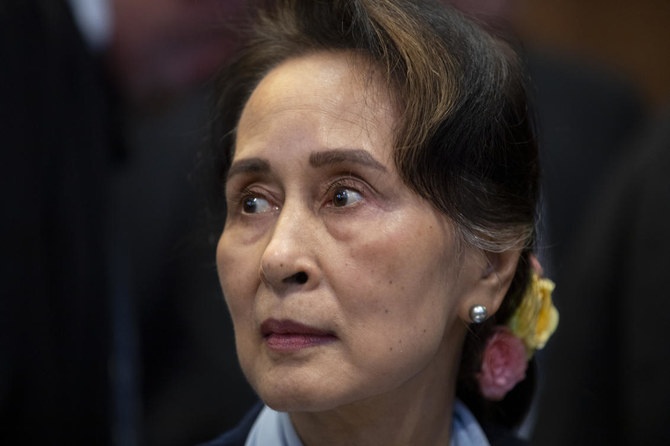
Former Myanmar leader Aung San Suu Kyi convicted again, Australian economist gets 3 years
Short Url
https://arab.news/b272y
Former Myanmar leader Aung San Suu Kyi convicted again, Australian economist gets 3 years
- Suu Kyi received a three-year sentence after being tried and convicted under the secrets law
- Australian economist Sean Turnell had served as an adviser to the former leader


Latest updates


© 2026 SAUDI RESEARCH & PUBLISHING COMPANY, All Rights Reserved And subject to Terms of Use Agreement.