US bombers join Japanese jets in show of force after China–Russia drills

1 / 2
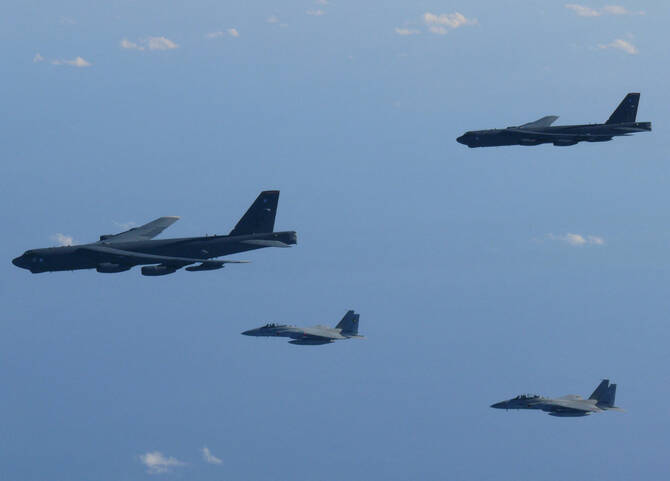
Japan Air Self-Defense Force's F-15 fighters hold a joint military drill with the US B-52 bombers over Sea of Japan on December 10, 2025. (Japan Defense Ministry/Handout via REUTERS)
2 / 2
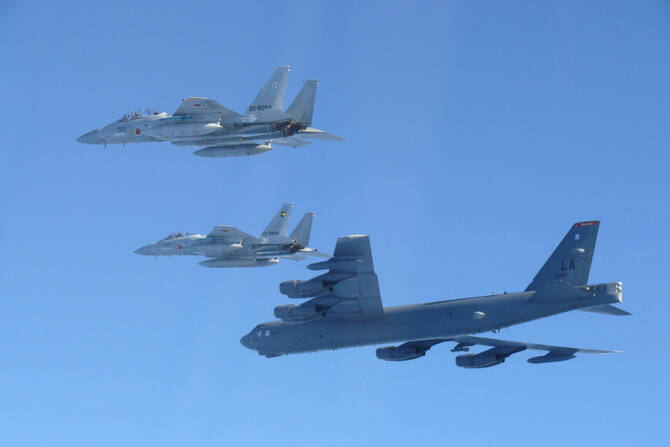
Japan Air Self-Defense Force's F-15 fighters hold a joint military drill with the US B-52 bombers over Sea of Japan on December 10, 2025. (Japan Defense Ministry/Handout via REUTERS)
Short Url
Updated 11 December 2025
Follow

US bombers join Japanese jets in show of force after China–Russia drills

  • Japan says US B-52 bombers flew with Japanese F-35s and F-15s
  • South Korea and Japan have scrambled jets during Chinese and Russian drills

TOKYO: US nuclear-capable bombers flew over the Sea of Japan alongside Japanese fighter jets on Wednesday, Tokyo said, in a show of force following Chinese and Russian drills in the skies and seas around Japan and South Korea.
Japan and the US “reaffirmed their strong resolve to prevent any unilateral attempt to change the status quo by force and confirmed the readiness posture of both the Self-Defense Forces (SDF) and US forces,” Japan’s defense ministry said in a press release on Thursday.
The flight of two US B-52 strategic bombers with three Japanese F-35 stealth fighters and three F-15 air-superiority jets was the first time the US had asserted its military presence since China began military exercises in the region last week.
The display follows a joint flight of Chinese and Russian strategic bombers in the East China Sea and western Pacific on Tuesday and separate Chinese aircraft carrier drills that prompted Japan to scramble jets that Tokyo said were targeted by radar beams.


A Russian Tu-95 nuclear-capable strategic bomber which flew from the Sea of Japan to the East China Sea to rendezvous with two Chinese H-6 bombers before heading into the Western Pacific on December 9, 2025. (Japan Self Defense Forces/Handout via REUTERS)

The encounter drew criticism from Washington, which said the incident was “not conducive to regional peace and stability” and reaffirmed that its alliance with Japan was “unwavering.”
Both Japan and South Korea host US forces, with Japan home to the biggest concentration of American military power overseas, including an aircraft carrier strike group and a US Marine expeditionary force.
China denied Tokyo’s accusation, saying Japanese jets flying near the carrier had endangered its air operations south of Japan.

South Korea’s military said it also scrambled fighter jets when the Chinese and Russian aircraft entered its air defense identification zone on Tuesday, an area that extends beyond its airspace and is used for early warning.


Chinese H6 nuclear-capable strategic bomber flies from the East China Sea over the Miyako Strait into the Western Pacific on December 9, 2025. (Japan Self Defense Forces/Handout via REUTERS)

Regional tensions have risen since Japanese Prime Minister Sanae Takaichi triggered a dispute with Beijing last month with her remarks on how Tokyo might react to a hypothetical Chinese attack on Taiwan.
China claims democratically governed Taiwan and has not ruled out using force to take control of the island, which sits just over 100 km (62 miles) from Japanese territory and is surrounded by sea lanes on which Tokyo relies. 


US Justice Department official eyes cases against Cuba leaders as Trump floats ‘friendly takeover’

Updated 07 March 2026
Follow

US Justice Department official eyes cases against Cuba leaders as Trump floats ‘friendly takeover’

  • “Working group” formed to build cases against people connected to the Cuban government
  • Trump’s has increasingly displayed aggressive stance against Cuba’s communist leadership

MIAMI: The top Justice Department prosecutor in Miami is considering criminal investigations of Cuban government officials, according to people familiar with the matter. The inquiry comes as President Donald Trump has raised the possibility of a “friendly takeover” of the communist-run island.
Jason Reding Quiñones, the US attorney for the Southern District of Florida, has created a “working group” that includes federal prosecutors and officials from the Drug Enforcement Administration and other agencies to try to build cases against people connected to the Cuban government and its Communist Party, according to one of the people. They spoke on the condition of anonymity because they were not authorized to publicly discuss the effort.
It was not immediately clear which Cuban officials the office is targeting or what criminal charges prosecutors may be looking to bring.
The Justice Department said in a statement Friday that “federal prosecutors from across the country work every day to pursue justice, which includes efforts to combat transnational crime.”
The effort is taking place against the backdrop of Trump’s increasingly aggressive stance against Cuba’s communist leadership.
Emboldened by the US capture of Cuba’s close ally, Venezuelan President Nicolás Maduro, Trump last month said his administration was in high-level talks with officials in Havana to pursue “a friendly takeover” of the country. He repeated those claims this week, saying his attention would turn back to Cuba once the war with Iran winds down.
“They want to make a deal so bad,” Trump said of Cuba’s leadership.
While Cuba has faded from Washington’s radar as a major national security threat in recent decades, it remains a priority in the US Attorney’s office in Miami, whose political, economic and cultural life is dominated by Cuban-American exiles.
The FBI field office has a dedicated Cuba group that in 2024 was instrumental in the arrest of former US Ambassador Victor Manuel Rocha on charges of serving as a secret agent of Cuba stretching back to the 1970s.
In recent weeks, several Miami Republicans, in addition to Florida Sen. Rick Scott, have called on the Trump administration to reopen its criminal investigation into the 1996 shootdown of four planes operated by anti-communist exiles.
In a letter to Trump on Feb. 13, lawmakers including Reps. Maria Elvira Salazar and Carlos Gimenez highlighted decades-old news reports indicating that former President Raúl Castro — the head of Cuba’s military at the time — gave the order to shoot down the unarmed Cessna aircraft.
“We believe unequivocally that Raúl Castro is responsible for this heinous crime,” lawmakers wrote. “It is time for him to be brought to justice.”
While no indictment against Castro has been announced, Florida’s attorney general said this week that he would open a state-level investigation into the crime.
The Trump administration has also accused Cuba of not cooperating with American counterterrorism efforts, adding it alongside North Korea and Iran to a select few nations the US considers state sponsors of terrorism.
The designation stems from Cuba’s harboring of US fugitives and its refusal to extradite several Colombian rebel leaders while they were engaged in peace talks with the South American nation.