ZARGWEZ, Iraq: Iran launched cross-border missile and drone strikes that killed nine people in Iraq’s Kurdistan region Wednesday after accusing Kurdish armed groups based there of stoking a wave of unrest that has rocked the Islamic republic.
The September 16 death of Kurdish Iranian woman Mahsa Amini, 22, while in the custody of Iran’s morality police has sparked a major wave of protests and a crackdown that has left scores of demonstrators dead over the past 12 nights.
Iran’s Islamic Revolutionary Guard Corps has in recent days accused the Iraq-based Kurdish groups of “attacking and infiltrating Iran from the northwest of the country to sow insecurity and riots and spread unrest.”
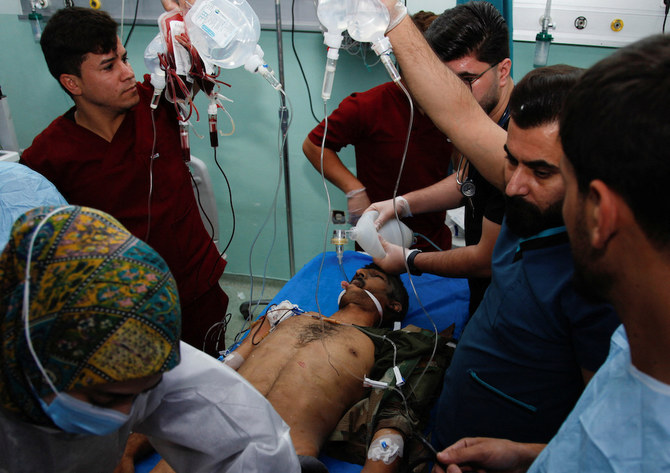
After several earlier Iranian cross-border attacks that caused no casualties, a barrage of missiles and drones on Wednesday claimed nine lives and wounded 32, said the regional health minister in Irbil, Saman Al-Barazanji, while visiting the wounded in a hospital in the capital of Iraq’s autonomous Kurdistan region.
“There are civilians among the victims,” including one of those killed, a senior official of the Kurdistan region earlier told AFP.
An AFP correspondent reported smoke billowing from locations hit, ambulances racing to the scene and residents fleeing, at Zargwez, about 15 kilometers (10 miles) from Sulaimaniyah.
In Baghdad, Iraq’s federal government called in the Iranian ambassador to protest the deadly strikes, while the UN mission in Iraq deplored the attack, saying “rocket diplomacy is a reckless act with devastating consequences.”
“These attacks need to cease immediately,” the UN mission said on Twitter.
The United States said it “strongly condemns” Iran’s deadly strikes in Iraqi Kurdistan and warned against further attacks.
“We stand with the people and government of Iraq in the face of these brazen attacks on their sovereignty,” State Department spokesman Ned Price said in a statement.
Other Iranian strikes Wednesday destroyed buildings around Zargwez, where several exiled left-wing Iranian Kurdish parties maintain offices.
“The area where we are has been hit by 10 drone strikes,” Atta Nasser, an official from Komala, one exiled Iranian group, told AFP, blaming Iran for the strikes.
“The headquarters of the Kurdistan Freedom Party has been hit by Iranian strikes,” Hussein Yazdan, an official from the party, told AFP, about the site in the Sherawa region, south of Irbil.
Another group, the Kurdish Democratic Party of Iran, said its bases and headquarters in Koysinjaq, east of Irbil, were struck by “missiles and drones.”
“These cowardly attacks are occurring at a time when the terrorist regime of Iran is unable to crack down on ongoing protests inside and silence the Kurdish and Iranian peoples’ civil resistance,” it tweeted.
Amini, 22, died in Tehran on September 16, three days after being arrested for allegedly violating Iran’s strict dress code for women that demands they wear hijab headscarves and modest clothes.
Her death sparked Iran’s biggest protests in almost three years and a crackdown that has killed at least 76 people, according to the Oslo-based group Iran Human Rights, or “around 60,” according to Iran’s semi-official Fars news agency.
Protests have rocked especially Kurdish communities in western Iran that share strong connections with Kurdish-inhabited areas of Iraq.
Many Iranian Kurds cross the border into Iraq to find work, due to a biting economic crisis in Iran driven in large part by US sanctions.
Iranian state television had said Sunday about earlier attacks that the “Revolutionary Guards targeted the headquarters of several separatist terrorist groups in northern Iraq with missiles and precision-guided attack drones.”
Two days later the Guards’ General Abbas Nilforoushan, deputy for operations, said “the establishment of a base by the enemies of the Islamic Revolution in this region is not acceptable,” Tasnim news agency reported.
“For some time now, counter-revolutionary elements have been attacking and infiltrating Iran from the northwest of the country to sow insecurity and riots and spread unrest.”
He added that several of “these anti-revolutionary elements were arrested during some riots in the northwest (of Iran), so we had to defend ourselves, react and bomb the surroundings of the border strip.”


![]()

Protest-hit Iran launches strikes that kill 9 in Iraqi Kurdistan
Short Url
https://arab.news/b3t8j
Protest-hit Iran launches strikes that kill 9 in Iraqi Kurdistan
- A barrage of missiles and drones on Wednesday claimed nine lives and wounded 32
- Iraq’s federal government called in the Iranian ambassador to protest the deadly strikes
Latest updates


© 2026 SAUDI RESEARCH & PUBLISHING COMPANY, All Rights Reserved And subject to Terms of Use Agreement.