

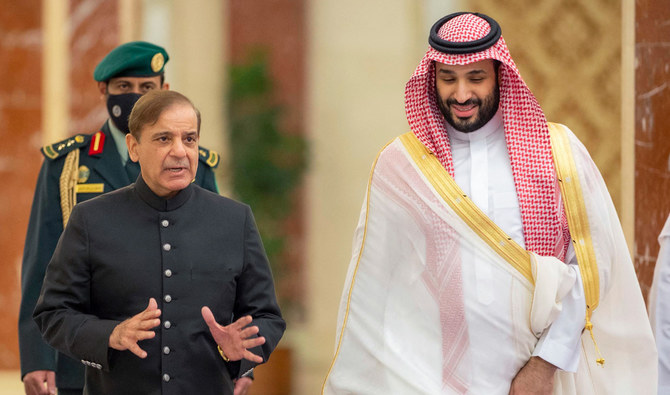
PM Sharif, army chief congratulate Saudi crown prince on becoming prime minister

A handout picture provided by the Saudi Royal Palace shows Saudi Arabia's Crown Prince Mohammed Bin Salman (R) welcoming Pakistani Prime Minister Shehbaz Sharif in Jeddah on April 30, 2022. (AFP/File)
Short Url
Updated 28 September 2022
Follow

PM Sharif, army chief congratulate Saudi crown prince on becoming prime minister

  • Saudi King Salman ordered the cabinet reshuffle on Tuesday
  • King’s son Khalid bin Salman becomes defense minister

ISLAMABAD: Pakistani Prime Minister Shehbaz Sharif and Army Chief General Qamar Javed Bajwa on Wednesday congratulated Saudi Crown Prince Mohammed bin Salman on becoming the kingdom’s prime minister.

Saudi Arabia’s King Salman bin Abdulaziz announced the cabinet reshuffle that also saw his second son Prince Khalid as defense minister, and another son, Prince Abdulaziz bin Salman, as energy minister, a royal decree, carried by state news agency SPA, said on Tuesday.

“I congratulate my brother Crown Prince Mohammad bin Salman,” Sharif said, praying for Saudi Arabia’s continued progress and prosperity.

The Pakistani army chief also shared his congrats with the crown prince, saying Pakistan valued its “historic and brotherly” relations with Saudi Arabia.

Saudi Foreign Minister Prince Faisal bin Farhan Al Saud, Finance Minister Mohammed Al-Jadaan and Investment Minister Khalid Al-Falih remained unchanged, the decree showed.

The crown prince had previously been the defense minister of Saudi Arabia. Prince Khalid bin Salman, his younger brother, previously served as deputy defense minister.

King Salman will still preside the cabinet meetings that he attends, the decree said.

The 86-year-old king, the custodian of Islam’s holiest sites, became ruler in 2015 after spending more than 2-1/2 years as the crown prince. He has been hospitalized several times over the last two years.

Prince Mohammed has changed Saudi Arabia radically since 2017, leading efforts to diversify the economy from dependence on oil, allowed women to drive and curbed the clerics’ power over society.


Pakistan reviews austerity measures amid Middle East crisis, urges strict nationwide implementation

Updated 11 March 2026
Follow

Pakistan reviews austerity measures amid Middle East crisis, urges strict nationwide implementation

  • Deputy Prime Minister Ishaq Dar chairs review meeting of austerity steps
  • Officials briefed on salary cuts, school closures, four‑day week, petrol conservation

ISLAMABAD: Pakistan’s government on Wednesday assessed progress on a sweeping set of austerity measures introduced to mitigate the country’s economic strain from sharply rising global oil prices and supply disruptions linked to the ongoing war in the Middle East.

Prime Minister Shehbaz Sharif this week announced a series of austerity steps, including a four‑day work week for government offices, requiring 50  percent of staff to work from home, cutting fuel allowances for official vehicles by half, grounding up to 60  percent of the government fleet and closing all schools for two weeks to conserve fuel amid the global oil crisis.

The measures were unveiled in response to global oil market volatility triggered by the conflict involving the United States, Israel and Iran, which has disrupted supply routes such as the Strait of Hormuz and pushed crude prices sharply higher, straining Pakistan’s heavily import‑dependent energy sector.

“The meeting stressed the importance of strict and transparent adherence to the austerity measures, promoting fiscal responsibility and prudent use of public resources,” Deputy Prime Minister and Foreign Minister Senator Mohammad Ishaq Dar said in a statement.

He was chairing a meeting of the Committee for Monitoring and Implementation of Conservation and Additional Austerity Measures, constituted under the directions of the PM, bringing together federal and provincial officials to review execution of the broad cost‑cutting plan. 

Dar emphasized the government’s commitment to enforcing the PM’s austerity steps nationwide. The committee’s review also covered reductions in departmental expenditure, deductions from salaries of senior officials earning over Rs. 300,000 ($1,120), and coordination with provincial administrations to ensure uniform implementation of the plan.

Participants at the meeting reiterated that all ministries and divisions must continue strict monitoring and reporting, with transparent oversight mechanisms, as Pakistan navigates the economic pressures from the prolonged Middle East crisis and its fallout on global energy and trade markets.